The Pocket That Held the Whole Town Square
ages 5–1012 minutesplayful, magical, and gentle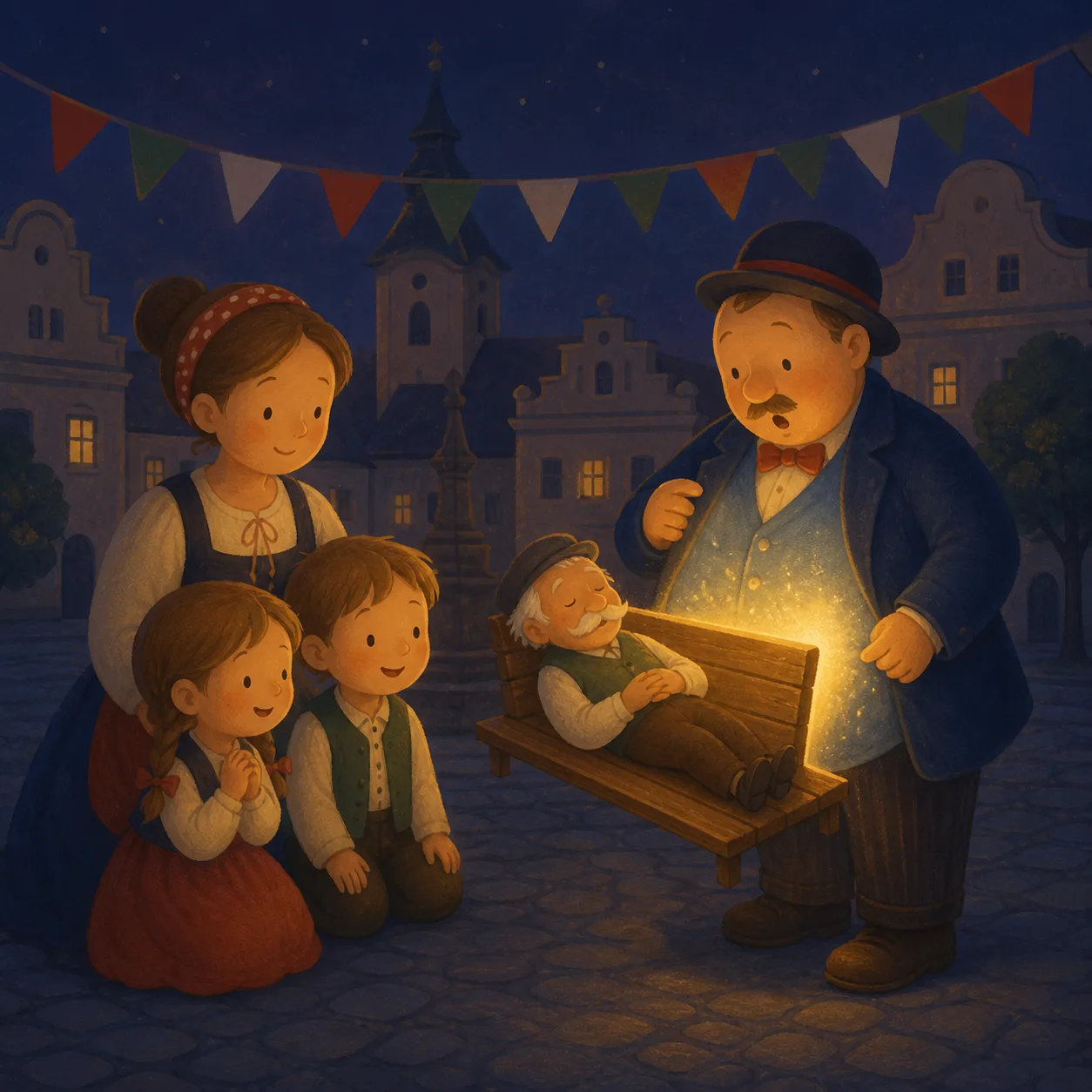
Read the story
Play videoTurn on sounds to bring the bold words to life. Each sound plays once per reading.
In a little town with a round fountain and a crooked town hall tower lived a seamstress named Anička. She sewed coats, patched elbows, and could sew on a button so firmly that not even the wildest children’s games could tear it off. Her workshop smelled of freshly ironed linen. A figure made from scraps sat in the window, and whenever Anička worked the treadle of her sewing machine, it nodded its head as if it understood everything.
One morning, Mayor Vavřinec came in. He searched his coat, waistcoat, and hat, puffing all the while. “I’ve lost the key to the town hall again! Yesterday it was my pencil, and the day before that, my handkerchief. Anička, sew me a proper pocket. One in which nothing will ever get lost.” The seamstress thought for a moment. In her grandmother’s old chest, she had a piece of midnight-blue fabric covered with tiny, shimmering silver knots. A note tied to it read: Whatever this fabric takes in, it will keep safe.
“It might help,” said Anička. “But it is magical. Treat it with care.” She made a pocket from the fabric and sewed it inside the mayor’s waistcoat. As soon as she finished the last stitch, the pocket gave a quiet chime. The mayor put a spare key, a pencil, and a clean handkerchief inside. The waistcoat did not even bulge. “Excellent!” he exclaimed. He paid, bowed as deeply as his belly allowed, and went out into the square.
At the baker’s, he bought six bread rolls. He had no basket, so he tried putting one into the pocket. The roll shrank as if it were moving farther away and vanished inside. The others followed. “That could come in handy,” the mayor muttered. At home, he added a candlestick, an umbrella, a cushion, and a large pot for plum jam. Everything fit inside the pocket. Even a ladder, which first looked like a ladder for a beetle and then disappeared among the silver knots.
The next day, Vavřinec stood beside the town pump. “What if it freezes tonight? The pump will be safe in my pocket.” He touched the handle and held the open pocket against its iron side. There was a splash, the pump curled up into a blue spark, and it was gone. The mayor nodded with satisfaction. He did not even notice the washerwoman standing behind him with an empty bucket and her mouth open.
In the marketplace, the merchants were just taking down their stalls before the expected rain. The mayor offered to make their work easier. “I’ll keep the whole marketplace nice and dry!” He touched the nearest counter and thought of all the stalls at once. Whoosh! The striped awnings, baskets, scales, and price boards spun like leaves in the wind and slipped into his waistcoat. The merchants were left standing on the bare paving stones. One of them was still holding a piece of string that had had an onion hanging from its other end only a moment before.
At last, the mayor saw the bench beneath the linden tree. “Such a fine bench. The rain will soak it too.” But old Cyril was dozing on the bench, covered with a newspaper. Before Vavřinec noticed him, the pocket gave a gulp and swallowed the bench with him on it. From deep inside came a startled cry: “Good heavens! Who turned out the town square?” The mayor went pale. For the first time that day, it occurred to him that he ought to take something out as well.
He reached into the pocket up to his elbow. He felt the pencil, but his fingers slipped off it. He caught hold of the pump handle, but it was as slippery as soap. He turned the pocket inside out, shook his waistcoat, and pleaded. Nothing fell out. “At least let the old man out!” he cried. “I’m all right,” Cyril replied from inside. “It’s dry in here, and there are little stars shining. But I’d like to go home for lunch. And your umbrella is poking me in the ear.”
The mayor ran to Anička. Behind him came the washerwoman with her bucket, the merchants without their stalls, and the children Bětka and Matěj, who wanted to know what had happened to their favorite bench. In the workshop, Anička examined the pocket carefully. Then she took from the chest the note tied to the remaining piece of magical fabric. Beneath the folded edge of the note, she found a second line written in silver letters: Only what the owner of the pocket truly gives to someone will come back out.
“Then I’ll lend the pump to the washerwoman!” Vavřinec exclaimed. The pocket did not even chime. “For a whole week! For two!” Nothing happened. “That is not a gift,” said Anička. The mayor frowned, thought for a moment, and then declared, “I give the ladder to Matěj. But he must return it tomorrow and must not show it to anyone else.” A quiet pfft came from the pocket, as if someone were snorting. The ladder stayed inside.
Bětka burst out laughing. “It saw right through you!” The mayor turned red to the roots of his hair. But Anička did not scold him. She sat him down on a stool and handed him a cup of water from her jug. “You must truly let something go,” she explained. “Not only from the pocket, but from your mind as well. You mustn’t be thinking of how you can get it back again.” Vavřinec clutched his waistcoat with both hands. Suddenly, it seemed heavier than a full sack of potatoes.
A rumble came from the pocket. “Excuse me,” said old Cyril. “That was my stomach.” The mayor remembered the bread rolls. “Cyril, I give you one of the rolls. Eat it. You don’t have to give me anything in return.” He meant it sincerely, because the old man’s stomach sounded truly miserable. The pocket chimed, and a golden tip appeared at its edge. Anička pulled out a fragrant bread roll, which slipped easily into her palm.
“It works!” Matěj cheered. They held the roll by the opening of the pocket. The old man’s hand emerged from the blue depths, but only as far as the wrist; Cyril was still inside with the bench. “Thank you,” came his voice, followed by contented crunching. The mayor smiled for the first time. But a moment later, he covered the pocket again. “The pump is useful, though. And so is the ladder. And who knows when I might need the stalls.”
Bětka and Matěj whispered to each other. Then Bětka took two marbles from her own pocket. She handed one to Matěj. “You can keep this green one. Green is your favorite, after all.” In return, Matěj offered her half an apple. “You don’t have to give me anything,” Bětka reminded him. “I know,” said Matěj. “But I want to.” Anička looked at them, and a spark flashed in her eyes. “We’ll hold a celebration,” she announced. “A celebration of giving. This very afternoon.”
The children ran from door to door, inviting their neighbors to the square. They did not have to bring anything expensive. A small thing they wanted to share would be enough. The baker brought pastries. The gardener brought a bunch of the last autumn flowers. The shoemaker offered to mend someone’s shoe for free, and the teacher prepared a cheerful song. Anička cut colorful scraps into pennants. They hung them between the linden tree and the town hall, so that even the empty square began to look festive.
Vavřinec sat down on a chair brought from the workshop. He watched the neighbors hand things to one another, laugh, and say thank you. No one had asked him for anything yet. Little Bětka came over to him with a paper pinwheel. “This is for you.” The mayor asked suspiciously, “And what do you want for it?” “Nothing. You just have to run with it when there’s no wind.” Vavřinec blew on the paper blades. The pinwheel spun, and the corners of the mayor’s mouth twitched unexpectedly.
Then he saw the shoemaker’s daughter holding a pastry in both hands because she had no plate. He remembered that he had also hidden a blue plate in the pocket at home. “She could use that,” he thought. Then he added aloud at once, “Anička, please take the blue plate out of my pocket and give it to her. It is hers.” Chime! The plate jumped into Anička’s hands. The girl put her pastry on it and smiled brightly. The mayor felt a strange warmth beneath his waistcoat.
“Now the bench,” Matěj whispered. Vavřinec flinched. Cyril coughed inside the pocket. “I would just like to point out that old men cannot be given away. I belong to myself.” “You are right,” the mayor said with a solemn nod. For a while, he stroked the edge of the pocket and then looked toward the linden tree. A pale rectangle of paving stones remained beneath it, and no one was sitting there. Suddenly, the place seemed terribly lonely.
“I give the bench to you, my neighbors,” he said. “To everyone who needs to rest. I will not lock it away or hide it.” The pocket rang like three small bells. A wooden splinter slipped out, grew into a plank in midair, and a moment later, the whole bench stood beneath the linden tree. Cyril sat on it with the newspaper across his knees. He held the last piece of bread roll in his hand. “Excellent,” he declared. “I’m just finishing.”
The children applauded, but the washerwoman spoke up. “But the bench already belonged to the town. So did the pump.” Vavřinec lowered his eyes. “They did,” he admitted. “I should have taken care of them, not taken them for myself.” He was silent for a long time. Then he turned to the people. “May I give them back to you? Truly give them up, so they can serve you instead of my pocket?” The washerwoman raised her empty bucket. “We would be very glad if you did.”
The mayor stood up. “I give the pump to the whole town. May everyone draw water from it whenever they need it!” There was a cheerful splash. A single drop flew out of the pocket and stopped in midair, and an iron pump grew around it. It settled exactly in its original place. The washerwoman worked the handle. The water rang against the bottom of her bucket, and everyone laughed. Even the pocket seemed to bubble contentedly.
The marketplace remained. Vavřinec ran his hand over his waistcoat. Having an entire marketplace in his pocket was certainly a great rarity. He could show it to someone. He could boast about it. But when he looked around, he saw the baker with her pastries on a crate and the flowers lying directly on the paving stones. The merchants had nowhere to display their goods. “What use is a marketplace where I can’t meet anyone?” he muttered. The pinwheel in his other hand moved slightly.
“I give the whole marketplace back to you!” he cried. “The stalls to the merchants, the goods to their owners, and the space between them to everyone who wants to talk. I don’t want any of it for myself anymore!” A ribbon of striped canvas flew out of the pocket. It unfurled above the square like a long dragon. Behind it came the counters, scales, baskets, and signs. Everything floated down slowly and gently, so that not even a radish leaf landed on anyone’s head. Only the bunch of onions obediently tied itself to the merchant’s string.
The celebration went on until evening. The mayor gave his ladder to the gardener and the cushion to Cyril for the bench. He handed out the remaining bread rolls to the children. He did not empty the pocket completely; there were some things he was not yet ready to give up. Anička said there was no need to hurry. When the lamps were lit, Vavřinec sat beneath the linden tree beside Cyril. He listened to the conversations around him and, for the first time all day, did not think about what else might come in handy.
The next day, he asked Anička for a second pocket. “An ordinary one,” he emphasized. “For my key and handkerchief. And preferably with a button.” He gave the spare key from the magical pocket to the town hall watchman and the pencil to Bětka, who wanted to draw plans of fantastical houses. He kept the blue pocket. Sometimes he put something into it that he wanted to give to someone later, and he always thought carefully about what it should be.
And the bench? It never disappeared again. Old Cyril went on dozing there with the newspaper on his stomach. Whenever the mayor walked past, Cyril always muttered, “Don’t put me away anywhere today, Vavřinec.” The mayor smiled, sat down beside him, and took out the paper pinwheel. Sometimes the wind blew. And when it did not, the mayor had to stand up and run a little way with the pinwheel. The children always ran with him.
Watch the story
An illustrated video — for the moments when eyes refuse to sleep yet.