Croaky the Frog and the Reed Baton
ages 5–1013 minutescheerful, gentle, and musical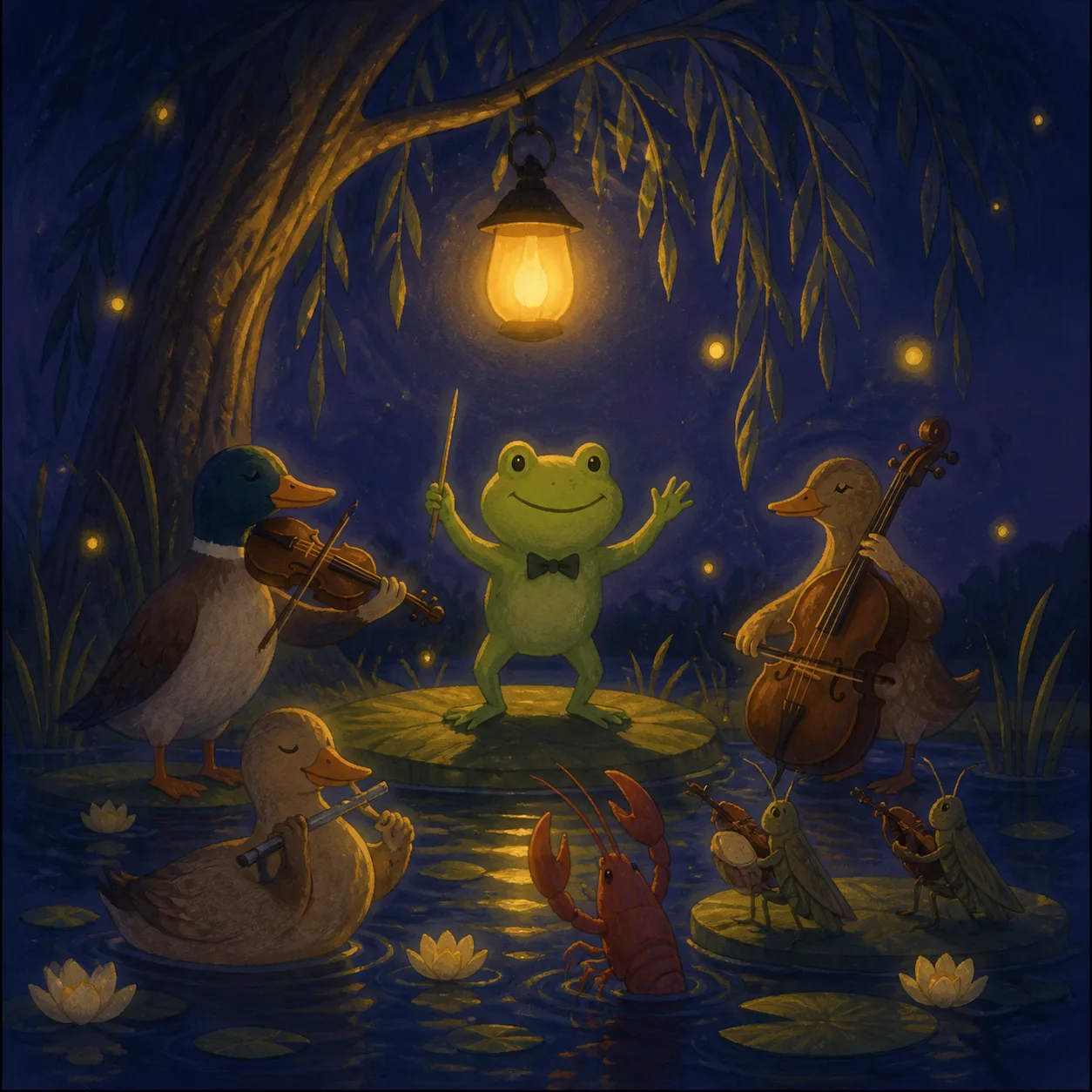
Read the story
Turn on sounds to bring the bold words to life. Each sound plays once per reading.
By the pond called Under the Willow lived a frog named Kvakoš. He had a green coat, eyes like two shiny buttons, and a voice that carried all the way to the last house beyond the meadow on still evenings. When he let out a deep croooak, even the moonlit path on the water was said to ripple. At least, that was what Kvakoš claimed. The moon never commented, because its mouth was full of light.
One morning, Kvakoš hung water-lily leaves with invitations all along the bank. GRAND POND CONCERT TONIGHT! each one announced. The ducks would sing, the crickets would play their fiddles, and Klapík the crayfish would provide the beat with his claws. Kvakoš himself was to open the celebration with a song about the sun dipping its toe in the water. The whole pond was looking forward to it. Even the old carp had the little fish clean his special stone for the occasion.
Kvakoš practised diligently from early morning. First on his stone, then beneath the willow, where his voice echoed beautifully, and finally on a tree stump, so that everyone could hear him properly. He sang low once, high the next time, and the third time so powerfully that a sparrow on a branch dropped the stalk it was carrying. But on the fourth attempt, his great croooak turned into a little squeak. And on the fifth, nothing came out at all.
The frog opened his mouth. He closed it. He opened it again. There was only a soft rustle, like a dry leaf scraping across a stone. Kvakoš anxiously touched his throat. He tried to call to Běla the duck, who was arranging pebble seats, but in the end he had to wave both arms at her. Běla paddled over, looked at his miserable face, and understood at once.
“You’ve worn your voice right out,” she said. She brought him some water in a clean shell and settled him in the shade. “Now let it rest. We’ll try playing by ourselves for the time being.” Kvakoš lowered his eyes. He had been looking forward to his evening song for three whole days. Still, he nodded. At least he could sit on the bank and listen to the others. After all, listening was part of a concert too.
The musicians gathered around the smooth tree stump. Emil the drake had a blue ribbon around his neck, and he had smoothed his feathers so carefully that not a single one was ruffled. “We’ll begin with my solo,” he announced. “The audience is sure to appreciate that most of all.” “But we’re supposed to sing together first,” Běla objected. Emil, however, had already drawn breath. “QUACK, QUACK, QUAAACK!” rang out over the water.
The other ducks hurriedly joined in, each at a different part of the song. Cilík the cricket launched into a fast melody, and his brother Vilík tried to catch up with an even faster one. Klapík the crayfish raised his claws. He waited for a moment, hesitated for another, and then went CLACK just as everyone was taking a breath. Emil skipped a note in surprise. “Don’t clack into my beak!” he snapped.
Before long, everyone was playing louder so they could hear themselves through the din. Běla was singing about the sun, Emil had already moved on to the moon, and the crickets looked as though they were racing to see whose bow would fly away first. Klapík clacked more and more miserably. Kvakoš’s head was ringing. He wanted to call for them to stop, but only a tiny rasp escaped his throat. No one even noticed him.
Beside the stone lay a slender reed that the wind had broken off the day before. Kvakoš picked it up and waved it over his head. Běla noticed the movement and fell silent. The other ducks followed. The crickets stopped playing, and Klapík gave just one more cautious clack. Kvakoš raised his free hand. The crayfish closed his claws. For the first time all morning, they could hear a drop fall from a willow leaf onto the water.
The frog breathed a sigh of relief. Then he pointed the reed at the crickets and gently swayed it. Cilík tried a long chirp. Kvakoš repeated the movement, and Vilík joined in. Up, down. Up, down. The two fiddles were suddenly holding hands, or at least that was how it sounded. Běla tilted her head. “Wait,” she whispered. “He’s showing us when to play!”
Kvakoš blinked in surprise. That had not occurred to him at all. He tried a larger movement, and the crickets played more loudly. He made a tiny movement, and they softened their fiddles to a gentle tickle. Then he pointed to Běla and nodded. The duck sang a simple quack, quack, quack. The fiddles made a soft path beneath her voice. Klapík eagerly raised his claws, but Kvakoš held up his hand. Not yet.
The reed swayed three times. On the fourth movement, Kvakoš pointed straight at the crayfish. CLACK! This time the sound fitted into the song exactly like the last stone in a path. Klapík’s eyes lit up. “I got it right!” he cried. That, of course, threw everyone out of rhythm, and they all burst out laughing. Kvakoš laughed too, though very quietly, his green belly shaking.
Běla brought over a broad burdock leaf, and Kvakoš used the wet end of the reed to draw several signs on it. An upward arrow: get ready. A long wavy line: hold the note. A short wavy line: play softly. And finally a circle, which meant silence. He demonstrated a hand movement for each sign. The musicians practised the movements like a new game. Only Emil stood apart, looking as though he had swallowed an unripe rowan berry.
“I certainly don’t need anyone waving at me,” declared the drake. “I sing beautifully without it.” Kvakoš nodded, because Emil really did have a fine voice. Then he pointed to all the others and clasped his hands together. “Beautifully together,” Běla translated. Emil puffed up the feathers on his chest. “Very well. But my solo must remain long. Very long. After all, the audience will be coming mainly to hear it.” Klapík wisely hid his smile behind one claw.
So they carried on rehearsing. Kvakoš soon discovered that waving was not as easy as it looked. When he scratched his nose with the hand holding the reed, the crickets suddenly sped up. When he shooed away a mosquito, Běla sang three times in a row. And when his foot slipped on a wet stone, Klapík began clacking as though a wooden horse were galloping towards the pond. This time, even Emil laughed.
Kvakoš found a dry place on a low stump and simplified his movements. His right hand swung the reed steadily. His left showed who should begin and who should wait. The crickets watched the reed, the ducks watched the frog’s hand, and Klapík thought it best to watch both. Little by little, they stopped stumbling over one another’s notes. The music no longer sounded like an overturned basket of pots. It was beginning to sound like the pond on a beautiful day.
But Emil’s solo still remained. The drake was to sing three clear quacks, then fall silent for two movements of the reed, and finally let out one long quaaack. During the brief silence, Cilík was to add a delicate chirp, like sunlight glinting on the water. Emil, however, sang without stopping. Cilík’s chirp vanished beneath his voice every time, like a crumb under a huge hat.
Kvakoš raised his hand. Emil continued. Kvakoš made a circle with both hands. Emil sang louder. Only when the others fell silent did the drake finally close his beak. “Why should I stop in the middle of such beautiful singing?” he asked indignantly. “They’ll think I’ve forgotten the song!” Běla explained that it was a pause. But Emil shook his head. “I don’t want a hole in my solo.”
Kvakoš thought for a moment. Then he climbed down from the stump and placed three pebbles close together on the ground. After them, he left a small empty space and finally added a large, shiny stone. He pointed to each in turn: first note, second note, third note, empty space, final note. Emil examined the stones. “Very nice,” he admitted. “But I’m not a gravel path.” Meanwhile, the sun had slipped much lower in the sky.
The frog lowered his reed. Evening was drawing near, and he did not know what to do next. Just then, a faint peep came from the reeds. Everyone fell silent. A green dragonfly that had been perched above them all day lifted its wings. The peep came again from the far bank. Two tiny birds were calling to each other across the water. One called, waited, and the other answered softly. Without thinking, Emil turned his head.
Kvakoš touched his wing and pointed to Cilík. The cricket played his tiny chirp. Then the frog motioned to Emil. The drake sang three notes. Kvakoš raised his hand. This time Emil waited, if only out of curiosity. The fiddles drifted lightly into the silence. Then came the long quaaack, unfolding beautifully above their sound. The drake blinked in surprise. His final note suddenly sounded much more magnificent.
“Once more,” Emil requested. They sang it again, and then a third time. During the pause, the drake did not so much as rustle a feather. He listened to the fiddles and silently counted two swings of the reed. “That chirp,” he finally told Cilík, “is like a tiny silver button on my finest coat.” “On our song,” Běla corrected him. Emil was silent for a moment. “Yes,” he conceded. “On our song.”
When the sky turned pink, the audience began to arrive. A family of hedgehogs settled in the grass, sparrows took over the willow’s lower branches, and little fish snouts appeared above the water. Fireflies lit tiny lanterns over the stump. Kvakoš smoothed his coat. His throat was still sore, and he felt a little sad that he would not be singing his song today. But then he saw the musicians waiting for him.
Běla stepped forward. “Today Kvakoš will lead us,” she announced. “With his reed baton.” The frog bowed, climbed onto the stump, and raised the reed. Everyone got ready. He waited just a moment longer, until even the rustling of hedgehog paws in the grass had faded. Then he swept the reed down. The crickets began the gentle opening, and the ducks joined them as precisely as friends setting off side by side.
The song drifted over the water. It told of the morning sun, of drops on leaves, and of little waves that chatted with the bank all day long. Klapík clacked in time and did not make a single mistake. But just before Emil’s solo, the wind began to blow. It bent the reeds, set the fireflies’ lanterns swaying, and carried a large willow leaf straight onto the end of the baton. The tip of the reed disappeared beneath the green flag.
Cilík hesitated. Klapík opened his claws slightly. Kvakoš’s heart leapt, but he kept his right hand moving steadily. He held his left hand where everyone could see it clearly. Emil watched every movement. He sang three pure notes, and then came the silence. Not the unhappy silence that follows a forgotten song, but a silence in which everyone waited eagerly. Cilík sent his silver chirp into it. And Emil’s final note soared all the way to the willow.
The hesitant cricket straightened up again, Klapík clacked exactly on time, and the other ducks joined in for the finale. Kvakoš let the last note ring out for a long time. Then he slowly closed his hand. The music stopped. For one brief moment, only the water could be heard. Then came the applause of paws, the beating of wings, and enthusiastic splashing. The old carp leapt so high that the front row was showered with a celebratory spray.
After the concert, Emil pointed to Kvakoš’s baton. The willow leaf was still attached to it. “Leave it there,” he said. “It makes a fine decoration. And keep that pause next time too.” Klapík placed the smoothest pebble in his collection before the stump, and the crickets promised a new song. Kvakoš wanted to thank them, but instead of his voice, only a faint squeak came out. So he bowed and pressed the reed to his heart.
Later, he sat beneath the willow with a shell of water and listened to the pond at night. Crickets chirped in the grass, water lapped softly at the bank, and far away in the reeds Emil gave a sleepy quack. Then he fell silent. Kvakoš smiled. In that little pause, a drop slipping from a leaf rang out beautifully. The frog closed his eyes and laid the baton beside him. Tonight, nothing needed to wave any more.