The Jay and the Voice Shop
ages 5–1014 minutesplayful, gentle, and slightly suspenseful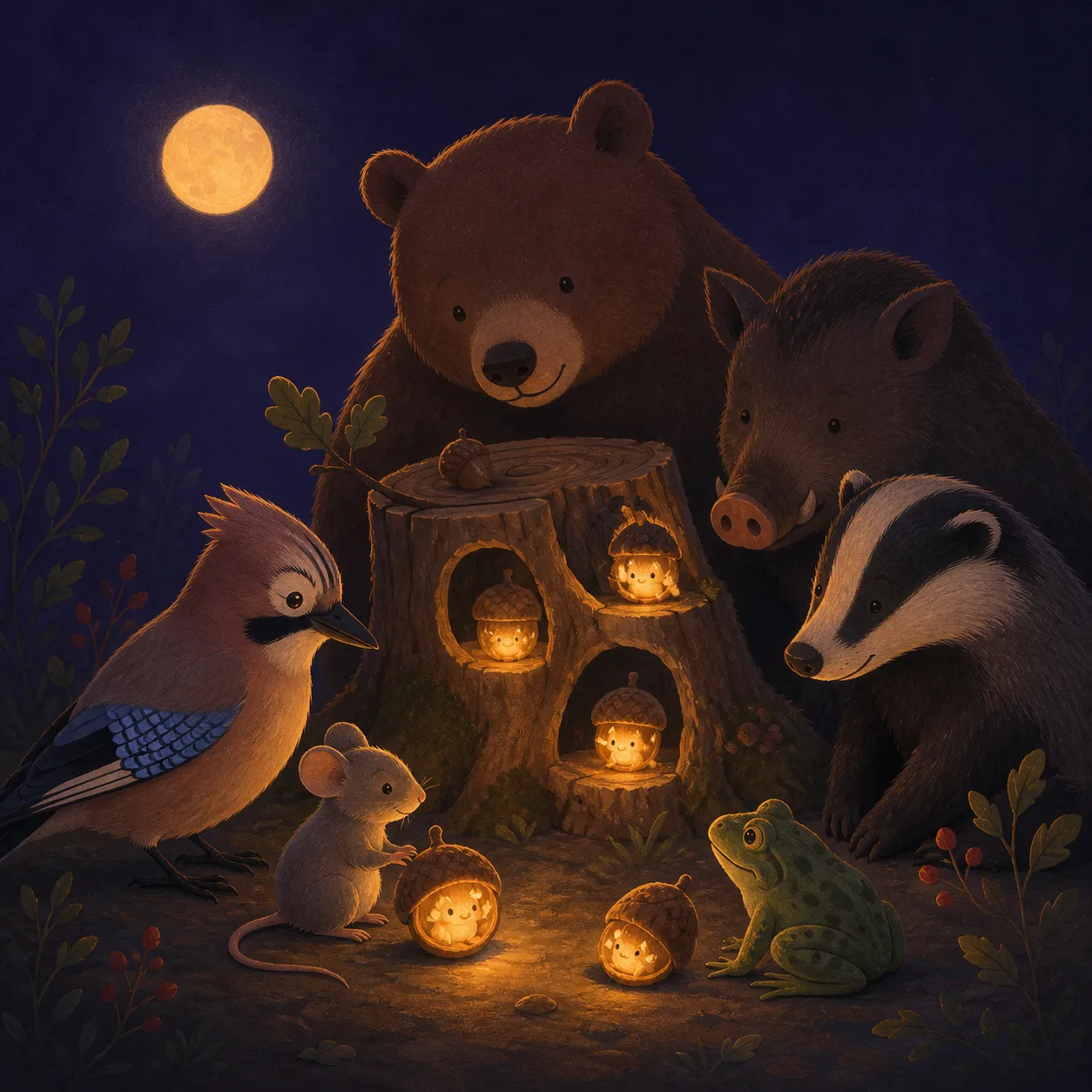
Read the story
Play videoTurn on sounds to bring the bold words to life. Each sound plays once per reading.
Jarka the jay knew every bit of news in the forest. She knew where the first fly agaric had grown, who had given birth to young, and which squirrel had once again hidden a hazelnut in its own bed and then grumbled about it all night. But one morning she discovered something no one had ever heard of before: an old hollow stump that was quietly humming inside.
Jarka peered in. Tiny compartments lined the walls, and in each one lay an empty acorn cap. Above them curled the words: LEAVE YOUR VOICE HERE. “I’d like to see that,” declared the jay. The moment she said it, a little blue spark leaped from her beak, curled up inside one of the caps, and stayed there like a ball of wool.
Jarka tried to cry out, but all that came from her was a faint puff of air. Horrified, she seized the cap in her beak. The little spark slipped back into her throat. “I’d like to see that!” rang out again, even though Jarka did not want to say any such thing now. Right after that, she could speak normally again. She thought about it for a while. Then her eyes shone like two drops of dew.
By noon, a birchwood sign was hanging in front of the stump: JARKA’S VOICE RENTAL. TRY A DIFFERENT SOUND! Jarka explained to everyone that all they had to do was speak into one cap and then hold another to their mouth. A borrowed voice could be returned in the same way. “And every voice remembers its owner’s favorite sounds,” she added. “That’s a little magical peculiarity.”
The first to arrive was the bear, who wanted a rest from his own growling voice. He borrowed the blackbird’s whistle and happily lumbered off to look for raspberries. Meanwhile, the blackbird wanted the frog’s croak, but then changed his mind and chose the bear’s voice. When he tried using it to greet an earthworm, he frightened himself. He quickly returned the growl and took the cricket’s voice instead.
Just then, Bětka the mouse approached. She was tiny and gray, and she spoke so quietly that the others usually had to bend down to hear her. But often they did not bend down. They kept on talking, and Bětka was left standing there with her sentence unfinished. “Please,” she squeaked now, “could I borrow the bear’s growl? Just for the afternoon. I’d like to finish saying something for once.”
Bětka placed her thin little voice in a cap, and Jarka wrote BĚTKA on the compartment in blueberry juice. The mouse drew a breath. “GOOD DAY,” she rumbled so deeply that a little rotten wood crumbled from the stump. Startled, she covered her mouth. Then she tried again, more quietly. This time her greeting sounded like distant thunder tucked beneath a quilt.
Břéťa the wild boar wanted the nightingale’s song. He had been composing a song about beechnuts for a long time, but at every performance he grunted his way through the whole thing. With the nightingale’s voice, he ran up a hill and sang so beautifully that three deer forgot to chew. Only the words remained a little unusual: “Beechnuts, beechnuts, best when piled up high, some are hidden in the muddy garden nearby!”
Matěj the badger borrowed the frog’s croak. He wanted to surprise his children when they returned to the burrow. Meanwhile, the frog chose the owl’s hoot, and the owl decided on the badger’s deep rumble. Everyone was having such fun at the rental that a line soon formed. Jarka hopped from branch to branch, wrote down names, and felt tremendously important.
Only Bětka noticed the dark cloud above the spruce grove. “Perhaps we should cover those labels,” she said quietly in the bear’s voice. But just then Břéťa sang another verse, and everyone burst out laughing. Jarka waved a wing. “In a moment, in a moment! I’ll serve the hare first.” Bětka brought a large burdock leaf, but before they could fasten it in place together, rain was already drumming on the leaves.
It was a brief but heavy shower. Water ran over the rim of the stump, carrying the blue-purple letters away with it. The caps remained safely tucked deep inside their compartments, but the names turned into puddles. When the rain stopped, only smears remained on the wood. And that was when the first customers returned for their own voices.
“Nothing to worry about,” Jarka announced far too quickly. “I’m an experienced rental keeper. Big animals get big voices, and small animals get small ones.” First, the customers returned the voices they had borrowed. She handed the bear the largest cap. The bear held it to his mouth, and a tiny “Squeak!” rang out. It contained Bětka’s speech. Břéťa got the owl’s hoot, and Matěj got a voice that could do nothing but chirp. No one was pleased.
“HOOO! I’m not a nesting box in a tree!” the wild boar fumed. “Chirp, chirp,” the badger objected, but no one knew what he meant. The bear tried to calm everyone in the mouse’s voice. This caused such confusion that the hare leaped over both the line and a low bush. At last, Jarka raised both wings. Everyone returned the voices they had just tried to the caps and took back the voices they had borrowed for the afternoon.
In all the commotion, a piece of wet bark slipped from the side of the stump. Beneath it appeared another inscription, until then hidden under the moss. Jarka read it slowly: AT THE FULL MOON, UNCLAIMED VOICES TURN INTO ECHOES. THE FIRST RAY OF MOONLIGHT DECIDES. The jay looked up at the sky. The clouds were breaking apart, and the sun was already sinking behind the treetops.
“Tonight is the full moon,” the owl reminded them in the badger’s voice. All the animals fell silent. Jarka tried covering the stump with burdock leaves, but the letters glowed beneath them, and a little moon carved into the wood pointed an arrow toward the horizon. The magic evidently knew exactly when the moon would rise. It could not be tricked by hiding the stump. Jarka slowly took the festive fern hat from her head.
“I don’t want to whistle anymore,” said the bear. “My cubs fall asleep to my growling voice.” “And my children won’t know I’m calling them to dinner,” Matěj added, croaking sadly. Jarka stared at the identical-looking compartments. For the first time all day, she did not know what to say. Her rental was full of voices, but none of them could give her any advice now.
Bětka gently tugged at one of her tail feathers. She did not thunder, though she could have. She waited until Jarka turned around and then whispered, “When you took back your voice this morning, it repeated your sentence, didn’t it?” The jay nodded. “And you said that voices remember their favorite sounds. Perhaps we shouldn’t sort them. Perhaps we should listen to them first.” Matěj and the owl immediately returned their borrowed voices to the caps.
Jarka thought for a moment. Then she carefully warmed one cap between her wings. A green thread lit up inside, and a sleepy croak sounded. When she brought the cap closer to her ear, she heard: “On a lily pad beneath the skies, a tadpole by his mother lies.” The frog jumped so high that she splashed mud onto her belly. “That’s what I sing at home!” she hooted excitedly.
That was it! Jarka set a wide piece of bark in front of the stump like a little table. Bětka arranged smooth pebbles on it so the caps would not roll away. The animals sat in a semicircle. This time there was no line, no pushing ahead, and no assigning voices by size. Everyone was to listen and speak up only when they heard something that was truly their own.
First, the frog returned the owl’s hoot. Jarka placed the newly filled cap to one side on a clean leaf, and the frog took back her croak. Just to be sure, she sang the whole lullaby once more. “Yes, that’s me,” she said contentedly. Bětka placed a small pebble beside the empty compartment. That made it easy to see that this voice was safely home.
Grunting came from the next cap. The wild boar immediately stood up, but Bětka raised a paw. They waited a little longer. The voice inside cleared its throat and began a cheerful rhyme: “Snout in the ground, four berries I found; I’ll save number five for a long wintertime.” Břéťa beamed. His grandmother had taught him that rhyme. He never recited it before an audience, only when searching for treats.
So he returned the nightingale’s song and gave a great grunt of relief in his own voice. But then he paused. “May I sometimes sing like this too?” he asked. The nightingale, who had been speaking in the hare’s voice until then, nodded. “The beechnut song is yours. Sing it in whatever voice you like.” Břéťa happily grunted the first line, very softly this time so he would not disturb the others.
Not all the voices were easy to recognize. One cap whispered with a rustling sound and then fell silent for a long time. Another gave only a brief whistle. A third laughed so infectiously that the whole row of listeners began laughing too. Meanwhile, the sun disappeared. Twilight settled over the ferns, and fireflies began flitting among the roots. Jarka glanced anxiously toward the east several times.
But Bětka did not hurry. She held each cap until the voice inside found its courage. At last, the badger’s voice did not growl but gave a long sigh: “Matýsek, Majda, Míša, wipe your paws now!” Matěj leaped up and held the cap to his mouth. “My children! I mean, that’s how I call my children!” He rumbled three times for joy.
The owl recognized her hoot by the way it counted the evening stars. The bear returned the blackbird’s whistle to its cap. The blackbird’s voice hummed a song he sang while repairing his nest. The hare’s voice revealed itself with a rhyme about a carrot that wore seven coats, all of them orange. Whenever someone claimed a voice, Jarka first listened to the memory and only then handed over the cap. The empty compartments slowly filled with pebbles.
At last, Bětka returned the bear’s borrowed growl as well. Before she did, she used it to tell the bear, “It was very pleasant. Thank you.” The bear bowed and took his voice back. At once, a gentle song rolled out of him: “Sleep now, little ball of fur; honey waits when morning stirs.” The bear looked a little embarrassed, but no one laughed. It was a lovely song, almost like a warm blanket.
Bětka could not speak at all now. She sat beside the last two caps and listened. One held the cricket’s voice. It was already playing all by itself, as if it knew its evening hour had come. The cricket quickly collected it. Only one cap remained, and no sound came from it. Not even a squeak. Inside, a silver thread glimmered very faintly.
“That must be Bětka’s voice,” said Jarka, handing her the cap. The mouse held it to her mouth, but the thread did not move. A drop of rainwater glittered at the bottom. The little voice was trapped inside it like a seed in the dew. Jarka leaned so close that her beak felt the chill. In the east, the edge of a cloud was just turning white.
Bětka pointed to some dry moss beneath an overhanging root. Jarka understood. She tore off a tiny piece and carefully touched it to the drop. The water soaked in, but the cap remained cold. The bear cupped his enormous paws around it without squeezing. The jay covered it with the tip of her wing. The others waited so quietly that they could hear the last raindrop slide from a leaf.
And then, very faintly, came the words: “A crumb here, a crumb there, for the winter I’ll prepare.” Bětka smiled. It was her song, which she sang while storing seeds in her pantry. The animals bent down toward her, but no one said a word. The mouse held the cap to her mouth, and the silver thread slipped into her throat at the very moment moonlight flashed between the branches.
The stump lit up from its roots to its mossy rim. Pebbles chimed in the empty compartments. Then a distant “Hellooo...” sounded from its hollow. It was not anyone’s lost voice, only the ordinary echo of an empty stump. Jarka sank straight into the wet grass with relief. The bear breathed out so powerfully that he dried at least her belly. Everyone had their own voice back.
“I’d like to say something,” Bětka squeaked. This time, every single one of them turned toward her. “Could we build the roof before opening next time?” Jarka nodded solemnly. “And we’ll carve the names into the wood. And we’ll only lend voices in the morning. And you...” She stopped. Instead of launching into another long explanation, she waited. “I’d be glad to help you,” Bětka finished for herself.
The next day, the rental got a proper bark roof and a gutter made of pine cones. Each compartment had the owner’s name and a little picture carved into it. Beside the entrance hung a new sign: CLOSED BEFORE THE FULL MOON. Jarka read it three times to make certain she would not forget. Beneath it stood a low stool for Bětka, head of listening and careful handling.
Sometimes someone came to borrow a voice just for fun. Matěj still liked croaking best, and Břéťa alternated between nightingale trills and his own grunting. But Bětka no longer needed to borrow the bear’s voice. When she began her crumb song in the evening, the large animals lowered their heads and the small ones moved closer. And Jarka, who had once known every bit of news, now also knew the songs that can only be heard when everyone is quiet for a while.
Watch the story
An illustrated video — for the moments when eyes refuse to sleep yet.