The Gingerbread House
ages 5–1014 minutesmagical, suspenseful, and gentle, with a happy ending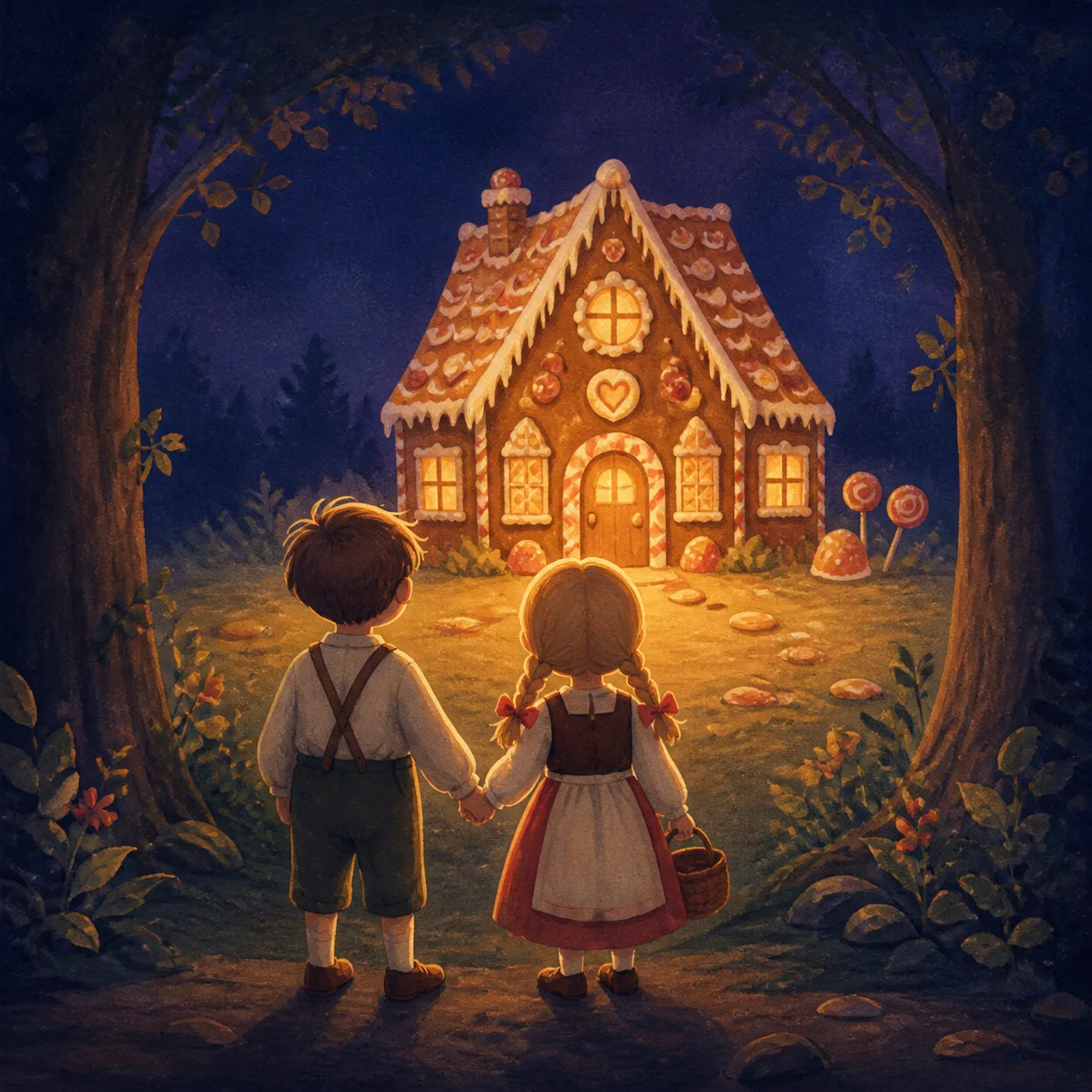
Read the story
Turn on sounds to bring the bold words to life. Each sound plays once per reading.
At the edge of a deep forest stood a small cottage. It was made neither of sugar nor of gingerbread, but of ordinary wood, and daisies grew beneath its windows. A poor woodcutter lived in the cottage with his children, Hansel and Gretel. Their mother was no longer with them, so the three of them helped one another as best they could.
Hansel would fetch water and gather dry twigs for kindling. Gretel swept the room and mended the small holes in her father’s shirt in the evening. When they had only a slice of bread and a mug of milk for supper, they shared them fairly. And when the wind howled outside, they pulled the bench closer to the stove and their father told them stories.
One morning, the woodcutter was preparing to go deeper into the forest, where he needed to cut up a fallen beech tree. The children begged him to take them along. They wanted to gather blueberries and help him collect brushwood on the way. So their father wrapped some bread in a cloth and gave each of them a small basket. Then they set off together along the path between the spruces.
“Stay nearby, and don’t go anywhere you won’t be able to hear me,” their father reminded them when they reached a clearing. Hansel nodded. Just in case, however, he kept a piece of bread in his pocket. If the paths became confusing, he could use it to mark the way. It seemed like an extremely clever idea to him.
At first, the children picked blueberries near the clearing. But a little farther on, the bushes were even bluer, and beyond them wild strawberries gleamed red. Hansel dropped crumb after crumb onto the ground while Gretel filled her basket. Neither of them noticed that the blows of their father’s axe were growing fainter and fainter, until the forest swallowed the sound entirely.
Only when the sun disappeared behind the tall treetops did Gretel raise her head. “Hansel, we should go back.” Her brother turned around, but the familiar clearing was nowhere to be seen. “Don’t worry, I left us a trail,” he said. But almost nothing remained of the crumbs. A blackbird was hopping on a branch, and beneath it sparrows were pecking up the last pieces of bread.
“They’ve eaten our whole way home!” Gretel gasped. They called for their father until their throats hurt, but only the echo answered them. They tried one path, then another. All the spruce trees looked alike, and every mossy stone seemed as though they had passed it before. At last, they had to stop.
Hansel took his sister by the hand. “We’ll stay together. Two people have a better chance of finding the way than one.” They shared the blueberries and sat beneath a spreading fir tree. When darkness fell, they covered their legs with dry leaves. Gretel rested her head on her brother’s shoulder, and they both fell asleep while stars glimmered through the branches above them.
Meanwhile, their father was searching for them. As soon as he discovered that they were nowhere near the clearing, he set down his axe and ran through the forest. He called their names, looked behind thickets, and asked every charcoal burner and forester he met. He did not return home even after dark. He walked among the trees with a lantern, hoping to catch sight of two small baskets.
In the morning, the children were awakened by dew and birdsong. They were hungry, and their legs were stiff from the cold. They set off toward the light between the trees. Suddenly, a white bird flew past them and landed on a low branch. When they reached it, it fluttered farther on. The children followed it for a while, until the forest suddenly opened before them.
In the middle of a small clearing stood a cottage unlike any they had ever seen. Its walls were made of brown gingerbread, its roof of honey cakes, and its windows of transparent sugar. White curls of icing wound around the door. A gingerbread heart sat on the roof ridge, and beneath the eaves hung icicles as sweet as rock candy.
Gretel stood there with her mouth open. “We must be dreaming!” Hansel carefully broke a tiny corner from the roof. He tasted it, and his eyes lit up. “It’s delicious!” He gave half to his sister. Then Gretel broke off a piece of the sugar window, and Hansel took another piece of honey cake, for they were both terribly hungry.
Just then, a croaking voice came from inside: “Who is nibbling at my gingerbread?” The children were frightened and crouched beneath the window. After a moment, Hansel squeaked, “It’s nothing, only the breeze.” But no breeze was blowing, and sweet crumbs crunched beneath their shoes. The door creaked, and a stooped old woman appeared on the threshold.
She wore a scarf tied beneath her chin, a long apron, and carried a stick in her hand. “Why, I have guests!” she cried in a honeyed voice. “Come inside, you poor little chicks. You must be hungry and tired.” The children told her that they were lost and looking for their father. The old woman nodded and invited them inside, where the warm scent of porridge filled the air.
Two bowls, a jug of milk, and a plate of cakes stood on the table. Two little beds with clean quilts waited by the wall. Hansel and Gretel thanked her and began to eat. The old woman watched them from the corner and smiled. Only her eyes were cold and motionless, like two black pits.
But the children were too tired to notice. They lay down and fell asleep at once. They had no idea that their hostess was not a kindly grandmother, but a wicked witch. She had built the gingerbread cottage on purpose to lure lost travelers to her. Her eyesight was poor, but she could hear even a mouse moving behind the cupboard.
Before dawn, the witch got up. She seized the sleeping Hansel, carried him to the shed behind the cottage, and locked him behind a sturdy barred door. Then she shook Gretel awake. “Get up, you lazy girl! You will cook for your brother and serve me.” There was no trace of her kindly voice. Gretel leaped out of bed and immediately asked where Hansel was.
When she saw him behind the bars, she burst into tears. But the witch only cackled. “First we’ll fatten him up nicely. Then I’ll heat the oven!” A chill ran down Gretel’s spine. Now she knew what terrible danger they were in. But she could not open the lock, because the key hung at the witch’s waist on a thick cord.
All day, she had to carry water, feed the fire beneath the pot, and cook thick porridge for her brother. She herself received only scraps. Whenever she was allowed to bring Hansel a bowl, she moved closer to the bars. “Father must be looking for us,” she whispered. “We have to hold on.” Hansel squeezed her hand and promised to watch for a chance to escape.
In a corner of the shed, he found a thin, gnawed bone among the straw. He picked it up and had an idea. The next morning, when the witch ordered, “Hansel, stick out your finger so I can tell whether you’re fat enough yet,” he pushed the bone between the bars instead of his finger. The witch felt it and smacked her lips in displeasure. “Nothing but bone! What a nuisance!”
And so Hansel tricked her day after day. The witch gave him larger and larger portions and complained that he was not growing fat. Gretel stirred the porridge, scrubbed the pots, and secretly studied the doors, windows, and locks. At night, she heard an owl beyond the wall and imagined it was her father calling. But each morning, she found only locked doors again.
Once, she tried to carry away a nail from the kitchen that might open the small lock. But the witch heard it clink and took it from her. Another time, Gretel tried to loosen a plank on the shed, but it was too strong. Still, she did not give up. Whenever she handed her brother his food, she smiled at him, though she felt nothing like smiling.
At last, the witch lost patience. “Enough waiting!” she croaked one morning. “Fat or thin, today we’ll heat the oven.” She ordered Gretel to bring in firewood while she kneaded dough in a trough. Flames soon crackled beneath the oven’s arched roof. Gretel added small logs, and her heart pounded so hard that she had to press a hand to her chest.
The witch paced through the kitchen and sniffed the hot air. Then she opened the iron door and pushed a low stool in front of the oven. “Climb up, girl, and look inside to see whether it is hot enough.” Gretel looked at her. She saw the witch’s outstretched hands and realized that the wicked old woman meant to push her into the oven.
At that moment, she knew what to do. She stepped aside and made herself look as helpless as possible. “But I don’t know how. I’m small, and I can’t see inside. How am I supposed to look?” The witch stamped her foot impatiently. “I’ve never seen anyone so clumsy! Why, the opening is large enough even for me. Here, I’ll show you!”
She shoved Gretel aside, stepped onto the stool, and bent into the open oven. Gretel did not hesitate. With all her strength, she pushed her in, slammed the iron door shut, and slid the bolt into place. The oven rumbled, a cloud of black smoke flew from the chimney, and then all was silent. The wicked witch could never harm the children or anyone else again.
Gretel was still trembling all over. For a moment, she sat down on the floor to catch her breath. Then she saw the key on the table. The witch had left it there while kneading the dough. Gretel seized it, ran behind the cottage, and turned it in the lock. “Hansel! Come out! We’re free!”
Her brother leaped out of the shed and hugged her so tightly that they both laughed and cried at the same time. “You saved me!” he kept saying. Gretel wiped her eyes with her sleeve. “Now we still have to find the way home.” But first, they drank some clean water and wrapped bread in a cloth. Neither of them wanted any more gingerbread.
While looking for their baskets, they discovered a small chest beneath a bench. It contained no witch’s spells, but pearls, precious stones, and gold coins. They put some of them in their pockets. “Father will be able to repair the roof,” said Hansel. “And buy flour,” added Gretel. Then they walked out the door and did not look back even once.
The forest beyond the cottage no longer seemed so dark. Sunlight shone between the branches, and drops of dew sparkled on the moss. The children walked hand in hand, and this time they stayed on the wide path. When they grew hungry, they shared the bread. Hansel carefully studied their surroundings, while Gretel listened for a human voice in the distance.
After a long journey, they reached a river. It was wide, and the water in the middle rushed swiftly over dark stones. There was no bridge, no footbridge, and not even a boat by the bank. The children walked along the reeds, searching for a shallow place. On the opposite bank grew birch trees that looked familiar to Hansel.
Then a large white duck appeared from behind the willows. It swam calmly against the current, and its feathers were as clean as freshly washed linen. Gretel crouched on the bank. “White duck, please help us across the water. We are looking for our father and do not know which way to go.” The duck bobbed its head and swam right up to their feet.
“We’ll both sit on her back,” Hansel suggested. But Gretel shook her head. “We would be too heavy for her. We’ll go one at a time.” So first the duck carried Hansel across. He held carefully to her soft feathers and did not move. Then she returned for Gretel and carried her safely over to her brother.
The children thanked her and crumbled the last piece of bread onto the bank. The duck quacked contentedly, flapped her wings, and disappeared among the reeds. The brother and sister continued up the path. Soon they recognized a stump shaped like a bear, then a split oak, and finally a small spring where they used to fetch water with their father. Home was close now.
They ran as fast as their tired legs could carry them. Beyond the last trees, they saw the wooden cottage and the daisies beneath its windows. Their father was standing by the gate with a lantern in his hand. He was preparing to go into the forest again. He was pale and exhausted, and his shoulders drooped. When he saw the children, he could not believe his eyes for a moment.
“Hansel! Gretel!” He set the lantern down in the grass and ran to meet them. He knelt on the path and wrapped them both in his arms. The children put their arms around his neck, and their father would not let them go. “I looked for you every day,” he whispered. “On every path, by the streams, and in the thickets. My children, my dear children!”
At home, he warmed some milk for them and brought them a blanket. Hansel and Gretel told him about the crumbs, the sweet cottage, the bone, and the white duck. When they poured their treasure onto the table, their father only shook his head. “What is most precious to me has already returned,” he said, stroking their hair. Only then did they all eat together.
With the gold coins, they repaired the roof and bought supplies for the winter. From that time on, they never went hungry. When the children went into the forest, they stayed close to their father and did not rely on breadcrumbs. And whenever they saw a white duck on the river, they waved to her. They always kept a small greeting and a handful of oats for every one they saw.