The Little Tailor Who Sewed on Shadows
ages 5–1014 minutescheerful, magical, and gentle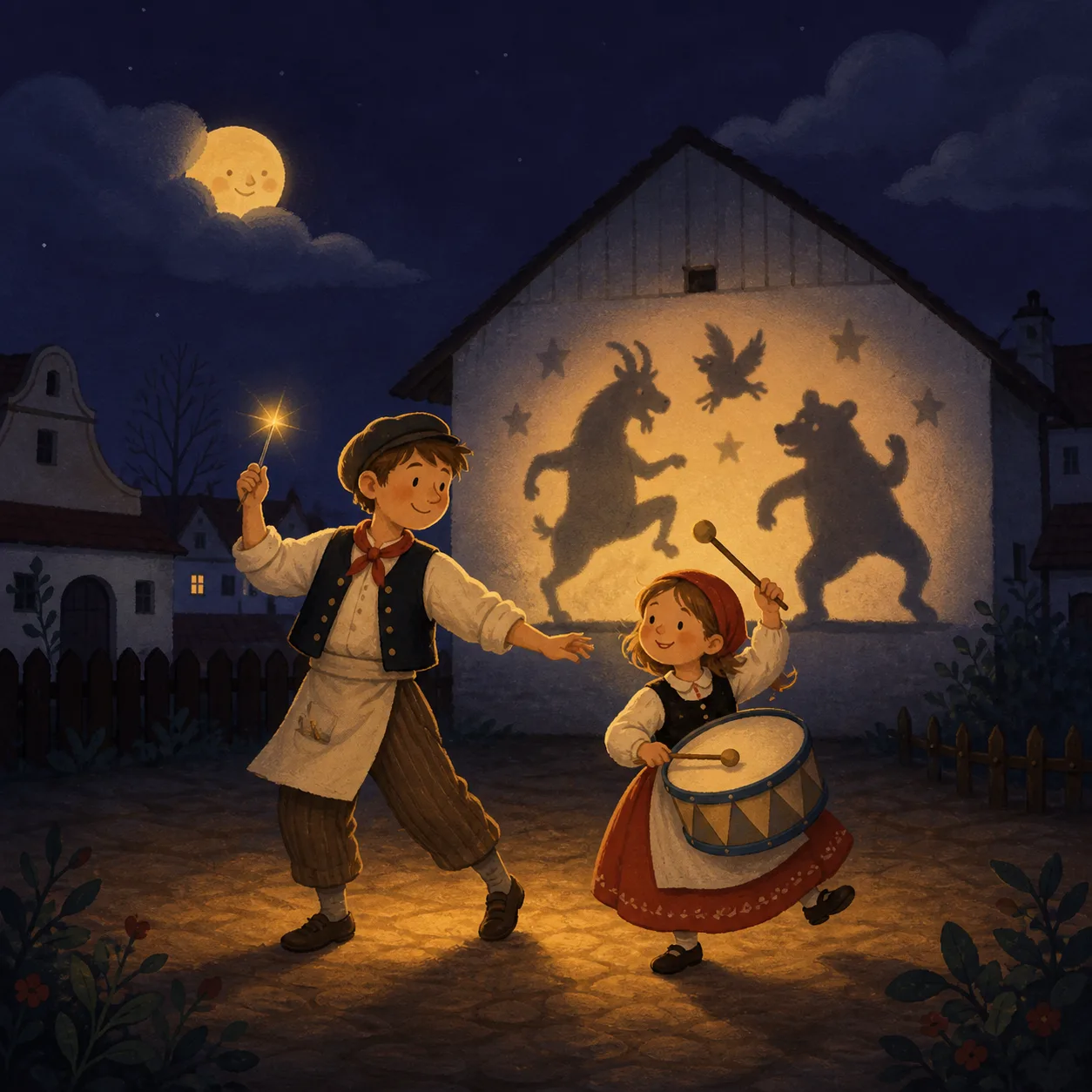
Read the story
Turn on sounds to bring the bold words to life. Each sound plays once per reading.
In a village with a round green stood a tailor’s cottage. In its shop window were three buttons as big as cakes, and behind the window was a geranium that kept leaning inside as though it wanted to have a coat made. There, a boy named Vítek served as an apprentice to Master Matěj. He could sew on a button, patch an elbow, and find a dropped needle even among the knots in the floorboards. But most of all, he liked everything to be neatly in its proper place.
The village feast was just being prepared. The baker was putting cakes into the oven, the mayor was hanging flags between the linden trees, and the children were carrying benches. Master Matěj was finishing a festive waistcoat so wide that a single table could not hold it. “Vítek, take this basket with the mended shawl to Grandmother Rozárka,” he asked his apprentice. “And don’t dawdle anywhere along the way. We still need to sort the ribbons by color.” That was exactly the sort of job Vítek liked.
Grandmother Rozárka lived beyond the last linden tree. When Vítek handed her the shawl, she examined the tiny stitches and nodded with satisfaction. “You have skillful fingers. I’ll give you something for them.” From a little box she took out a slender needle that shone even though the sunlight did not reach it. A silver thread was threaded through its eye. The thread led to a small ball, as cold and light as morning dew.
“With this needle, you can sew up even something you cannot hold in your hand,” Grandmother said. “A hole in an echo, a torn song, or even a shadow. But remember: its stitches will come loose only in moonlight.” Vítek smiled. He had never seen a torn song, though he knew plenty of torn trousers. He carefully wrapped up the needle and thanked her. While he was still on the doorstep, he noticed that Grandmother’s shadow bowed a moment later than Grandmother herself.
Meanwhile, a strange commotion had broken out on the village green. The baker’s shadow leaped onto a wall and curled itself into the shape of an enormously long crescent roll. The mayor’s shadow hid beneath a cart full of pumpkins, while the schoolmaster’s shadow hopped over the paving stones. The schoolmaster himself stood perfectly still and frowned. The children laughed, but the grown-ups had their hands full. “We really don’t have time for such fooling around!” the baker called.
Vítek set down the basket and thought. A loose ribbon could be sewn down. So could a torn-off sleeve. Then why shouldn’t a disobedient shadow be fastened down too? He pulled out the magic needle, knelt beside the baker’s shoe, and called, “Just keep still for a moment!” He made three tiny stitches. The thread passed through the shadow and the edge of the heel as easily as if both were made of fine cloth. The shadow stopped hopping at once.
“Excellent!” the baker rejoiced. “Now do the mayor!” Vítek sewed and sewed. He caught the blacksmith’s shadow, the schoolmaster’s, and the gingerbread seller’s as well. At last he also sewed down his own, because it did not seem right to let it run about when the others were not allowed to. Before long, all the shadows were sitting properly at their owners’ heels. The sun was high and the shadows were short, so no one noticed how firmly Vítek had drawn them in.
“That has put an end to the confusion,” he told himself with satisfaction. Hardly any thread at all was missing from the silver ball. Vítek returned to the workshop, straightened the ribbons, and said not a word about the needle. Master Matěj praised the tidy table. The scent of plum-jam cakes drifted from the village green, and the first evening bird flew over the rooftops. It looked as though the feast would begin quite ordinarily.
But then the sun began to sink. The baker’s shadow wanted to stretch across the road, as shadows do in the evening. The stitches would not give. The baker’s heels flew up, her legs waved like the sails of a windmill, and bump! She landed in a basket of clean towels. Fortunately, she held the cakes high above her head. “Who pulled my shoes?” she wondered. Behind her, her shadow twisted helplessly.
By the fountain, things turned out even more strangely. The mayor tumbled over a low stool and ended up with his legs in the air like an overturned beetle. The blacksmith somersaulted straight into a pile of hay prepared for the musicians’ horses. The schoolmaster tried to walk with dignity, but after every third step he hopped backward. At first the children applauded. Then they saw that the grown-ups were not enjoying themselves at all.
Vítek ran out of the workshop, and at once his own heels swung up to his chin. He landed with a thump on a folded canvas sheet. Only then did he realize what he had done. The shadows needed to grow as the daylight faded, but he had sewn them too short. He reached for his scissors. The silver thread rang between the blades and remained whole. He tried to untie a knot. It would not budge either.
Some of the neighbors decided they would rather sleep through the feast. But there was no peace at home either. As soon as the gingerbread seller lay down, his shadow tried to stretch along the bed and pulled his feet out from under the blanket. The schoolmaster’s shadow rolled across the wall, and with every roll the schoolmaster rolled across his mattress. In the end, everyone gathered again on the village green, this time with pillows under their arms.
Vítek looked up at the sky. The moon should have been shining long ago, but it was hidden behind a thick quilt of clouds. Not even a silver sliver could be seen. “Just a little light,” Vítek whispered. “Just enough for a needle to fit inside.” The clouds did not move. But then a wagon rattled along the road and a horn sounded. The musicians who were to play for the feast dance were arriving.
Beside the driver sat Bětka, a young drummer. She wore a red cap and carried a drum with a blue rim. She jumped down, struck it once with her drumstick, and stopped short. All over the village green, people sat on pillows, clutching their ankles and looking as though someone had replaced their celebration with a visit to the dentist. Only their shadows darted restlessly in the light of the glowing lanterns.
“Is this some new kind of dancing game?” Bětka asked. Vítek turned red to the tips of his ears. He could have said that the shadows had gone mad all by themselves. He could have hidden the magic needle and pretended to be surprised. But just then the baker hissed because her shadow had tugged at her heel again. So Vítek stepped into the middle of the green. “I did it,” he confessed. “I wanted everything to be orderly. I sewed down the shadows, and now I don’t know how to set them free.”
For a moment, only the crackling of the lanterns could be heard. “You sewed us down?” the mayor gasped. Vítek nodded and explained everything about the needle and the moonlight. Master Matěj sat down beside him. “You made a mess of this,” he said. “But now that we know where the mistake is, we can look for a way to mend it.” The baker handed Vítek a pillow. “Then do your looking sitting down, so you don’t break your nose while you’re at it.”
Meanwhile, Bětka crouched beside a lantern. Her own shadow had not been sewn down because she had only just arrived. It gave a small bow on the paving stones. The baker’s shadow answered, but the stitches stopped it short. Bětka tilted her head. “Wait. They aren’t trying to run away.” She tapped her drum lightly. The shadows raised their arms. She tapped it a second time. Every arm pointed toward the dance floor that had been prepared.
“Do you want to dance?” she asked. So many nodding heads swept across the wall that they looked like grain rippling in the wind. The baker’s shadow pointed at the cakes and then at itself. The mayor’s pointed at the flags. The schoolmaster’s bowed toward the empty space beside the musicians. “We invited all the neighbors to the feast,” Bětka said slowly. “But none of you thought to invite them, did you?” The shadows’ shoulders drooped.
Vítek remembered how his own shadow had reached toward the colored ribbons that morning. He had thought it was merely getting in the way. Now he felt more ashamed than ever. “I’m sorry,” he said to the shadows. “I should have looked first to see what you wanted.” His shadow turned its head toward him and gave a slight bow. But the stitches still held, and the clouds over the village were as thick as quilts for a giant.
“Perhaps we could wake the moon,” the blacksmith suggested. The musicians blew their horns toward the sky. Nothing happened. The mayor shouted, “Moonlight, please!” Still nothing. Bětka twirled a drumstick between her fingers. “Grandmother says the moon is the most curious spectator in the world. If we put on something it has never seen before, it will be sure to peek out.” She looked around at the shadows. “We’ll put on a shadow dance for it!”
“A dance?” the schoolmaster cried in dismay. “But we can’t stay on our feet!” “Then we won’t dance with our feet,” Bětka replied. She had wide benches brought over and placed beside the white wall of the barn. The neighbors sat down, rolled-up blankets were put beneath their heels, and the lanterns were arranged so that the shadows were short and the stitches did not pull. Vítek carefully tried moving each person’s shoe. Only when no one grunted in pain did Bětka raise her drumsticks.
“And now we warmly invite every one of you,” Vítek announced to the shadows. “To the feast, to the music, and most of all, to the dance. Your place is here, on the largest wall in the village.” The shadows straightened. Their arms spread like the branches of a tree. The musicians exchanged glances, the fiddler struck up a merry tune, and Bětka began: boom, tap, boom, tap! The rehearsal could begin.
At first, everyone merely waved. Then Bětka showed them how to make a rabbit with their fingers. Twenty pairs of ears sprang up on the wall. The blacksmith’s rabbit had ears so enormous that they looked like two shovels. The baker folded her hands into a bird, and her shadow added extra wings. No one knew how it had done that. That was exactly why everyone began to laugh. Even the mayor, whose pillow had been uncomfortable only a moment before.
The shadows soon grew bolder. They did not need to stretch their legs to do marvelous things. The schoolmaster’s shadow made enormous spectacles out of its own elbows. The blacksmith’s pretended to hammer an invisible horseshoe, and each time, the baker’s turned it into a crescent roll. Bětka’s free shadow glided among them like the leader of a merry parade. When it lifted its cap, shadow cherries spilled from it onto the wall.
At first, Vítek stayed to one side. He clutched the needle in his hand and watched the sky. “It isn’t complete without you!” Bětka called. So he sat down beside Master Matěj and raised his hands. His shadow took hold of a pair of enormous invisible scissors and began cutting out a coat for the mayor’s shadow. The coat had one sleeve pointing up, the other pointing down, and a pocket right in the middle of its back. The mayor laughed so hard that his cap fell off.
High above the clouds, something moved. The moon was not asleep after all. It was lying in a misty rocking chair and counting raindrops, which was terribly boring. From below came the sound of drumming and laughter. “What have they got down there?” it muttered. Carefully, it pulled back a corner of a cloud. It saw a rabbit with shovel-shaped ears and a coat with a pocket on its back. It had never seen anything like that before. It pulled the cloud back a little farther.
A narrow beam of silver light fell onto the village green. “Now!” Vítek gasped. Bětka heard him and drummed even more merrily. The musicians quickened the tune, the shadows circled their arms, and the moon poked out its whole face. Its light flooded the benches and the paving stones. Vítek knelt beside the baker’s shoe, slipped the needle beneath the first stitch, and tugged gently. The thread came loose like a ribbon on a present.
One stitch, then the second, then the third. The baker’s shadow slowly stretched across the green. The baker carefully put her feet on the ground. Nothing pulled at her. “Keep the moon out!” Bětka commanded as Vítek ran to the next neighbor. The freed shadows were already dancing all over the barn wall. The moon leaned lower and lower so that it would not miss a single part of the performance. Meanwhile, the clouds drew aside.
Vítek unpicked the stitches from the mayor, the schoolmaster, the blacksmith, and the gingerbread seller. At last he lifted his own heel. The final silver stitch slipped out of his shoe and curled around the needle in a tiny spiral. Vítek’s shadow stretched all the way to the fountain, gave its arms a thorough shake, and then performed one single somersault. This time Vítek remained standing. “That one was yours alone,” he said with a relieved laugh.
Only then did the real feast begin. The benches were moved over to the tables, the baker handed out the cakes, and the musicians played so briskly that the flags trembled. People danced on the village green, and shadows danced on the ground and along the walls. Now and then, a shadow did something quite different from its owner, but no one minded. The mayor even asked his shadow to teach him that funny bow with the elbows.
Grandmother Rozárka arrived only in time for the last song. Vítek wanted to return the needle to her. “I still don’t know how to use it properly,” he admitted. Grandmother gently closed his hand around the needle. “You know more about it now than you did this morning.” Master Matěj nodded. Vítek put the needle away, but this time he repeated the words about moonlight to himself three times. Then he brought Bětka the largest plum-jam cake and gave her shadow a deep bow.
From that time on, before every village feast, an invitation hung by the fountain: All neighbors and their shadows are warmly invited. Beneath it, a large blank piece of paper was left so there would be room for anyone people might have forgotten. And when the lanterns were lit in the evening, Vítek no longer tried to straighten the shadows. Instead, he placed a lantern in front of a white wall and waited to see what dance they would invent that time. The moon always arrived on time.