Clara and the Garden Between the Apartment Blocks
ages 5–1014 minutesheartwarming, cheerful, and neighborly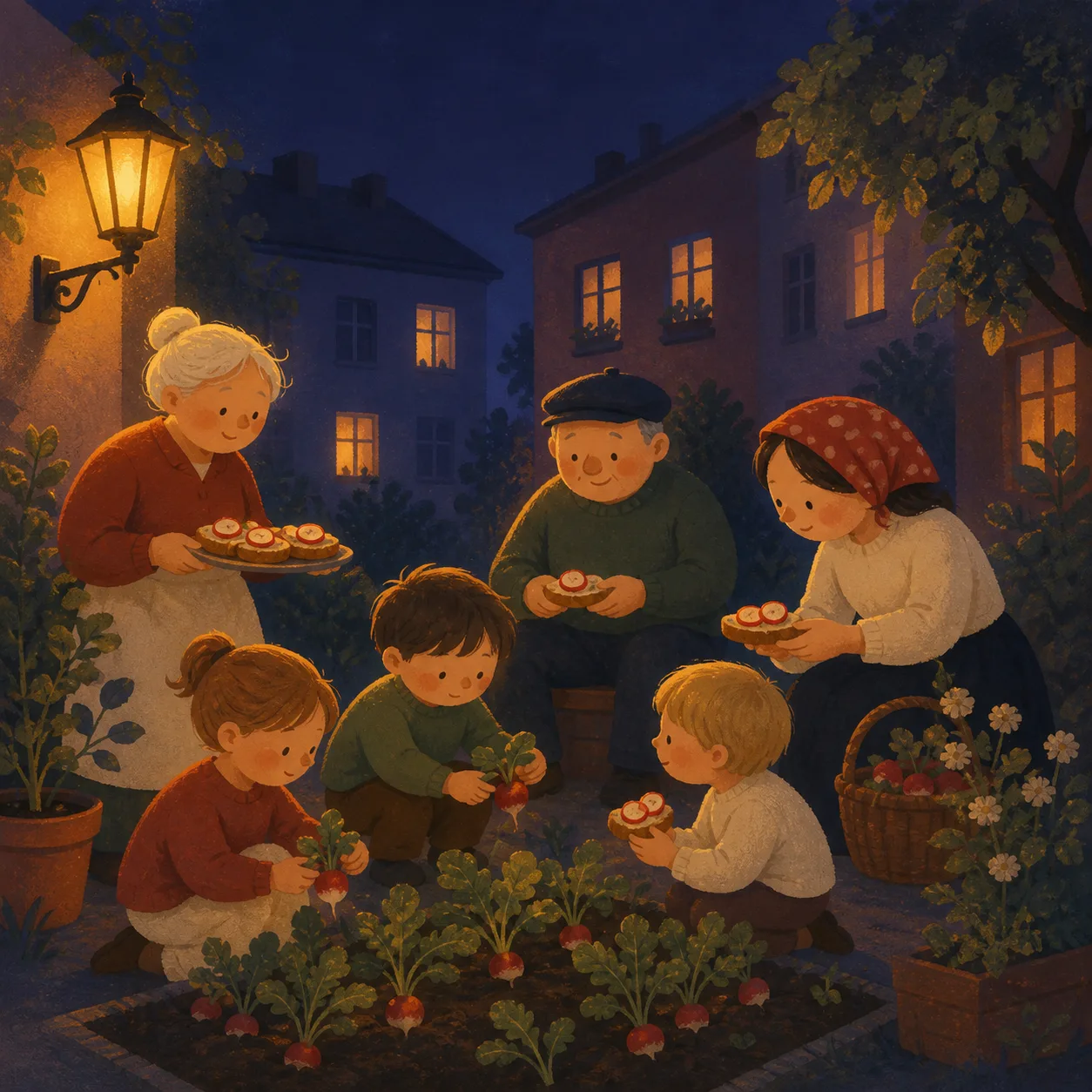
Read the story
Play videoTurn on sounds to bring the bold words to life. Each sound plays once per reading.
Between three tall apartment blocks lay a courtyard. It had a sandbox, two benches, and a carpet-beating frame where no one had beaten a carpet for a long time. By the wall grew a little grass, a few thistles, and one clump of dandelions. Klára knew the courtyard well. She knew where the biggest puddle formed after the rain and which bench the ball most liked to roll under. But until one Tuesday in June, it had never occurred to her that something edible might grow there.
That Tuesday, she met Mrs. Růžičková from the third floor in the elevator. Her neighbor was carrying empty flowerpots, and a colorful packet was sticking out of her pocket. “Would you like some radish seeds?” she asked. “I don’t have any room for them on my balcony.” Klára examined the packet. The picture showed red balls with white tails. But inside, something merely rattled very quietly. “From tiny specks like these?” she said in surprise. “From tiny specks like these,” her neighbor nodded.
Downstairs, Klára called a meeting. Tonda came with his scooter, Bětka with her chalk, and her little brother Matýsek brought half a bread roll. “We’re going to make a garden,” Klára announced. Tonda immediately wanted peas and a watermelon as well. Bětka suggested flowers all around the edge. Matýsek declared that he was going to grow a digger. In the end, they agreed to start with radishes, because they already had those, at least in the form of a rattling packet.
They chose a sunny patch by the wall where no one ran around. But the shared courtyard was not their bedroom, to be rearranged however they pleased. So Klára brought her mother, and they all went to see Mr. Vávra, who looked after the building. He studied the spot for a long time. “And who will do the weeding? And who will put the tools away?” he asked. Four hands shot into the air. Matýsek’s was sticky from his bread roll.
Mr. Vávra spoke to the other adults, and on Saturday he brought a piece of string and four stakes. He marked out a garden bed as long as a bench and two children’s steps wide. Klára’s mother helped remove the turf and loosen the soil. The children picked stones out and put them in a bucket. They found a rusty bottle cap, a blue marble, and an earthworm. “We’ll leave this one at home,” Bětka decided, carefully placing the earthworm back in the soft earth.
Mrs. Růžičková came to show them how to sow the seeds. She made shallow rows with a stick and placed several seeds in the first one, leaving spaces between them. “They don’t need to be squashed together like people on the morning bus,” she explained. The children carried on by themselves. Klára worked slowly, Tonda finished first, and Bětka whispered to the seeds, telling them where to grow. Then they gently covered the rows and watered them with a watering can fitted with a sprinkler head that made a tiny rain shower.
Matýsek waited until the others turned away. Then he pulled a large yellow button out of his pocket and pressed it into the soil in the corner of the bed. “What are you putting there?” Klára asked. “A little sun,” he replied. The button had four holes and had come from his bear’s old sweater. Matýsek stuck a twig into the ground above it. “A button tree will grow here. The next time Bear loses one, I’ll pick him a new one.”
The next day, there was nothing to see. On the third day, there was still nothing. Klára bent over the bed on her way to school and on her way home. Tonda decided that the seeds needed more to drink. He watered them before breakfast, after lunch, and again in the evening. By the time Bětka arrived with her own watering can, the soil was already glistening. “That’s good,” Tonda said. “At least the water will last them a long time.” A little puddle formed in one of the rows.
Bětka, meanwhile, was troubled because they did not know what was happening underground. So she dug up one seed with her finger. It had a tiny white shoot. She ran to show Klára, and then she wanted to put it back, but she was not sure which way was up. She tried to find another one so she could check. When Mrs. Růžičková arrived, two children were arguing over a muddy little hole, and Tonda was already bringing more water.
“Wait with that watering can,” their neighbor gently stopped him. She knelt beside them and picked up a little soil. “It’s wet enough. The roots need air too. And the sprouts are delicate, Bětka. If we keep moving them around, they’ll have a hard time growing.” Bětka lowered her eyes. “I only wanted to look.” Mrs. Růžičková nodded. “I know the feeling. So we’ll make one observation seed for the windowsill.”
At home, they placed a seed against the side of a glass jar, between the glass and some damp paper. That way, Bětka could watch the white root every day without pulling it out. In the courtyard, the children made a rule: first touch the soil, then water it if necessary. They fastened a sheet of paper with their names to the door of the shared storage room. Whoever watered the bed drew a drop beside their name. Tonda drew drops so large that they looked like pears.
On the fifth morning, Klára spotted the first green tip. Then a second and a third. She ran to fetch her friends so fast that her sandals slapped against the stairs. Soon four heads were bending over the garden bed. The plants looked like tiny open palms. Only above Matýsek’s button was there no sign of green. “I suppose it’s a late sleeper,” Matýsek said, carefully moving a stone away from his twig.
The radishes grew, and so did the grass that had not been invited into the garden bed at all. Mrs. Růžičková showed the children what to pull out and what to leave. They also thinned the plants where they were crowded together. Tonda did not like that. “If we leave more of them, we’ll have more radishes.” Their neighbor showed him how much space one radish bulb needed. Tonda thought for a moment and then gave in. “All right. Each one can have its own room.”
People began stopping by the garden bed. A woman with a shopping bag guessed that lettuce was growing there. A man from the next entrance asked if it was carrots. “Radishes,” Klára replied proudly every time. Mr. Vávra came by to check that no rakes had been left lying around. One day, he brought a short board from his workshop. Bětka wrote GARDEN on it and drew a red circle with green hair beneath the word.
One afternoon, Tonda came running with bad news. “We’re going to Grandma’s on Saturday. For a whole week.” Klára stopped weeding. She was leaving with her parents for their country cottage that very Saturday. Bětka and Matýsek were packing their little suitcases for a visit to their aunt. Until then, they had all been looking forward to the holidays. Now they stared at the rows and imagined seven long days without a single drawn drop.
“We’ll take the garden bed with us,” Matýsek suggested. Tonda wanted to pour ten watering cans into the soil in advance. But then he remembered the puddle and shook his own head. Klára ran to Mrs. Růžičková. But her neighbor was just packing a bag for a trip to a spa. “I could manage the first two days, but then I’m leaving too,” she said. “There are still plenty of other hands living in these three buildings, though.”
Klára looked up at the long rows of windows. Someone lived behind every one of them, but she knew most of those people only by sight. Some did not even greet one another in the elevator; they only watched the glowing floor numbers. “What if they don’t want to?” she asked. “We’ll find out,” her mother replied when Klára told her about the gardening problem at home. She brought a large sheet of paper and sat down with the children at the kitchen table.
Tonda’s first suggestion read: DON’T LET OUR RADISHES DIE! Bětka thought that sounded too sad. In the end, they wrote: HOLIDAY GARDENERS WANTED. JUST ONE EVENING. Under the heading, they added seven boxes with dates and simple instructions from Mrs. Růžičková. Matýsek drew a watering can that looked a little like an elephant. Klára added: Anyone who helps us can share our first harvest.
With her mother’s permission, they put the paper up on the building noticeboard. All the next day, the boxes remained empty. Klára walked past them six times. The seventh time, she felt like taking the paper down. “Maybe no one noticed it,” Bětka said. So the following afternoon, they put up a sign beside the garden bed that read COME AND HAVE A LOOK. They waited on the bench like guides in a tiny botanical garden. Matýsek washed his knees for the special occasion.
Mr. Vávra was the first to stop. “And who will look after you when the children go away?” he asked the plants. Klára explained everything to him, quietly at first and then quite loudly. Mr. Vávra rubbed his chin. “I’m usually home on Tuesdays. And on Thursdays too.” Tonda immediately ran to fetch a pencil. A moment later, two boxes on the paper had been filled in, and the green plants in the bed looked much greener to Klára.
The woman from the ground floor volunteered for Monday. The young man who went running could do Wednesday after he got back. Klára’s mother took Saturday before they left, and Mrs. Růžičková took Sunday. That left Friday. At last, a voice called from a window, “I could do it, but where do you get the water?” It was the woman from the second floor who always hurried past. Bětka waved so enthusiastically that her cap fell off.
On Friday before they left, they held a short demonstration on caring for the garden bed. Mr. Vávra arranged access to the water in the shared laundry room, and the watering can was given a place right beside the door. The children showed everyone how to check the soil and water slowly so that the earth would not wash away. “And when it rains, the watering can gets the day off,” Tonda added knowledgeably. The neighbors introduced themselves to one another beside the garden bed. Two of them discovered that they had lived directly above and below each other for six years and still did not know each other’s names.
Matýsek took Mr. Vávra by the hand and led him to the twig. “The button is here. Don’t weed it out.” Mr. Vávra looked as serious as he did when checking the lock on the main door. “Noted,” he said. He wrote BUTTON on a small label and stuck it into the corner. Only then was Matýsek willing to leave and pack. He added a spare sweater to Bear’s suitcase, because the button harvest clearly could not be relied upon.
At the cottage, Klára gathered pinecones, built little houses out of bark, and listened to crickets in the evening. But she thought about the garden every day. On Tuesday, her mother received a photograph from Mr. Vávra. It showed the watering can, part of his shoe, and green leaves. On Thursday, their neighbor sent another picture. Tiny red shoulders were peeking out from under the leaves. Klára zoomed in on the photograph. “They’re coming out down below too!” she called joyfully.
When the children returned after a week, they headed for the courtyard before they had even unpacked. The garden was green, and there was a note in every box on the chart. One said WATERED, another said RAINED, and Friday’s read SOIL WAS DAMP, JUST CHECKED. Mr. Vávra and the woman from the ground floor were talking by the bench. Klára had never heard them talk together for so long before. Now they were arguing over whether to try chives or parsley next time.
Mrs. Růžičková returned two days later. She carefully brushed the soil away from the largest radish and nodded. “This one is ready to come out.” Klára grasped the leaves close to the ground and pulled. The garden bed released a red ball with a white root. It was smaller than the one on the packet and had a strange bump on one side. Even so, Klára thought it was beautiful. The others applauded, and Matýsek called, “Now let’s pull out the bread!”
They did not pull any bread out of the ground. Klára’s mother brought it in a basket along with some butter. The gardening helpers and several curious neighbors came to Saturday’s tasting. Tonda pulled up the radishes, Bětka counted them, and Klára carried them away to be washed. Some were nicely round, while others were as thin as a finger. A few plants had only leaves. They left those to grow some more. In the end, Bětka counted eighteen radishes and many more people waiting.
Tonda grew uncertain. “I thought we’d have a whole bowlful.” Their harvest lay on the table, with a large basket of bread beside it. Suddenly, the radishes looked very small. But Mrs. Růžičková had brought a cutting board and a knife. “Then we’ll slice them into thin rounds,” she suggested. The adults sliced, the children spread butter on the bread, and they placed several red-and-white rounds on each slice. Matýsek added exactly three. He ate the fourth one every time.
It was not enough for a grand feast, but everyone got a taste. People sat on the benches, stood around the table, and passed plates to one another. Mr. Vávra told them how the watering can had once sprinkled his shoes instead of the garden bed. Bětka showed everyone her observation seed in the glass jar. The woman from the second floor offered them some old window boxes. They even agreed to repair the bench the following Saturday, because the board at one end had been wobbling for a long time.
Meanwhile, Matýsek squatted down beside his twig. He carefully dug into the soil and pulled out the yellow button. It had not grown even a little. He turned it over in his palm for a while, then took it away to rinse it. “So, what about the button tree?” Bětka asked. Matýsek shrugged. “I suppose it didn’t have enough sweater.” Mrs. Růžičková laughed and promised to sew the button back onto Bear’s sweater. To be safe, Matýsek hid it deep in his pocket.
That evening, Klára carried away the last plate and stopped beside the garden bed. Several red tips remained among the leaves for the next harvest. Windows were opening above the courtyard, and someone called Mr. Vávra by name from one of them. From another came an invitation to tea. Klára turned over the almost empty seed packet. One last tiny seed remained in the corner. She closed it in her palm and ran to ask whether there might still be room beside the radishes.
Watch the story
An illustrated video — for the moments when eyes refuse to sleep yet.