Every large language model from OpenAI, Anthropic, or Google pays the same price. The longer the input, the more work it requires. Not twice as much, but four times as much. This has been true since 2017, when transformers came to dominate the field. And this is precisely what startup Subquadratic is targeting with its first SubQ model.
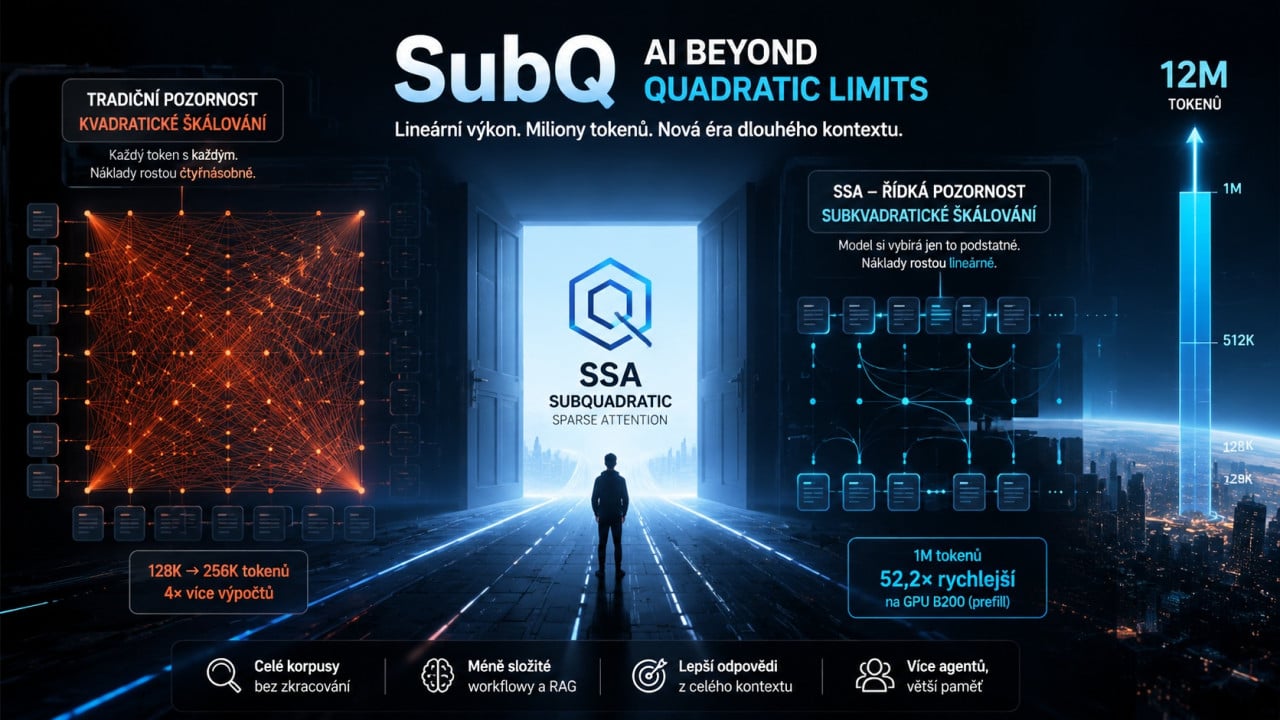
The company emerged from stealth with a claim that part of the research community greeted with genuine curiosity and part with open skepticism: its SubQ 1M-Preview model is said to be the first large language model built on a fully subquadratic architecture, where computational costs grow linearly with context length. At 12 million tokens, the company says this means an almost thousandfold reduction in attention computation compared with other state-of-the-art models.
What does quadratic scaling mean?
Under normal operation, every token in a text is compared with every other token. Double the input length? The cost does not quadruple only in a metaphorical sense; it actually quadruples. This mechanism is called attention and forms the foundation of all transformer models.
The industry has been struggling with this for years. Developers build entire stacks of workarounds on top of models: RAG systems retrieve only a small portion of the relevant data because sending an entire data corpus to a single model is simply not feasible. Strategies have emerged for splitting text into smaller sections, multi-agent orchestration, and prompting techniques. “I used to manually fine-tune prompts, retrieval systems, conditional logic, and connect workflows. That wastes human intelligence while also limiting the quality of the results.” Subquadratic CTO Alexander Whedon said.
The standard limit for models available today is 128,000 tokens, while leading cloud models such as Claude Sonnet 4.7 or Gemini 3.1 Pro reach up to one million. SubQ is talking about 12 million.
SSA technology skips computations that do not matter
The technology behind SubQ is called SSA, short for Subquadratic Sparse Attention. The principle is simple to describe but difficult to implement: instead of comparing every token with every other token, the model itself decides which comparisons are worth performing. And this decision depends on the content, not on a fixed position in the text.
The result? According to the company’s own figures, on a B200 GPU SSA achieves a 7.2-fold speedup in the prefill phase compared with standard attention at 128,000 tokens. It also achieves a 13.2-fold speedup at 256,000 tokens, 23-fold at 512,000 tokens, and 52.2-fold at 1 million tokens. The longer the context, the greater the advantage. This is precisely the reversal that Subquadratic presents as the foundation of its approach.
The company trained the model in three phases: pretraining, supervised fine-tuning, and a reinforcement learning phase focused specifically on failures involving long-context processing. That final part is important. As the company’s technical blog explains, models tend to answer based on nearby context because it is easier to use, even when the key evidence appears much earlier in the text. SSA suppresses this tendency.
The benchmarks look great, but...
On paper, SubQ competes with models from organizations that spend billions. On SWE-Bench Verified, a test of real-world software tasks from GitHub, SubQ achieved 81.8%, compared with 80.8% for Opus 4.6 and 80.0% for DeepSeek 4.0 Pro. On RULER at 128,000 tokens, SubQ scored 95%, while Opus 4.6 achieved 94.8%. On MRCR v2, a demanding test of multi-level retrieval across long contexts, SubQ scored 65.9%, compared with 26.3% for Gemini 3.1 Pro and 32.2% for Claude Opus 4.7.
However, the choice of these three tests is no coincidence. All of them emphasize exactly what SubQ is designed for: long contexts and programming. The company has not published broader evaluations of general reasoning, mathematics, multilingual performance, or safety. A complete model overview is reportedly “still premature.” Moreover, there is a 17-point gap between the research result of 83 points on MRCR v2 and the verified production version’s 65.9 points, which remains unexplained. Each benchmark was run only once because of the high cost of inference, with no statistical confidence intervals.
The company also claims that it achieved 95% accuracy on RULER 128K for $8, while Claude Opus cost approximately $2,600 for comparable performance. Without published API pricing, this cannot yet be verified.
The research community is divided
A few hours after the announcement, discussions exploded. Commentator Dan McAteer summed it up in one sentence: “SubQ is either the biggest breakthrough since the transformer, or it is the Theranos of AI.” The comparison to the infamous Theranos fraud may be an exaggeration, but it captures the tension in the air.
Experienced engineer Will Depue wrote that SubQ is “almost certainly sparse attention fine-tuned on top of Kimi or DeepSeek,” meaning that the company merely fine-tuned an existing open-source model. Whedon confirmed this: the company does indeed use the weights of open-source models as a starting point, due to its limited funding and stage of development. Depue then intensified his criticism, arguing that the claims of O(n) scaling and the reported speedup figures “simply do not add up” and describing the messaging as “extremely poorly presented, or simply false.”
Others point to a structural question: if SubQ really reduces computation a thousandfold and costs less than 5% of Opus’s price, why is access limited to early access? Developer Stepan Goncharov described the benchmarks as “very deliberately selected,” while another commentator called them “suspiciously perfect.”
On the other hand, researcher John Rysana rejected the Theranos comparison as exaggerated. He wrote that this is “subquadratic attention done well, which is highly meaningful for long-context work,” and that the chances of it being a fraud are, in his view, “extremely low.”
Magic.dev promised the same thing. Then it went quiet.
Perhaps the most telling context for evaluating SubQ comes not from benchmark tables, but from recent history. In August 2024, Magic.dev announced a model with a 100-million-token context window and claimed a 1,000-fold increase in efficiency. On that basis, it raised approximately $500 million. By early 2026, there is no public evidence that anyone is actually using LTM-2-mini.
The parallels are striking. Both companies claimed enormous context windows. Both mentioned an approximately thousandfold increase in efficiency. Both primarily targeted software engineering. Both launched products with limited external access.
And that is only one chapter in a longer story. Kimi Linear, DeepSeek Sparse Attention, Mamba, and RWKV all promised subquadratic scaling. They all encountered the same problem: architectures that are theoretically linear lag behind quadratic attention on real-world tasks at large scale. Or they ended up as hybrid models that combine subquadratic layers with standard attention, thereby losing the pure scaling advantages.
Subquadratic does not ignore this legacy. The company’s technical blog discusses every previous approach by name and argues why SSA avoids their weaknesses. Whether that is actually the case can only be confirmed through independent verification.
The team, the money, and the open questions
The company is led by CEO Justin Dangel, a five-time founder with a background in healthcare technology and consumer goods, and CTO Alexander Whedon, formerly a software engineer at Meta and head of generative AI at TribeAI. The team includes 11 PhDs with backgrounds at Meta, Google, Oxford, Cambridge, ByteDance, and Adobe.
Subquadratic raised $29 million in a funding round. Investors include Tinder co-founder Justin Mateen, former SoftBank Vision Fund partner Javier Villamizar, and early investors in Anthropic, OpenAI, Stripe, and Brex. According to The New Stack, the company’s valuation is around $500 million for a seed-stage company with no published research, no peer-reviewed scientific paper, and no disclosed revenue.
The company does not plan to release the model weights as open source, but it wants to offer enterprises tools for their own fine-tuning. By the end of 2026, it is targeting a context window of 50 million tokens.
Whedon responded quickly to the technical criticism and published a detailed technical blog post. This signals a team that understands that merely describing the results is not enough; it must substantiate them. However, the technical report is still labeled “early.”