

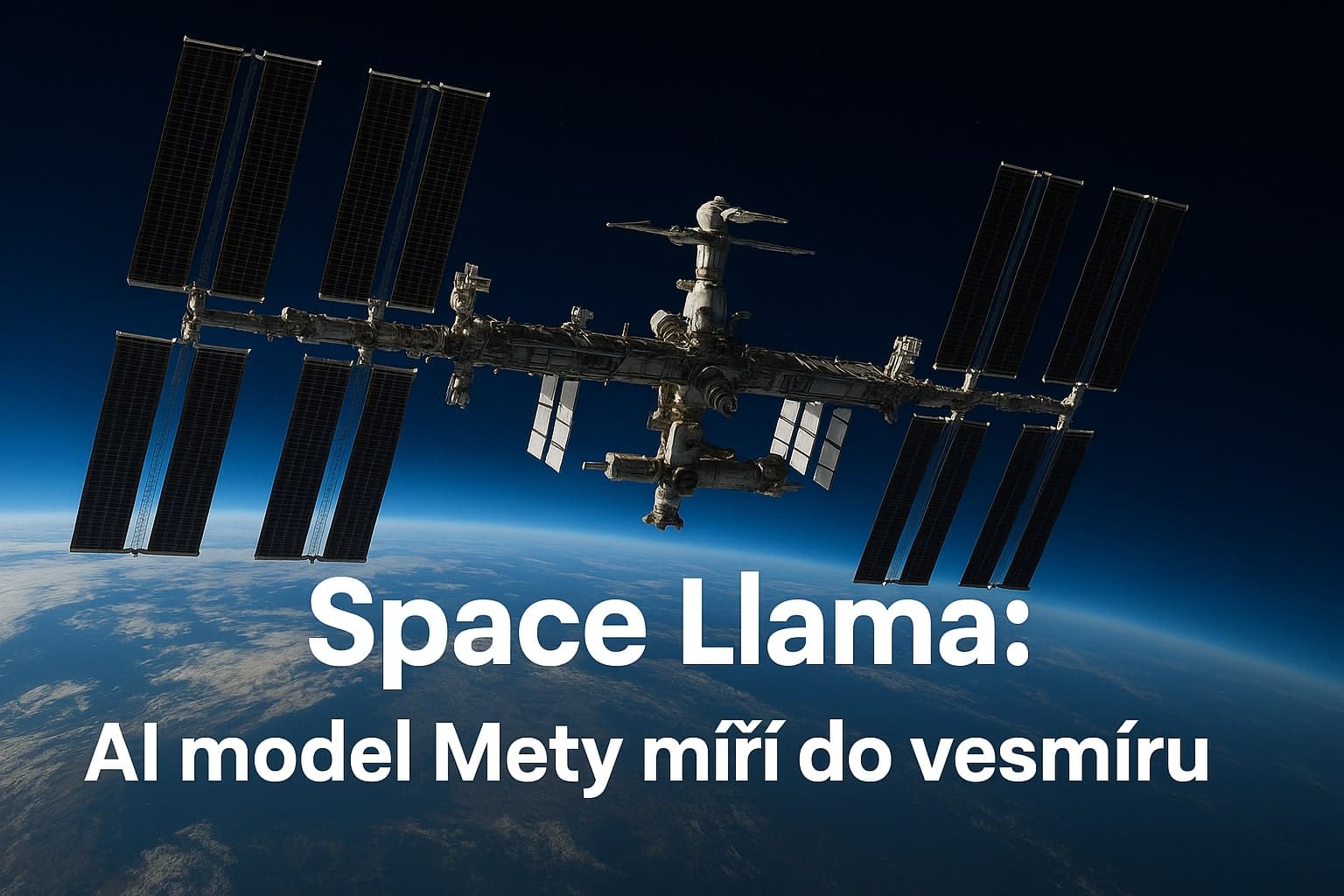
New technology for space missions launched in April 2025
In April 2025, Meta and Booz Allen Hamilton announced a significant technological breakthrough—the first deployment of a multimodal AI model aboard the International Space Station (ISS). The system, called "Space Llama", is based on Meta's open-source Llama 3.2 model.
Technological foundation and key capabilities
Space Llama is not merely an ordinary language model—it is an advanced multimodal system capable of processing both text and visual information. This capability allows astronauts to analyze technical diagrams, diagnose equipment problems, and access manuals without having to rely on an internet connection to Earth. "This system is a shift in how astronauts work in space," said John Doe, the project's lead researcher. "By combining text and visual processing, Space Llama can assist with tasks ranging from identifying components to complex diagnostic procedures. "Technically, Space Llama is deployed on a Hewlett Packard Enterprise (HPE) Spaceborne Computer-2 using NVIDIA CUDA graphics processors. This configuration enables real-time processing with minimal energy consumption—which is absolutely crucial in an environment with limited energy resources, such as the ISS.
Offline functionality is crucial
One of Space Llama's most significant features is its ability to operate completely independently of communication with Earth. This function is critical during missions when communication may be interrupted or delayed due to distance. "As astronauts travel farther from Earth, communication delays increase. The Space Llama model provides immediate support without the need to wait for instructions from mission control," explains Susan Smith, technical director at Booz Allen Hamilton. "This is essential for future missions to the Moon and Mars, where autonomy will be even more important." The system also significantly reduces operating costs by replacing paper documentation and reducing dependence on instructions from Earth. Astronauts can quickly assess problems, find solutions, and carry out repairs without waiting for directions from mission control.
Collaboration at the cutting edge of technology
Space Llama was created as a result of collaboration between several technology leaders. Its technological foundation consists of:
- Booz Allen Hamilton's modular A2E2™ (AI for Edge Environments) platform
- A modified version of Meta's open-source Llama 3.2 model
- HPE's Spaceborne Computer-2 hardware
- NVIDIA CUDA software acceleration
"This collaboration builds on our success from August 2024, when we first deployed large language models in orbit," said Michael Johnson, president of the national security division at Booz Allen Hamilton. "We have now expanded these capabilities with advanced visual processing, enabling even broader use in the space environment." Susan Jones, vice president of AI at Meta, added: "Our open-source approach to AI development brings benefits to many industries, but seeing Llama 3.2 on the ISS is particularly exciting. It demonstrates the true potential of multimodal systems in the most demanding environments."
Space Llama represents an important step toward autonomous operations in space:
- Support for critical missions: It enables astronauts to quickly assess problems, find solutions, and carry out repairs without waiting for instructions from mission control.
- Foundation for future exploration: The technology paves the way for missions to the Moon and Mars by demonstrating how compact AI systems can operate reliably in the edge, disconnected, or low-power environments typical of deep-space exploration.
- Broader applications: Beyond spaceflight, this innovation could benefit industries such as oil and gas extraction or remote infrastructure management, which require robust edge computing solutions in isolated locations.
"The successful deployment of Space Llama in 2025 is not the end, but the beginning of a new era of AI in space," said Robert Brown, a space analyst. "Over the next five years, we expect similar systems to become a standard part of every space mission, not only in orbit but also beyond."
The successful demonstration sparked optimism about commercial opportunities at the intersection of AI and space exploration. For investors: "Meta shares rose 6.32% in the week of the announcement," reflecting confidence in its expanding role in the space AI technology sector. Booz Allen is also well positioned to secure future contracts supporting national security initiatives involving autonomous systems beyond Earth's orbit.
As David Williams, director of NASA's space operations, added: "Space Llama is not just a technological curiosity, but a practical tool that is changing how we conduct space missions. It is another step toward making humanity a truly multiplanetary species."


