American entrepreneurs have come up with an idea that only a few years ago sounded like the plot of a science fiction movie. Data centers in Earth orbit, powered by sunlight, without overheating issues and with a virtually unlimited energy supply. Startup Cowboy Space Corporation has just announced the completion of a $275 million funding round at a $2 billion valuation. And it has a concrete plan for achieving this goal.
The company’s founder and CEO, Baiju Bhatt, is no newcomer. He is also behind the Robinhood trading app, which brought millions of retail investors to the U.S. markets. This time, however, he has turned his attention to physics and space.
From solar energy to AI computing power
The company was originally founded in 2024 under the name Aetherflux with the goal of collecting solar energy in space and transmitting it to Earth. Over time, however, Bhatt and his team realized that it made the most sense to consume this energy directly where it is generated: in orbit.
The catalyst was the explosive interest in artificial intelligence. Data centers on Earth face two problems at once: a shortage of electrical power and cooling challenges. Conditions in space are different. The sun shines continuously without atmospheric attenuation, and heat can be dissipated into the surrounding space without the need for cooling towers or enormous air-conditioning systems.
The company plans to launch its first satellite later this year to test the transmission of energy from orbit to Earth using infrared lasers. It is a technology demonstrator—or, as Bhatt himself described it, "a building block, but in the long term, we are interested in using that energy in orbit for AI computing, not just transmitting it down."
A rocket as a data center: an idea that changes the entire architecture
Cowboy Space does not want to merely launch satellites into orbit. The company has decided to build its own launch vehicle. Why? Bhatt approached a number of launch providers but found none with sufficient capacity or economics that made sense. "The rocket market is extremely constrained for the next three to four years, and the leading rocket operators will prioritize their own payloads," he said. Simply put: SpaceX will primarily launch for itself. Blue Origin will do the same. Third parties will be left with the scraps.
Cowboy Space therefore came up with an idea unlike anything else in the space industry. Instead of becoming discarded waste after deploying its payload, the rocket’s upper stage will become the data center itself. Each upper stage will remain in orbit and become a data center with a capacity of 1 megawatt. The stage’s structure will also serve as a radiator.
"A first-principles approach," in Bhatt’s words. He did not take a terrestrial data center and adapt it for space. He designed the entire system from scratch to operate optimally there. The planned rocket will be larger than SpaceX’s Falcon 9 (which stands 70 meters tall), but smaller than Starship. Its target payload capacity is 20 to 25 metric tons to orbit. Cowboy Space plans the first launch of its own rocket before the end of 2028.
NVIDIA in space and a team of SpaceX and Blue Origin veterans
Cowboy Space has partnered with Nvidia to deploy NVIDIA Space-1 Vera Rubin modules, AI computing hardware adapted to the conditions of low Earth orbit. Each data center will accommodate approximately 800 graphics cards.
The company plans to deploy its first "Galactic Brain" node, its first orbital data center, in early 2027.
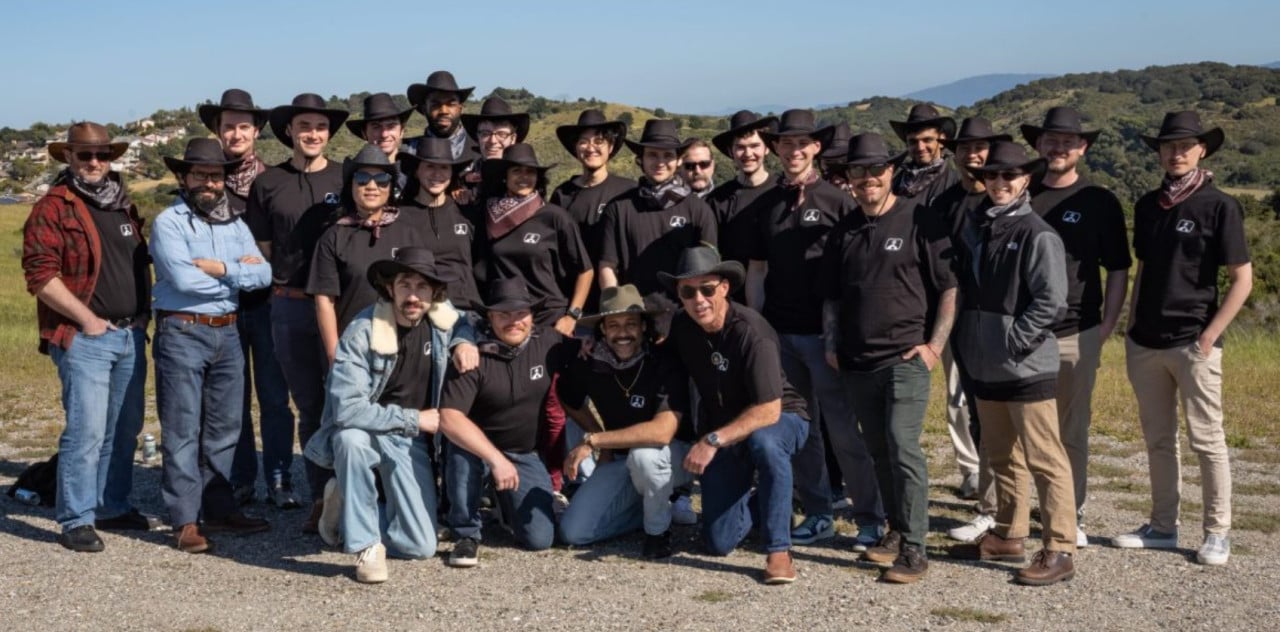
The team behind the project includes Tyler Grinnell, former director of launch operations at SpaceX, and Warren Lamont, who led the development of rocket engines and the rocket’s lower stage at Blue Origin. The company is developing its own rocket engine in-house. Satellite engineering takes place in Seattle, while engine development is based in Los Angeles.
"We are designing the launch vehicle, upper stage, and orbital computing platform as a single integrated system optimized specifically for AI infrastructure in orbit," Bhatt says. The company does not intend to use any external suppliers for the core architecture.
A crowded market and a race that is only just beginning
Cowboy Space is not the only company targeting this market. Startup Starcloud reached a valuation of more than one billion dollars last year following a $170 million funding round and is now seeking at least another $200 million. SpaceX and Blue Origin are also considering orbital data centers. AI company Anthropic recently expressed interest in using SpaceX’s orbital data centers.
Google is working on Project Suncatcher, although it is targeting the mid-2030s instead. Starcloud currently plans to use SpaceX’s Starship. Bhatt sees this dependence on external rockets as a key weakness of competitors.
So far, the startup has not launched a single satellite, has not filed any full applications with the Federal Communications Commission, and its rocket program is only just getting underway. Bhatt, however, sees this clean slate as an advantage. "We are focused on demonstrating capabilities before moving to full commercial services."
Sources: techcrunch.com, spacenews.com and cryptobriefing.com