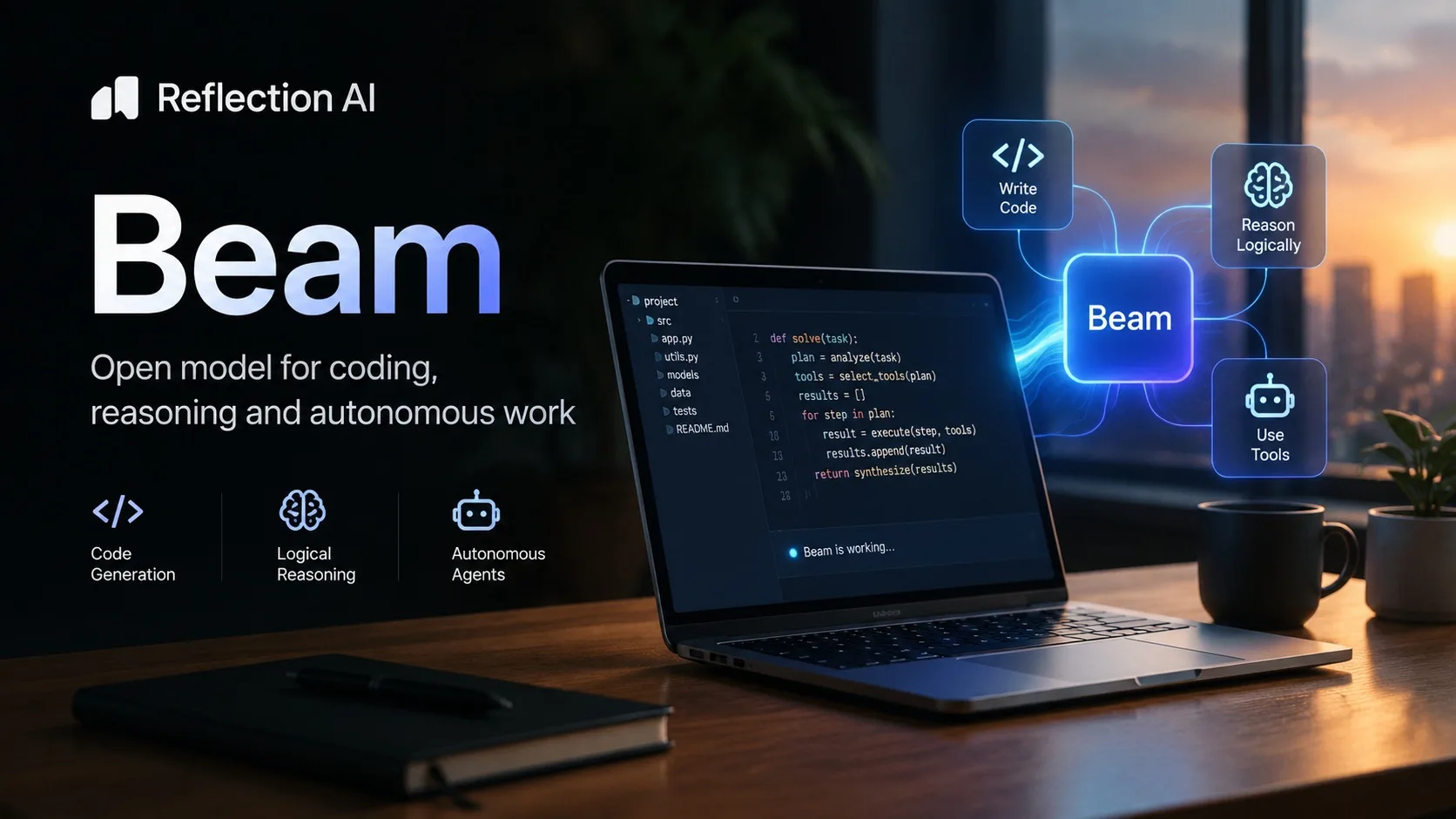
American startup Reflection AI has unveiled its first large language model. It is called Beam, and the company plans to offer it as an open model, allowing anyone to download it, run it on their own computer, and customize it to their needs. The model focuses primarily on coding, logical reasoning, and tasks in which artificial intelligence works independently and uses external tools on its own. According to the company, Beam matches the performance of open Chinese models while requiring significantly less computing power.
Less Talk, More Results
Beam is a large model. It has more than 500 billion parameters in total. However, it does not use all of them at once for every response. It works like a team of specialists, with only the most qualified ones engaged for each piece of text. In practice, about 23 billion parameters operate at any one time, which is only a small fraction of the total. This makes Beam faster and cheaper to use. By comparison, the Chinese GLM-5.2 model from Z.ai has roughly 744 billion parameters and activates around 40 billion of them while working.
The model can work only with text; it cannot directly process images or audio. However, it can retain an enormous amount of information at once, such as an extensive software project or long documents. This capacity is technically known as the context window, and Beam's context window is one million tokens.
Reflection also trained Beam to be economical with words. The model was rewarded for correct solutions but lost points when it generated unnecessarily lengthy internal reasoning. Early in its training, it therefore learned to complete tasks more directly. Later, as it mastered more complex work, it began reasoning at greater length again, but this time the longer analysis genuinely helped it achieve better results. Users can adjust this balance themselves. At a lower reasoning level, the model responds briefly and quickly, while at a higher level it takes more time for demanding tasks. Users can therefore choose their preferred balance between speed, cost, and quality.
The company sees this efficiency as its model's main advantage. According to Reflection, Beam achieves results similar to GLM-5.2 in logical reasoning tests while using three to four times less computing power. The difference is reportedly even more pronounced with larger models, such as China's Qwen 3.8-Max, which has more than two trillion parameters. The most powerful Chinese models, such as Kimi K3, still have an advantage in raw performance. Reflection is therefore positioning its model as a reliable worker for businesses, government agencies, and developers.
It Even Learned What No One Taught It
The company points to one unexpected development. During training focused on programming and command-line work, the model also improved at searching the internet, even though it had not been given any such tasks. When it was later granted web access, it figured out on its own that it could search for information, query other language models, and analyze documents using text-recognition tools.
Reflection also demonstrated several examples. Beam, for instance, created a live map of the New York City subway using publicly available transit authority data. It found the documentation itself, worked out how to authenticate with the data service, and programmed the entire application, including a server that continuously updates the map. It also created a three-dimensional game in which an astronaut falls toward Earth while avoiding asteroids. Although the model cannot process graphics, it was able to conceptualize the game's appearance entirely in text.
In another demonstration, Beam independently prepared and carried out the fine-tuning of Google's small Gemma 4 model to convert ordinary queries into the SQL database language. This increased the smaller model's success rate by roughly two-thirds.
Founded by DeepMind Veterans and Funded by Nvidia
The company intends to offer the model primarily to businesses and governments. It is attracting them with so-called artificial intelligence factories—local systems that institutions can train on their own data. According to Axios, interested parties include funds and trading firms. Reflection is already testing a similar project with the South Korean Shinsegae Group.
Reflection plans to release the model weights in October under the permissive Apache 2.0 license, together with documentation and tools for running, testing, and modifying the model. Beam is intended to be the first in an entire series of models, and the company is already working on the next one. For now, only a limited group of people has access to it, but Reflection intends to release the complete model before the end of October.
The startup was founded in 2024 by two former Google DeepMind researchers. According to the PitchBook database, the company has raised roughly $4.7 billion from investors including Nvidia, Sequoia Capital, and Lightspeed Venture Partners. In the most recent funding round, investors valued the company at $25 billion. Nvidia CEO Jensen Huang has long championed the idea of artificial intelligence factories; after all, his company would supply the chips on which such systems would run.
Reflection has also secured the computing power it needs for years to come. This summer, it signed contracts with SpaceX and Nebius worth more than $7 billion in total, guaranteeing it access to Nvidia GB300 chips through 2029.
Sources: reflection.ai and techcrunch.com