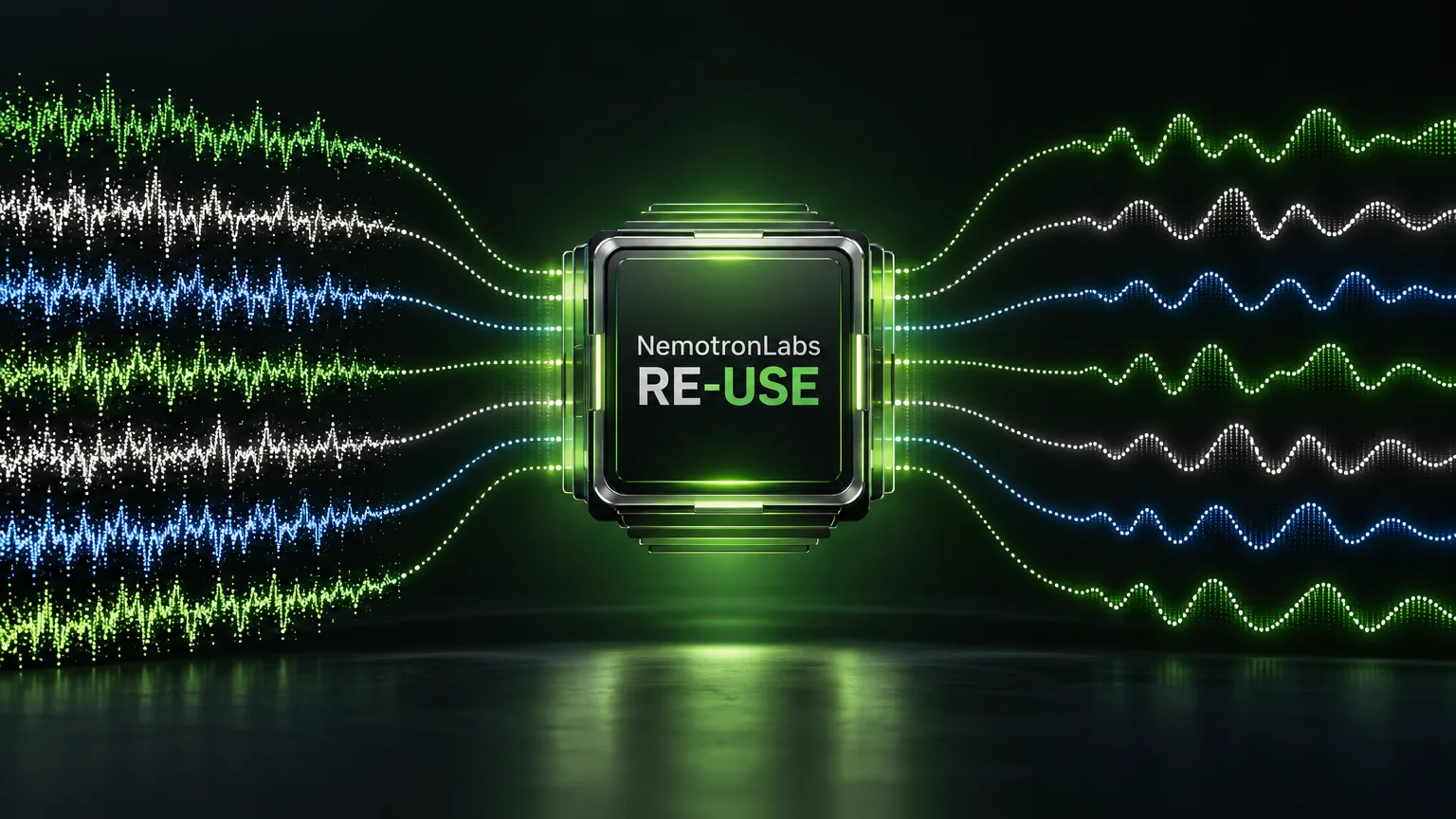
Nvidia has released NemotronLabs RE-USE, an open multilingual model for cleaning up speech recordings. It is designed to remove noise, reverberation and other defects while preserving intelligibility and speaker identity. A single checkpoint, or set of model weights, accepts recordings at seven sample rates.
One checkpoint for different recordings
RE-USE is designed to clean speech affected by problems such as noise, reverberation, clipping and codec artifacts. It also addresses defects associated with packet loss and microphone distortion. It supports sample rates of 8, 16, 22.05, 24, 32, 44.1 and 48 kHz without a separate checkpoint for each one.
When voices overlap, the training target is to preserve the main speaker and suppress the others. Separate source separation or diarization tools are needed to retain or identify every speaker. For applications that need to preserve laughter more effectively, Nvidia provides a related checkpoint called NemotronLabs RE-USE-laughter.
Comparison with larger models
The model has 9.6 million parameters, and its FP32 weights occupy approximately 38.4 MB before packaging. Nvidia compared it on the URGENT 2025 non-blind test set with models including Sidon, which has 250 million parameters, and UniPASE, which has 500 million.
According to Nvidia, RE-USE scored 2.57 on PESQ, a measure that estimates perceived speech quality. UniPASE scored 2.17 and Sidon 1.73. On STOI, which estimates intelligibility, the respective scores were 0.78, 0.76 and 0.62.
In the same results, Nvidia reports a speaker similarity score of 0.86 and speech-recognition character accuracy of 89.17% for RE-USE. UniPASE scored 0.81 and 87.28%, while Sidon reached 0.74 and 84.68%. RE-USE did not lead on every measure: Sidon scored higher on some UTMOS and DNSMOS perceptual quality predictors.
Other published results at 16 kHz show speech-recognition character accuracy rising from 76.5% for noisy input to 87.1% after cleanup. On the 44.1 kHz subset, RE-USE achieved a speaker similarity score of 0.90, compared with 0.57 for Resemble Enhance.
Mamba architecture and training data
The model places a 30-layer bidirectional Mamba core between a convolutional encoder and decoder. The encoder converts audio into the model’s internal representation, and the decoder converts it back. Mamba’s sequence-modeling computational cost grows linearly with sequence length.
Nvidia trained the model on approximately 2,500 hours of synthetic mixtures containing speech in English, German, Spanish, French and Mandarin. The company describes it as language-agnostic.
Sources of clean training speech included LibriVox, LibriTTS and Common Voice, while noise came from AudioSet and Freesound. Training also incorporated approximately 60,000 simulated room impulse responses and 70 microphone impulse responses.
Demo and running the model
The model card lists the OpenMDW 1.1 license and describes RE-USE as ready for commercial use. Nvidia’s previous checkpoint had noncommercial terms. The company also offers a hosted demo for trying individual files.
The standard script reads files from the noisy_audio/ directory and saves cleaned audio to enhanced_audio/. For recordings longer than 30 seconds, the repository offers inference_chunk.sh, which splits audio into overlapping segments to manage GPU memory use.
The published inference path targets Nvidia Ampere GPUs, specifically the A100, and uses Triton acceleration.