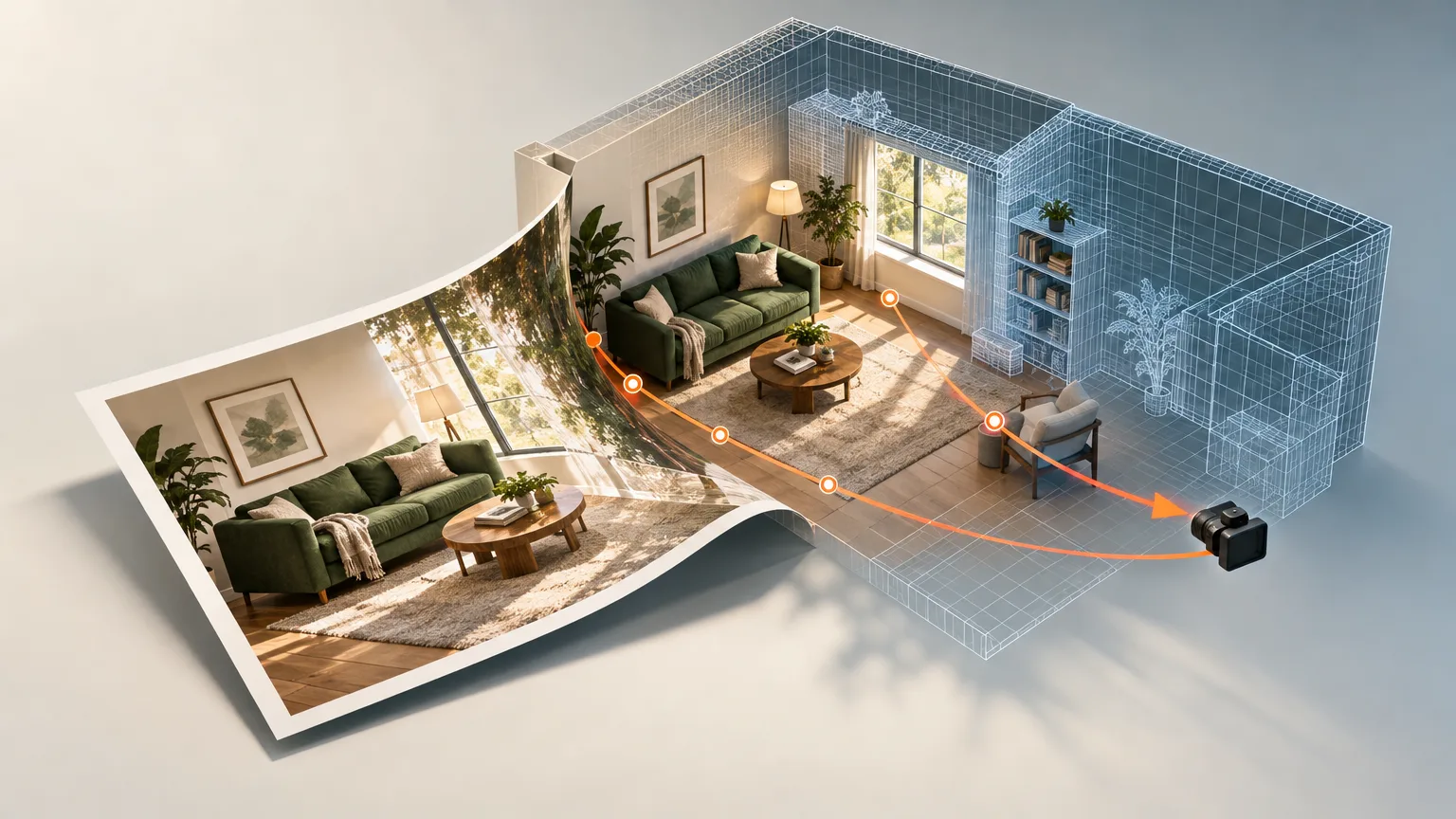
NVIDIA’s Spatial Intelligence Lab has released Lyra 2.0, a system that creates explorable 3D environments from a single photograph. Users choose a camera path, and the system generates a walkthrough along it before converting the result into a form suitable for rendering or simulation.
From a photograph to a walkthrough
The input is an image with a resolution of 480 × 832 pixels. In an interactive 3D explorer, users select camera positions and viewing directions and can add a text description of the scene. NVIDIA recommends generating 81 frames per segment.
A video diffusion model based on WAN-14B creates views along the chosen path, including parts of the space that are not visible in the original photograph. A reconstruction network then converts the resulting frames into explicit 3D geometry.
The output can take the form of 3D Gaussian splats, suited to fast rendering of new viewpoints and interactive exploration. Alternatively, Lyra can produce polygonal surface meshes that can be edited and used in simulation tools.
Memory for revisiting locations
Longer walkthroughs need to account for places the camera has already left. Lyra uses a continuously updated 3D memory for this purpose. Its records contain a full-resolution depth map, camera parameters and a downsampled point cloud.
At a new camera position, the system projects stored point clouds into the target view and accounts for occluded areas. It then returns the most visible earlier frames to the model, along with correspondences between the old and new viewpoints.
Another part of the approach targets errors that accumulate between segments. During training, the diffusion transformer receives deliberately degraded versions of its previous outputs and learns to remove the resulting artifacts.
Simulation uses and geometric limits
Exported scenes can be used in NVIDIA Isaac Sim. Gaussian splats provide the environment’s visual appearance, while polygonal meshes can be prepared as collision surfaces. Intended uses include creating environments for navigation and training robot control policies.
The system estimates hidden rooms and surfaces rather than measuring them, so the geometry is approximate. Generated meshes can also have incomplete surfaces or topology that needs repair.
A mesh export does not provide ready-made physical properties. Setting up collisions, mass, materials, joints and semantic labels requires further work.
Compute requirements and access
NVIDIA says generating an 80-frame video takes about nine minutes on a single H100 GPU with 80 GB of memory, followed by roughly one minute for 3D reconstruction. A distillation LoRA adapter is available for faster inference; it can be loaded alongside the base model and reduces diffusion sampling to four steps.
Lyra 2.0 is available as an open-source framework under the Apache 2.0 license, and NVIDIA says it can be used commercially. The release includes model weights and a repository with the interactive interface, training code, reconstruction pipeline and distillation LoRA. Production deployments also need to review the licenses for WAN-14B and other dependencies.
The system was accepted to SIGGRAPH Asia 2026, where the NVIDIA team plans to present it.