

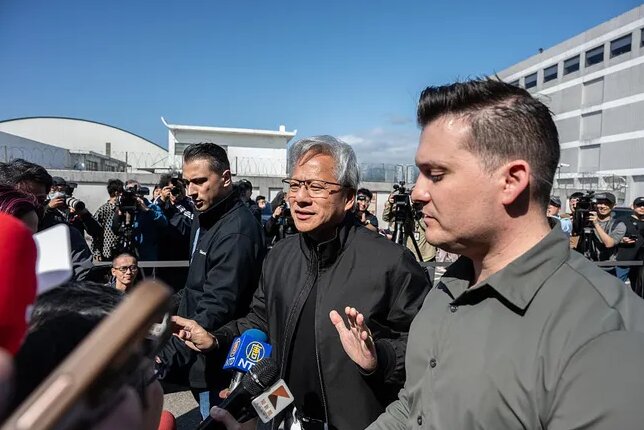
Nvidia CEO Jensen Huang on January 31 in Taipei firmly rejected reports that he was unhappy with OpenAI. According to him, the claims are "nonsense," and the company instead plans to invest a record amount in the creator of ChatGPT, likely the largest investment in Nvidia's history.
A $100 billion deal is not on the table
Huang spoke to reporters after the Wall Street Journal reported that the original plan to invest up to $100 billion in OpenAI (approximately CZK 2.3 trillion) had stalled. According to the newspaper's sources, Huang had privately emphasized in recent months that the original $100 billion agreement was non-binding and had not been finalized. In September 2025, Nvidia announced its intention to invest up to $100 billion in OpenAI, which would provide the company with the necessary capital and access to advanced chips that are crucial to maintaining its dominance in the increasingly competitive artificial intelligence market.
The Wall Street Journal also reported that Huang had privately criticized the lack of discipline in OpenAI's business approach and expressed concerns about the competition it faces from companies such as Alphabet (Google) and Anthropic.
"I love working with Sam," Huang says
When asked about these reports in Taipei, Huang categorically dismissed them as "nonsense." "We are going to make a huge investment in OpenAI. I believe in OpenAI, the work they are doing is incredible, they are one of the most consequential companies of our time, and I really love working with Sam," Huang said, referring to OpenAI CEO Sam Altman. "Sam is closing a funding round, and we will definitely participate," Huang added. "We will invest a large amount of money, probably the largest investment we have ever made."
Asked whether the amount would exceed $100 billion, Huang replied: "No, no, nothing like that." He added that it was up to Altman to announce how much funding he wanted to raise.
Amazon and other investors in the running
Reuters reported on Thursday, January 29, that Amazon was in talks to invest tens of billions of dollars in OpenAI, with the amount potentially reaching as much as $50 billion (approximately CZK 1.15 trillion).
According to earlier Reuters reports, OpenAI is seeking to raise up to $100 billion in funding, which would value the company at approximately $830 billion (about CZK 17.1 trillion).
According to Bloomberg, OpenAI is reportedly in talks with other potential investors for its funding round, which could value the company at more than $800 billion. Interested parties include SoftBank and leading investors from the Middle East. The Wall Street Journal also reported that OpenAI may be considering an IPO (initial public offering) in the latter part of 2026.
Concerns about circular financing
While so-called AI hyperscalers (cloud service providers) invest hundreds of billions of dollars annually to rapidly expand their capacity, concerns are emerging about so-called circular financing, which may obscure the actual return on capital.
OpenAI buys Nvidia chips as it adds computing capacity, while simultaneously receiving investments from the chipmaker. In a similar deal that attracted attention, Nvidia recently announced plans to invest another $2 billion (about CZK 41.2 billion) in cloud service provider CoreWeave, which is also a buyer of Nvidia chips.
A trillion-dollar dinner
Huang spoke to reporters outside a restaurant in Taipei after hosting all of Nvidia's key suppliers in Taiwan, including the world's largest contract chip manufacturer, TSMC. Taiwanese media dubbed the event a "trillion-dollar dinner" because of the combined market capitalization of the participating companies.
In September, Nvidia signed a letter of intent to invest up to $100 billion in OpenAI for new data centers and other artificial intelligence infrastructure. This infrastructure requires enormous amounts of computing power, electricity, and water—not to mention all the land, building materials, and labor needed to construct large-scale data centers.


