Meta’s FAIR (Fundamental AI Research) team has released a model called TRIBE v2. The acronym stands for TRImodal Brain Encoder. It sounds technical, but the principle is surprisingly easy to understand: you give it video, audio, or text, and it tells you how the human brain would respond.
An experiment became a universal tool
The previous version of the model, TRIBE v1, began as a competition project. The team trained it on brain scans from just four people and used it to win the international Algonauts 2025 competition, in which 263 teams competed.
TRIBE v2 is in a completely different league. Meta collected more than 1,000 hours of fMRI data from 720 volunteers. These people lay in a scanner and watched movies, listened to podcasts, and read texts. In other words, normal human activities rather than artificial laboratory stimuli. From all this, the model learned to recognize patterns of brain activity so accurately that it can predict the brain response of a person it has never scanned.
Yes, you read that correctly. It even works on people whose data it has never seen. This is called prediction without prior training (zero-shot prediction), and it is probably the most impressive feature of the entire project.
How can it predict your thoughts?
TRIBE v2 works in three steps. First, it processes the input: it analyzes video using the V-JEPA 2 model, audio through MERT, and text through LLaMA 3.2. These three “eyes and ears” capture the features of the content as perceived by artificial intelligence.
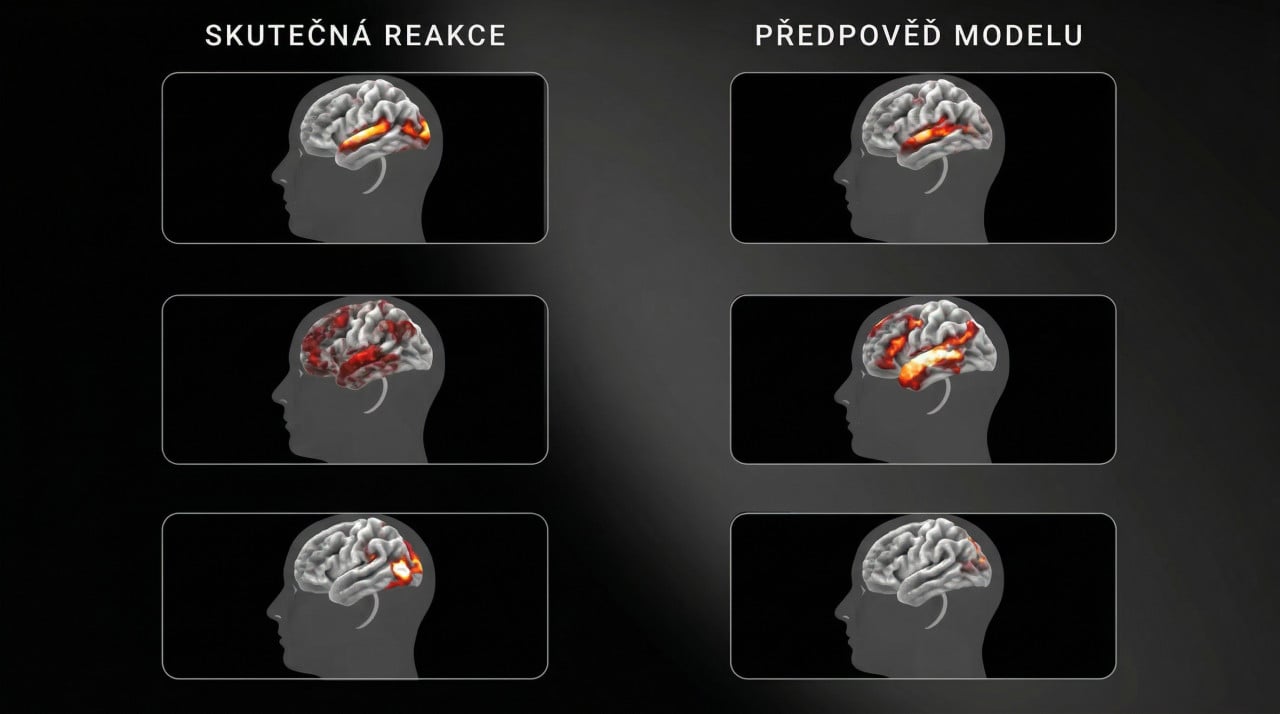
Then a transformer comes into play, combining all three streams of information into a single shared representation. Finally, a third layer translates this representation into a brain activity map containing roughly 70,000 points (known as voxels). Compared with the original version, that is a seventyfold increase in resolution.
And the result? When you show the model a movie trailer, you get a detailed map of which areas of the brain would light up, by how much, and in what order. And here is the slightly unsettling part: the model’s predictions are, on average, more accurate than an actual scan of a particular individual, because real fMRI also captures noise, head movements, and heartbeats.
Easier work for laboratories
A single fMRI examination costs thousands of dollars and takes hours. You need expensive equipment, trained staff, and a willing volunteer who can lie motionless inside a noisy tube. TRIBE v2 bypasses all of this. A researcher simply runs the model on a computer, enters a stimulus, and has a simulation of the brain’s response within seconds. Hypotheses that would previously have required months of laboratory work can now be tested in an afternoon.
For physicians and neuroscientists, this opens the door to faster testing of theories about neurological disorders. Instead of waiting for studies to be approved and recruiting dozens of patients, they can first test ideas “on a computer” and only take the most promising ones into the laboratory.
An article on Medium compares TRIBE v2 to the moment when Google published the paper “Attention Is All You Need” in 2017. At the time, hardly anyone paid attention to it. It looked boring and technical. Yet it gave rise to the transformer architecture, the foundation of today’s language models, ChatGPT, and the entire current wave of artificial intelligence.
It is possible that TRIBE v2 is a similar quiet starting gun. This time, not for chatbots, but for understanding human perception. If you can predict how the brain responds to content, you have a tool with enormous potential for medicine, education, interface design, and even media personalization.
Meta released all of it. For free.
The model, source code, research paper, and interactive demo. All under the CC BY-NC 4.0 license, meaning they are freely available for non-commercial use. The repository already has more than 1,100 stars on GitHub, and anyone can download the model weights from Hugging Face.
One enterprising developer even turned TRIBE v2 into an SEO tool designed to predict which parts of a web page will attract the human brain’s attention. Does that sound crazy? Maybe. But it shows where this kind of technology can go when you release it into the wild.
And so, while most attention revolves around language models and image generators, Meta has quietly built something that goes much deeper. Straight to the heart of how human perception works. And if this path proves viable, it will be one of the most fascinating attempts to connect artificial intelligence with the biological intelligence we carry inside our heads.