

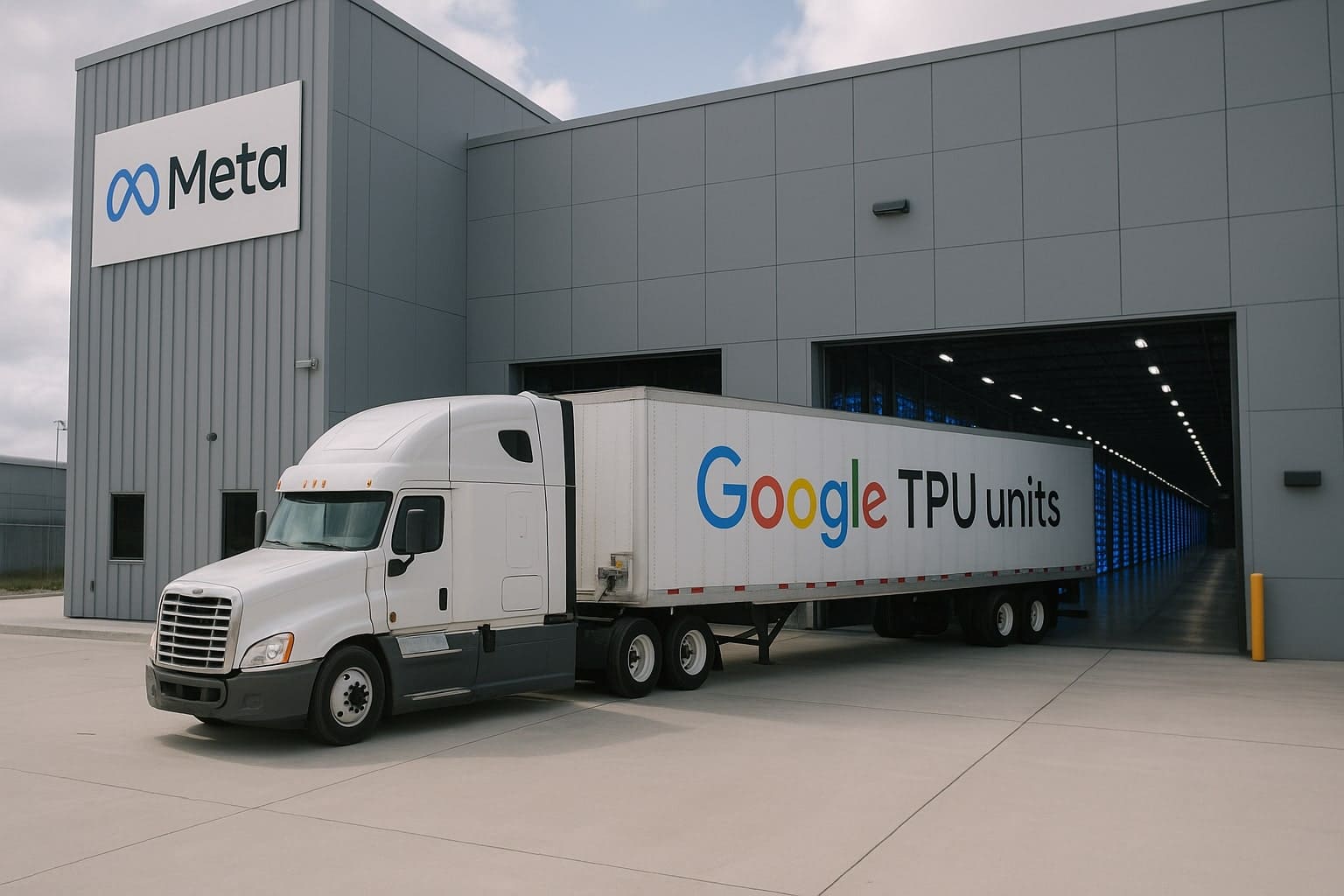
Meta, the company behind Facebook, is considering a major change to its artificial intelligence (AI) chip strategy. According to reports from The Information, Meta is in talks to purchase billions of dollars’ worth of Google tensor processing units (TPUs) for 2027. This could weaken Nvidia’s strong position in the market. The talks also include the possibility of Meta renting TPUs from Google Cloud as early as next year.
Reuters reports that such a deal would represent a major change for Google, as it has so far used its TPUs only in its own data centers. This shift comes as AI workloads grow and companies seek alternatives to Nvidia GPUs, which are often scarce and expensive.
Google is betting on its chips
If the deal between Meta and Google goes ahead, it will expand the market for Google’s proprietary chips and intensify competition in AI processors for data centers. Some Google Cloud executives believe this strategy could capture roughly 10% of Nvidia’s annual revenue, according to Reuters.
This speculation shook the stock market. Shares of Alphabet, Google’s parent company, rose by more than 4% in premarket trading on Tuesday, bringing its valuation closer to $4 trillion. Broadcom gained 2%, while Nvidia shares fell by more than 3%.
Winning Meta as a customer would be a huge success for Google. The social media giant plans to spend up to $72 billion (approximately CZK 1.656 trillion) this year, much of it on Nvidia hardware. A switch to TPUs would signal confidence in Google’s chips, which recently powered the well-reviewed Gemini 3 model.
Interest in proprietary AI chips is growing everywhere. For example, Anthropic expanded its agreement with Google last month to use up to one million TPUs.
Still, dethroning Nvidia will not be easy. Its CUDA software ecosystem has nearly two decades of development behind it and is relied upon by more than 4 million engineers worldwide.
Nvidia fights back
When Nvidia shares fell, the company responded to concerns about Google’s growth and speculation surrounding Meta. “We’re delighted by Google’s success – they have made great advances in AI and we continue to supply them,” Nvidia wrote on X.
Nvidia emphasized that it is a generation ahead of the entire industry. “It is the only platform that runs every AI model and does it everywhere computing is done,” the company stated. It highlighted the flexibility of its Blackwell-class GPUs compared with specialized chips such as Google’s TPUs. “Nvidia offers greater performance, versatility, and interchangeability than specialized chips.”
Google responded that it is seeing growing demand for both its TPUs and Nvidia GPUs. “Google Cloud is experiencing accelerating demand for both our custom TPUs and Nvidia GPUs; we are committed to supporting both, as we have done for years,” a Google spokesperson told CNBC.
Nvidia CEO Jensen Huang commented on competition from TPUs this month. He said Google remains a customer and emphasized that the Gemini model also runs on Nvidia hardware. Huang added that Google DeepMind CEO Demis Hassabis had sent him a message confirming that the “scaling laws” of AI – the principle that larger models trained on more chips produce better results – remain valid.
Impact on the stock market
Nvidia shares fell by as much as 7% on Tuesday before recovering to a decline of 4.3%. Alphabet rose 4.2% following a 6% rally on Monday. Broadcom, which helps Google design TPUs, rose by more than 1% after gaining 11% the previous day.
Google launched the first generation of TPUs in 2018, originally for its own use in its cloud business. Since then, it has released more advanced versions designed for AI workloads. TPUs are custom-built chips, which experts say gives Google an advantage because it can offer a highly efficient product for AI.
If Meta uses TPUs, it will be a major victory for Google and validation of the technology. Nvidia remains the leader with GPUs that form the foundation of much of the AI infrastructure. Its dominance is unlikely to change in the near future, but Google’s TPUs are adding further competition to the AI semiconductor market.
Shares of Advanced Micro Devices (AMD), previously seen as Nvidia’s main challenger, fell by 6%. Arm shares dropped by 4.2%. “There had been a sense that AMD could be number two in the market, but now it is clear that there may not be room for it,” Gil Luria, head of technology research at D.A. Davidson, told CNBC.
Companies building AI infrastructure are seeking diverse chip sources to reduce their dependence on Nvidia. Meta is among the biggest spenders, with planned expenditures of $70 billion to $72 billion (approximately CZK 1.61 trillion to CZK 1.656 trillion) this year.
These stock price movements come amid debates over whether an AI “bubble” is overvaluing technology companies. Nvidia is at the center of this debate and last week announced a better-than-expected sales forecast for this quarter, but technology stocks subsequently fell.
Nvidia holds more than 90% of the AI chip market, but with Meta exploring alternatives and Google pushing forward, 2027 could look completely different from today.


