

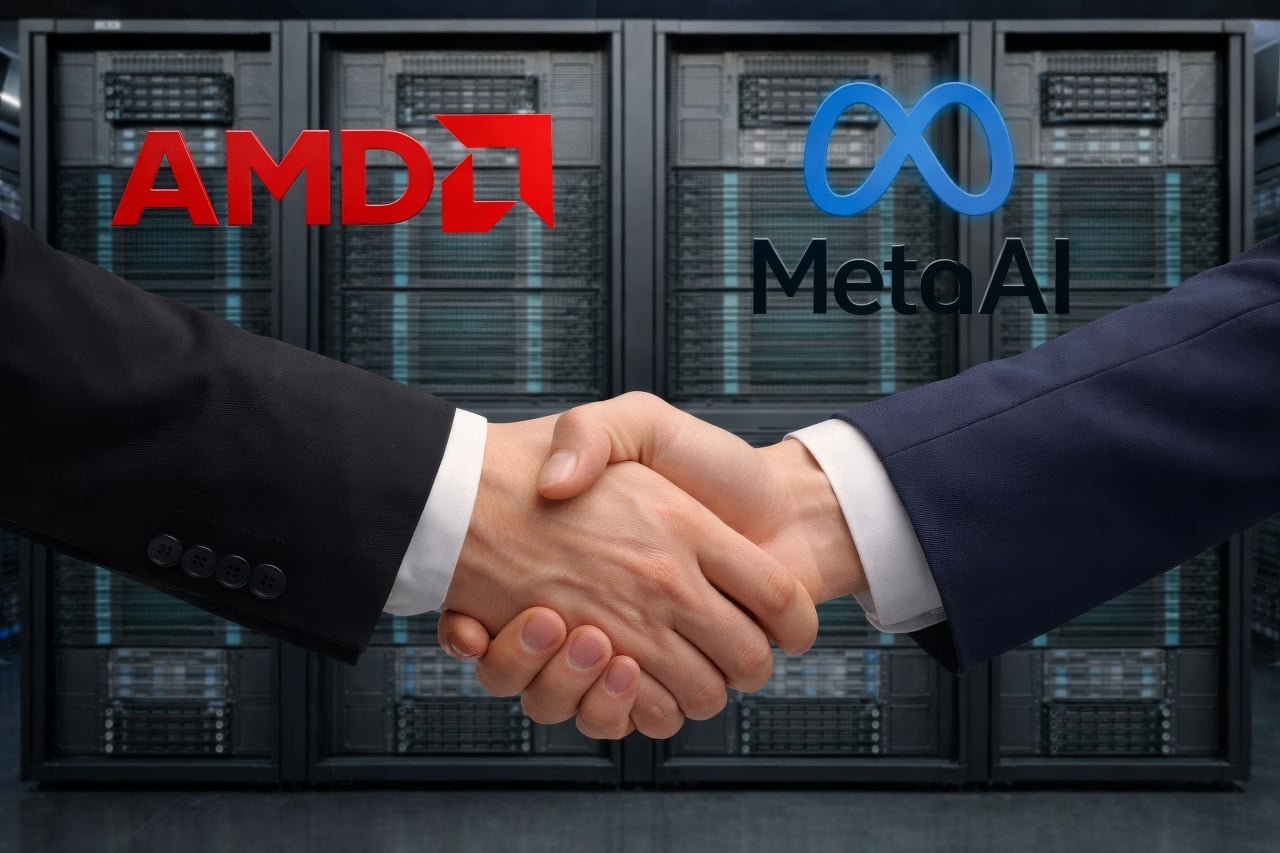
First, Meta announced an expansion of its partnership with Nvidia and the deployment of millions of its processors. Then, barely seven days later, another deal followed. Meta and AMD signed a multi-year agreement to deploy up to 6 gigawatts of AMD Instinct GPUs for AI infrastructure. Zuckerberg does not want to depend on a single chip supplier.
Deal details
The figure of 6 gigawatts sounds abstract, but let’s put it into context. Creative Strategies analyst Ben Bajarin estimates that the deal is worth tens of billions of dollars and that its full deployment will take at least four years. It is the largest AI chip deal in AMD’s history.
The first GPU deliveries will begin in the second half of 2026. These will be custom chips based on the AMD Instinct MI450 architecture, optimized specifically for Meta’s workloads. The servers will run on the rack-scale AMD Helios architecture, which the two companies jointly developed through the Open Compute Project. In addition to GPUs, Meta will also deploy 6th-generation AMD EPYC processors code-named "Venice" and "Verano".
The deal also includes an interesting financial instrument: AMD granted Meta the right to purchase up to 160 million shares, representing roughly 10% of the company.
Why Meta is betting on AMD, not just Nvidia
Nvidia holds approximately 90% of the AI chip market, and its market capitalization exceeds $4.6 trillion. By comparison, AMD is valued at roughly $320 billion. Nevertheless, Meta is deliberately building what it calls a "portfolio-based approach", meaning a diversified portfolio of suppliers. Mark Zuckerberg put it plainly: "This is an important step for Meta as we diversify our computing capacity. I expect AMD to be an important partner for many years."
Meta does not want to end up in a situation where its entire AI strategy depends on a single supplier. The company is developing its own MTIA chips (Meta Training and Inference Accelerator), is negotiating with Google to deploy its TPU processors, and is now adding AMD as another piece of the puzzle. The more sources of computing power it has, the greater the flexibility and resilience of the entire infrastructure.
AMD finally in the spotlight
For AMD, this deal is groundbreaking. AMD CEO Lisa Su described it as one of the "most transformative deals" in the company’s history. AMD shares jumped 7% after the announcement. And no wonder. AMD signed a similar deal with OpenAI in October 2025, which also included the right to purchase 160 million shares. That was when AMD began to be discussed as a viable alternative to Nvidia. The deal with Meta reinforces that perception and takes it even further.
Helios, AMD’s rack-scale system, represents the first genuine large-scale competitor to Nvidia Grace Blackwell systems, which have been in enormous demand since 2024. And what is particularly interesting is that Meta will receive custom GPUs tailored to its needs. Analyst Bajarin points out that we have not yet seen anything like this from Nvidia. This flexibility could help AMD secure more major contracts.
Billions invested in AI
Meta plans to spend up to $135 billion on capital expenditures this year. It is building 30 data centers, 26 of which will be in the US. And AMD is at the center of it all. The partnership includes aligning development roadmaps across silicon, systems, and software. The two companies will jointly develop hardware and software so that they fit together seamlessly. ROCm software, EPYC processors, Instinct GPUs, and the Helios architecture together form an ecosystem intended to enable Meta to innovate faster than anyone else.
It could be said that AMD backed the right horse. And Meta bet on AMD. Who will ultimately benefit more? Only time will tell.


