

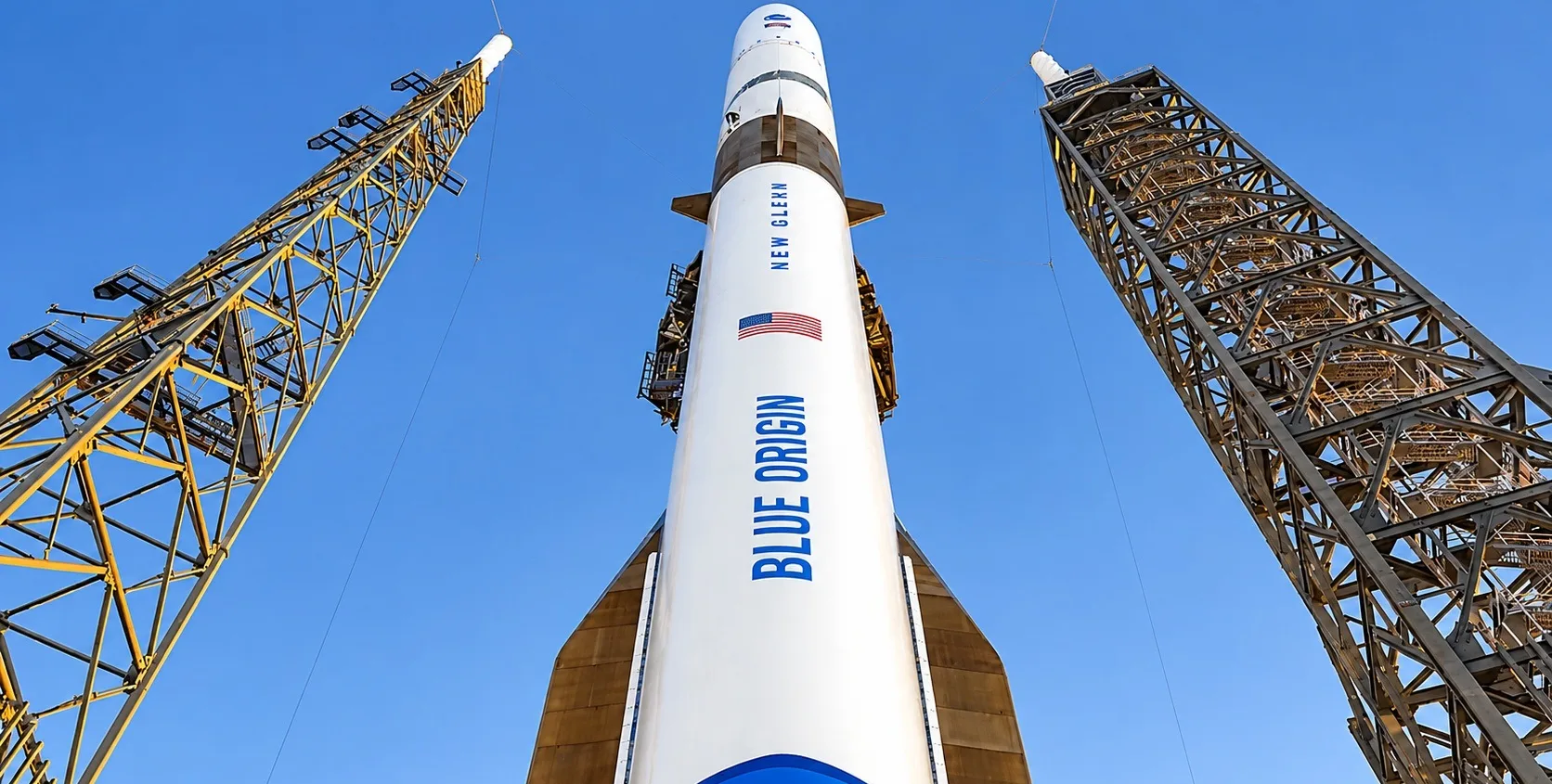
Google has chosen who will carry its satellites with artificial intelligence chips into orbit. Jeff Bezos’ Blue Origin announced that the technology giant selected its New Glenn rocket for Project Suncatcher, an experiment aimed at operating AI systems beyond Earth. The companies are planning the launch for the first quarter of 2029. It will be the first flight of the heavy-lift launch vehicle dedicated solely to this project, carrying several computing satellites.
Data centers in orbit
Artificial intelligence computing consumes enormous amounts of electricity, while terrestrial data centers require ever more land, energy, and cooling. Google is therefore testing whether some of the work could be handled by solar-powered satellites, easing the burden on power grids and cooling systems on Earth.
Each satellite will carry Tensor Processing Units, or TPUs, Google’s own chips designed to run artificial intelligence programs. Their computing power will be roughly equivalent to a single server rack in a conventional data center. The equipment will be sent into an orbit where it will be illuminated almost constantly, allowing the company to determine whether sunlight can power demanding computing tasks in space. Project head Travis Beals describes it as a long-term and highly ambitious plan to expand AI infrastructure beyond the atmosphere by harnessing the abundant energy available in orbit.
Why Blue Origin
The deciding factor was primarily the payload volume that New Glenn can carry. The rocket’s payload fairing has a diameter of seven meters and offers twice as much space as smaller fairings in the five-meter class. The first stage is designed for at least 25 flights. When announcing the agreement, New Glenn program head Jordan Charles emphasized that the rocket’s high payload capacity and spacious cargo area give customers the freedom to place new technologies into orbit. For Google, which wants to launch several units with the computing power of server racks at once, the large volume beneath the fairing is a practical advantage.
However, the technology giant is not switching launch providers entirely. The announcement does not mean that SpaceX has lost an existing contract or that Blue Origin will handle all future project launches. For now, the agreement covers a single launch, so Google is simply adding a second option for reaching space.
For Blue Origin, the contract comes at the right time. The company is trying to expand its launch business after delays and an explosion on the launch pad in May. The rocket has not flown since the accident, and its return has been postponed until January. The contract, signed three years in advance, gives the company a clear target around which it can plan and could help it attract additional customers.
A poem and laser links
Google already has some experience in orbit. A prototype launched on October 1 aboard a Falcon 9 rocket as part of the Transporter-18 rideshare mission, alongside more than one hundred other spacecraft. The company built it together with satellite operator Planet. The satellite carries four TPU processors and generates up to one kilowatt of power, enough to operate one chip for about twenty minutes.
After approximately three weeks of commissioning, the equipment responded to its first prompt. Google DeepMind’s Gemma 4 model ran on a TPU unit of the kind used in data centers and sent a short haiku about life beyond our planet back to Earth. The response arrived on October 30 as the spacecraft passed over Svalbard. The technology giant described it as the first-ever response from artificial intelligence running on hardware of this class in orbit.
A poem from space is more of an impressive demonstration; the real work is only just beginning. The mission is testing whether the electronics can withstand the forces of launch, radiation, and extreme temperatures. Engineers are also working out how to cool the hardware without the airflow they are accustomed to on Earth. Radiation can damage circuits and corrupt data, while heat from powerful components must be dissipated through pipes and panels because conventional cooling does not work there.
If the technology proves successful, Google will launch two more satellites with TPU chips in 2027. They will have more power and will test an optical link between them. Laser connectivity is essential to the entire concept because a single spacecraft could never match the performance of a data center. In the long term, the company envisions dense clusters of satellites, each carrying dozens of processors and communicating with the others by laser. Only then will a larger fleet be launched aboard New Glenn into a sun-synchronous orbit.
Space-based data centers are attracting more companies
Google does not have a monopoly on this idea. Elon Musk’s SpaceX and the startup Starcloud are also exploring computing nodes in orbit, as the growing use of AI drives demand for computing power and terrestrial infrastructure struggles to keep up.
Experts warn that the path to large-scale operations will be a long one. High launch costs, technical obstacles, and limited satellite production could delay the commercial use of orbital data centers by several years. Google has not yet announced a date for full-scale deployment, and the first major step aboard a Blue Origin rocket also depends on how New Glenn’s return to flight goes in January.
Sources: investing.com, pcmag.com and theinformation.com