Aeneas by DeepMind: AI That Helps Decipher the Secrets of Ancient Inscriptions
Google DeepMind has introduced a new AI model called Aeneas. It is designed to become historians' right-hand assistant and help them better understand the history of ancient Rome. It can reconstruct, date, and interpret fragments of Latin inscriptions very quickly and with maximum accuracy.
Aeneas: An Expert in Ancient Latin Texts
Artificial intelligence is helping in dozens of fields, from education and science to medicine and industry. Now it is also assisting historians, enabling them to better understand both political and everyday life in ancient Rome.
Inscriptions and texts were characteristic of Rome and can be found everywhere. Over time, however, many of them have been damaged, and the interpretation of often incomplete texts poses a challenge for historians.
Reconstructing them is crucial to gaining a better understanding of history. That is why Google DeepMind came to historians' aid and, together with several European universities, developed the Aeneas AI model, which has already achieved excellent results!
What Aeneas Can Do
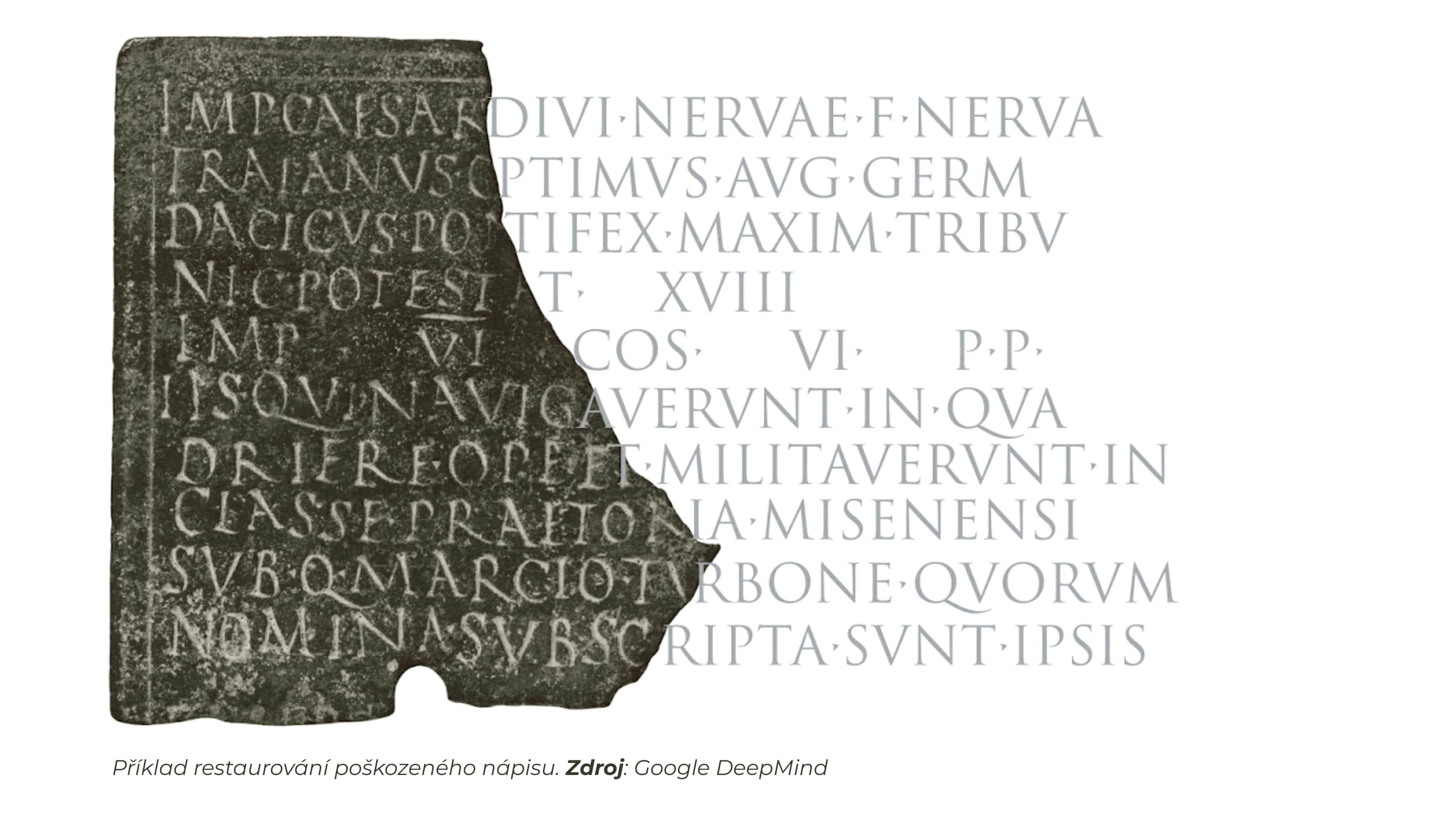
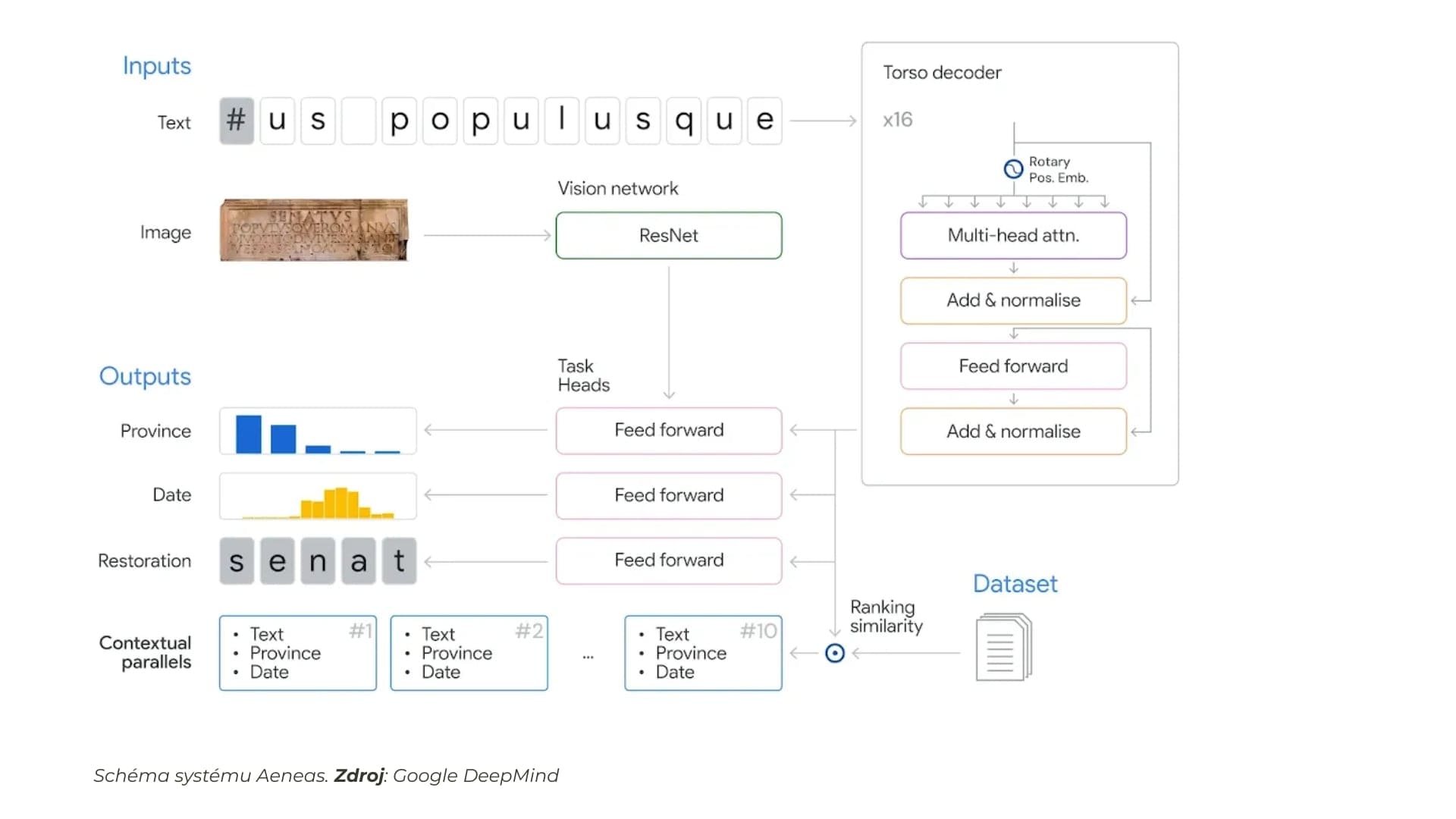
Aeneas can identify and reconstruct parts of an inscription that have been lost to time, even when it has no information about how many words or letters are missing. It can then estimate the place and date of origin of the inscription with an accuracy of ±13 years, which is a smaller margin of error than expert historians typically work with. Finally, it can search a database of around 175 000 Latin inscriptions and find texts that are similar in meaning and context.
Both a text transcription and a photograph can be uploaded to Aeneas. Once the AI model determines the possible wording of the missing text, it provides evidence for its decision. This is precisely what makes it a highly reliable and responsive tool that saves historians a great deal of time.
Thorough Training and High Accuracy
The Aeneas model is trained on the Latin Epigraphic Dataset, comprising more than 175 000 inscriptions and millions of characters. All the texts date from the period between the 7th century BCE and the 8th century CE and come from 62 provinces of the Roman Empire. In addition, new texts are assigned to the corresponding province with an accuracy of up to 72%.
And how does working with Aeneas actually work? The model uses special characters to mark missing parts of the text that need to be reconstructed. If a letter is missing, the user inserts “?” into the text; if a passage of unknown length is missing, “#” is inserted. The success rate for reconstructing longer texts is particularly impressive. The model achieves a 73% success rate for passages of up to 10 characters, while for longer passages, the rate is around 58%.
What Does It Look Like in Practice?
Aeneas has already delivered results. In one study, for example, this AI model was able not only to analyze a text by Emperor Augustus and correctly place it within the estimated historical context, but also to identify several parallels. By linking other texts with a similar style, the model was able to confirm the spread of Augustan ideology across the individual provinces.
An Assistant to Historians, Not Their Replacement
The purpose of the Aeneas AI model is not to replace human expertise, but merely to make it faster and more accurate. Its goal is to provide broader context and fill historical gaps with greater speed and precision. In a trial involving 23 historians, the AI model's capabilities proved useful in a full 90% of cases and strengthened the experts' hypotheses.
Would You Like to Try Aeneas? You Can!
Aeneas is available to everyone free of charge. Simply visit predictingthepast.com to test the tool for free. The website also features the Ithaca model for working with ancient Greek fragments.
Source: Google DeepMind, Nature, The Guardian