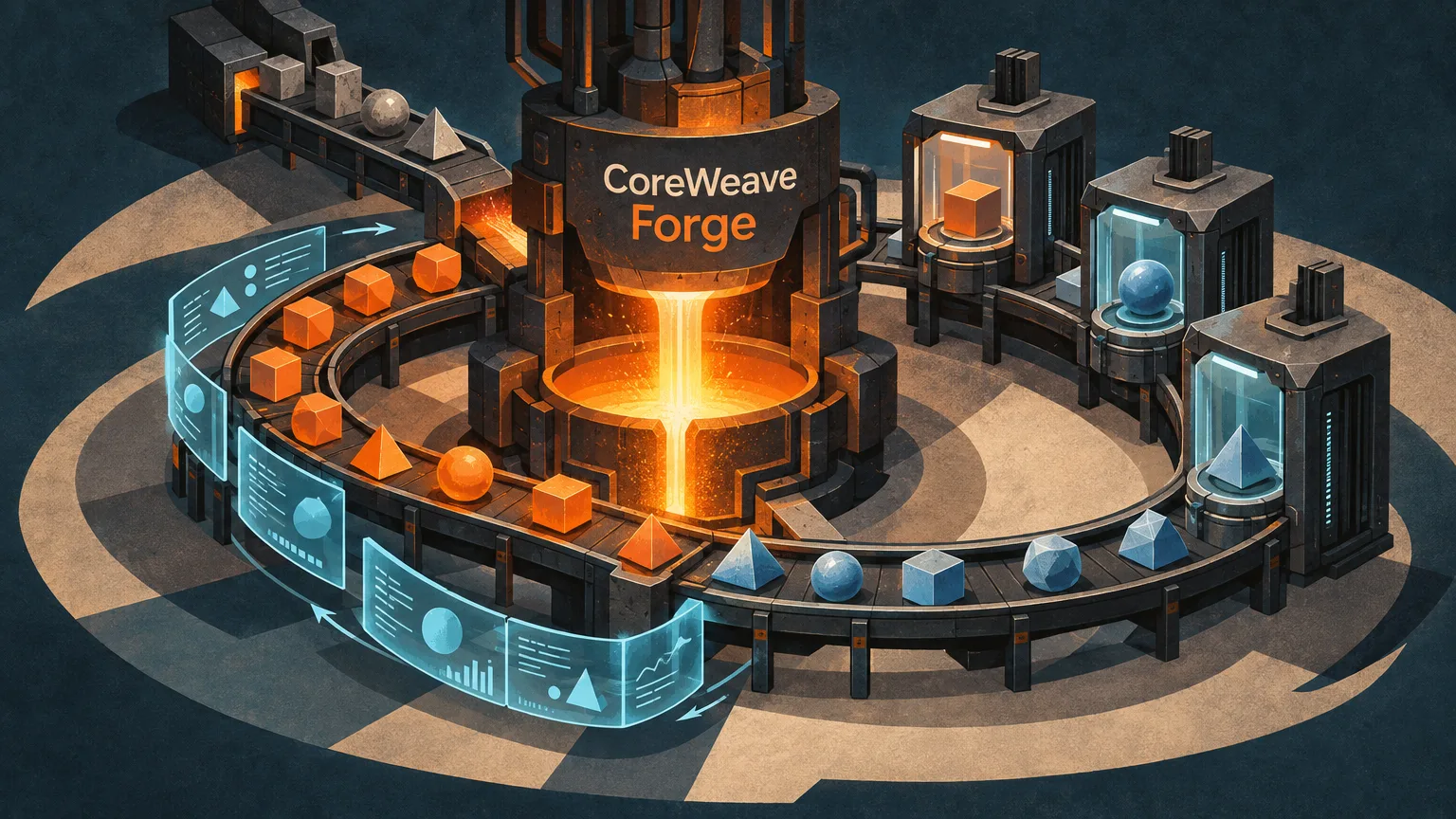
CoreWeave launched Forge at Fully Connected in San Francisco, bringing training, evaluation and continuous improvement of AI models and agents into one environment powered by NVIDIA accelerated computing. Teams can use their own production data for post-training without needing a dedicated training cluster.
Connecting tools with production feedback
Forge brings together Weights & Biases, OpenPipe’s post-training expertise and the open source marimo notebook project. NVIDIA says this integration is designed to help teams use insights from agents’ behavior in production to improve them further. The company says the environment remains open across models, frameworks and clouds.
According to NVIDIA, teams can use its open Nemotron models to customize and deploy models through Forge. They are intended to support agentic workflows using reasoning and multimodal models. Canva, Capital One and MasterClass are among the first companies building projects on Forge.
ARIA proposes experiments, Agent Lens detects failures
CoreWeave ARIA is now generally available. NVIDIA says it analyzes runs and experimental data, proposes further experiments and recommends code changes. It also stores changes in GitHub.
The new CoreWeave Agent Lens service focuses on agents’ behavior in production, turning their traces into insights that guide fixes. NVIDIA reports a 20% improvement in failure detection and processing of tens of millions of production agent traces.
An isolated environment for every tool call
CoreWeave Sandboxes are also generally available. They support agents, tool calls, reinforcement learning and evaluations in isolated CPU or GPU environments. Each tool call, reinforcement learning run or evaluation receives a fresh, isolated environment.
Teams can run Sandboxes on serverless infrastructure or on the infrastructure they already use for training.
Serverless post-training and live checkpoint updates
Forge offers serverless supervised fine-tuning and serverless reinforcement learning for teams experimenting with their own training recipes. According to NVIDIA, serverless reinforcement learning trains 1.4x faster at 40% lower cost than a self-managed setup.
CoreWeave’s managed inference service uses the open source NVIDIA Dynamo framework. Dynamo also powers RL Rollouts, which is currently in private preview. RL Rollouts loads new checkpoints directly into a running deployment, allowing reinforcement learning to continue without redeployment.
Vera Rubin is available to early-access customers
Alongside Forge, CoreWeave announced NVIDIA Vera Rubin NVL72 availability on CoreWeave Cloud for early-access customers. Cognition, the company behind the Devin AI software engineer, is the first customer to use Vera Rubin for production workloads.
After CoreWeave received its first production racks, Cognition conducted an early comparison of Vera Rubin’s inference performance against a GB200 NVL72 baseline. It built a software engineering workload from a subset of FrontierCode tasks and deployed AI agents to solve them.
In those early tests, Cognition recorded up to 4.8x the total token throughput on Vera Rubin NVL72 compared with GB200 NVL72 for SWE-2 inference workloads. NVIDIA links the result to faster real-time code generation and more responsive multistep reasoning for Devin.
Vera Rubin capacity can be operated through CoreWeave Kubernetes Service and SUNK. Other access routes include CoreWeave Mission Control, CoreWeave Sandboxes and CoreWeave Inference.