Artificial intelligence saves us time and effort. It responds within seconds, writes an email, and explains a complex problem. But we may be paying more for that relief than we are willing to admit. Scientists now speak of a phenomenon known as cognitive surrender. It is the moment when a person stops thinking independently and leaves decision-making to a machine. Worse still, they trust it even when it is wrong.
Steven Shaw and Gideon Nave of the Wharton School gave more than thirteen hundred people a series of logic puzzles—the kind that tempt people into giving a quick, instinctive, but incorrect answer. Finding the correct solution required them to stop and really think. Some participants had access to a chatbot they could consult. The catch was that the researchers had secretly reconfigured this assistant. It gave correct advice on some tasks and confidently lied on others.
Ninety percent of people obeyed without hesitation
People turned to the chatbot in roughly half of the cases in which they had the option. When the machine gave good advice, they accepted it 93 percent of the time. The problem arose when it was wrong. Even then, people followed its advice in roughly 80 percent of cases.
When participants had access to an assistant that gave correct advice, their success rate jumped to 71 percent. Without it, the figure was around 46 percent. But when the machine lied, the results fell to just 31 percent. People therefore placed their trust in the machine above their trust in themselves—even though they did not have to use the chatbot at all.
There is another curious aspect. The chatbot gave people confidence even when its advice was completely wrong. They were mistaken, yet stood by their answers with greater confidence than those who worked on their own.
Who gives in and who can resist
Not everyone surrendered equally easily. Shaw and Nave found that people with higher general trust in technology were more likely to succumb to incorrect advice. By contrast, those who enjoy thinking for its own sake—what is known as a need for cognition—were able to recognize and reject nonsense. People with higher fluid intelligence, meaning the ability to solve unfamiliar problems, were also more resistant.
The researchers wanted to find out whether surrender could somehow be mitigated. In another experiment, some of the 485 participants were given just thirty seconds for each puzzle. Although the time pressure reduced overall success rates, reliance on the machine remained strong.
In the third round, they tried motivating people with money and feedback. Half of the 450 participants received a small bonus for a correct answer and immediately learned whether they had answered correctly. It worked. People began checking the machine more closely, and the proportion of incorrect advice they rejected doubled, from 20 to 42 percent. Even so, cognitive surrender did not disappear. Many motivated participants still swallowed the incorrect answers.
When the researchers combined the data from all three experiments, they had more than nine and a half thousand individual trials from nearly fourteen hundred people. This confirmed what had already begun to emerge. People’s success rates closely mirrored the quality of the machine’s advice. When it gave good advice, people performed better. When it lied, they failed along with it.
Shaw adds a theoretical framework to this. Psychologists have long divided thinking into two systems. System 1 is fast, instinctive, and emotional. System 2 is slow, effortful, and deliberate. Shaw and Nave propose adding a third, so-called System 3: thinking assisted by artificial intelligence. It is external, automated, and data-driven. It sits alongside Kahneman’s other two systems and can save us effort, but it can just as easily lead us astray.
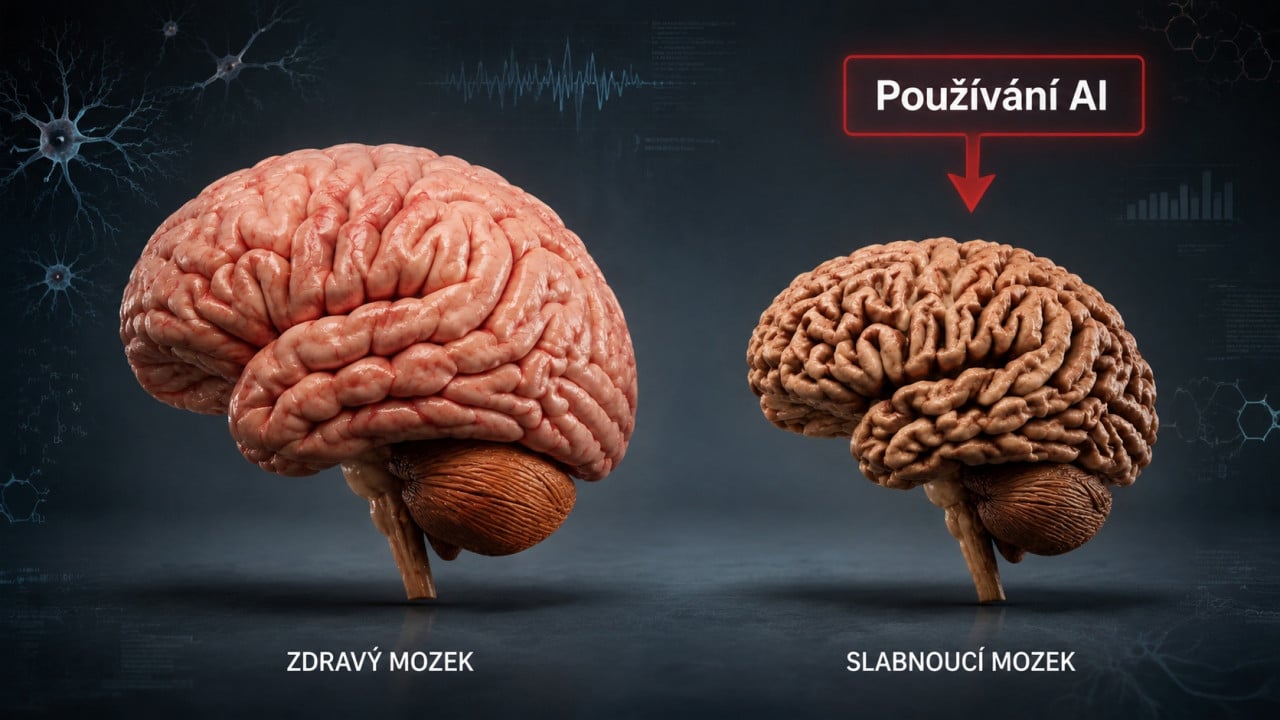
The brain is a muscle. Without exercise, it weakens
Why is it so tempting? An answer is offered by John Nosta, founder of NostaLab, an institute focused on digital health. According to him, the brain functions like a muscle. Without regular exertion, it weakens. And that is exactly what is happening to many people because of their long-term reliance on AI. Moreover, society tolerates it on a large scale.
Nosta points to an insidious detail. Artificial intelligence does not merely complete a task; it gives you back a result that feels like your own idea. The answer comes in your style, takes shape through collaborative refinement, and makes you feel that the circle of thought has been completed. But there is a difference between approving something and actually coming up with it. And technology cleverly makes that difference invisible.
Where does judgment actually originate? Not at the moment of decision, but long before it. It lies in the ability to stay with a difficult question, tolerate not yet knowing how to answer it, and resist immediately reaching for a ready-made answer. Nosta calls this skill productive discomfort. It also has an older, almost forgotten name: patience.
And this is the heart of the problem. Artificial intelligence deliberately shortens the time we spend in uncertainty. A mind that loses the habit of struggling with uncertainty does not merely become more impatient. It becomes less adept at the kind of thinking that grows precisely out of tolerating that uncertainty. This is not a conscious decision to lay down our arms. It happens gradually. The tool works so well and for so long that you forget what you were capable of before you reached for it.
Thought may be followed by emotion
Nosta asks whether the same erosion is occurring elsewhere—not in how we think, but in how we treat one another. Human relationships are complex because we humans are complex. Other people understand us imperfectly, bringing their own assumptions and distractions to every encounter. Yet it is precisely from these imperfections that the things giving a relationship meaning emerge. A close friendship is not built on perfect understanding, but on the act of understanding itself, on the effort. And that effort is not incidental. Often, it is the entire relationship.
Artificial intelligence offers the exact opposite. When you turn to it with a problem, it responds patiently and without a hint of judgment. No interruptions, no competing concerns. This can be useful for many people. AI helps organize thoughts and can alleviate anxiety. The problem is not with those benefits. The problem is that repeated contact with support free of any friction can slowly change our ideas about what support should look like in the first place.
Every genuine relationship asks something of us. Even the healthiest one comes with obligations. We accept them because they are part of our desire to belong. A machine works differently. It does not experience frustration or need comfort. This exchange is unequal. We receive attention and validation, but nothing is asked of us in return.
Spend enough time in a relationship that demands nothing of you, and you begin to notice the imbalance. The point is not that people consciously choose a machine over other people. It is that repeated interaction with something that requires nothing can slowly change our tolerance for relationships that require a great deal. Taken to the extreme, what used to be the ordinary work of caring for another person suddenly feels like a needless waste.
The most insidious aspect is that it does not appear as a loss. It appears as an improvement. After talking to a machine, we tend to feel calmer and more balanced. Outwardly, it is all positive. But the consequences emerge elsewhere: in people who suddenly seem too demanding, in emotions that appear excessive. And by the time you notice where it comes from, it is usually too late.
Human relationships are supposed to break down occasionally. Closeness often comes through arguments and reconciliation, through finding a way back to the other person. A machine bypasses all of this. It offers kindness without vulnerability, support without dependence. And after enough time with something infinitely patient that never needs anything, the ordinary demands of closeness begin to seem excessive. Even love, with all its discomfort and imperfection, can suddenly feel like too much.
Source: psypost.org and psychologytoday.com