

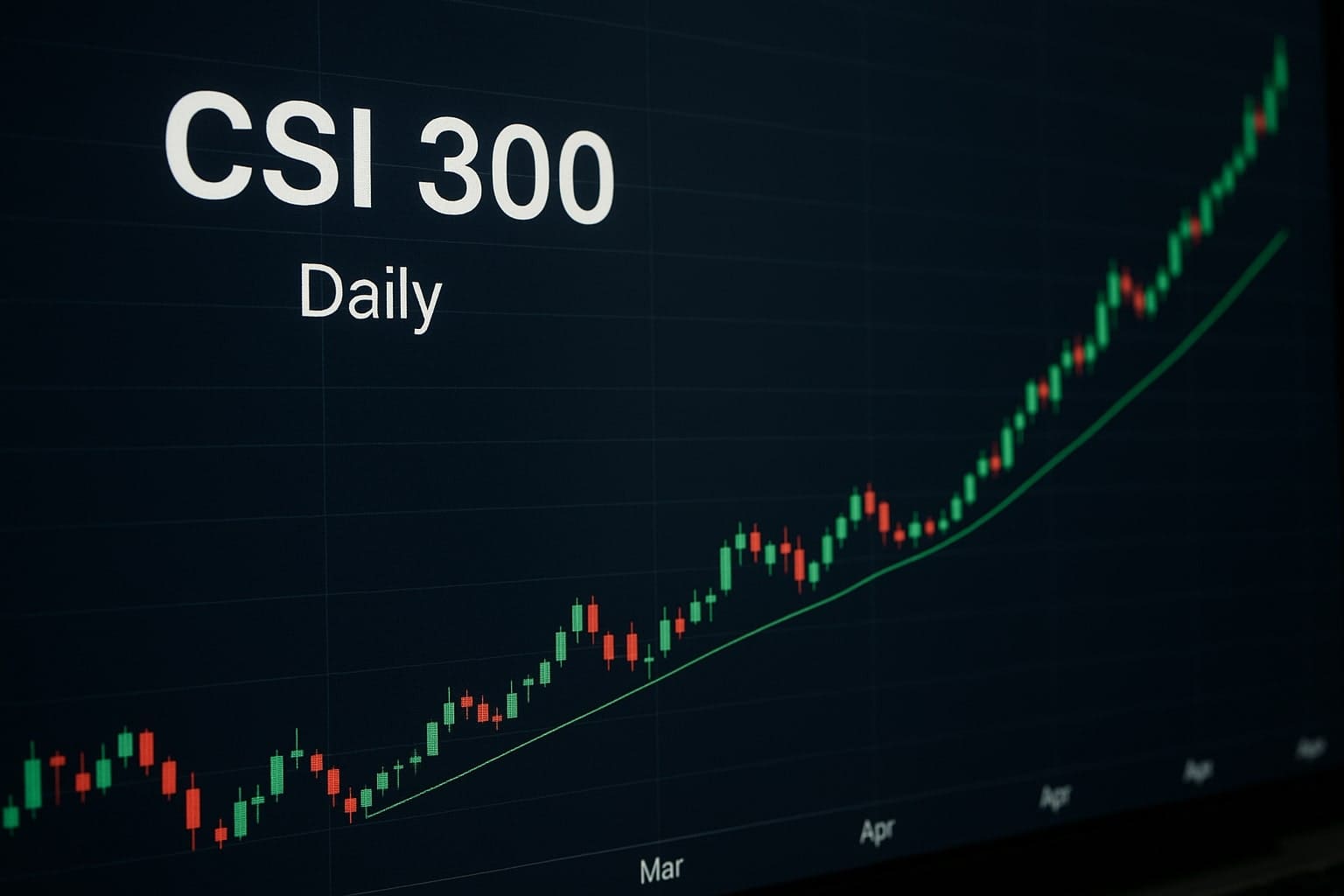
Chinese stock markets resumed trading on Thursday, October 9, 2025, after the week-long Golden Week holiday and immediately showed strength. The CSI 300 Index on the mainland exchange closed the day up 1.5 percent. Chinese stocks traded in Hong Kong also performed well, with their benchmark rising 0.1 percent. The yuan weakened by 0.1 percent against the dollar, but overall it remains up more than 2 percent this year thanks to demand for Chinese assets.
Investors focused on sectors promising rapid growth despite signs of a sluggish economy. According to data from the Ministry of Commerce, retail and food service sales during the eight-day holiday rose by only 2.7 percent year over year, less than the 6.3 percent increase recorded during the May holiday.
AI and Gold Lead Gains
Stocks linked to gold and chips delivered the biggest gains. The materials benchmark jumped 6.8 percent, driven by companies such as Jiangxi Copper Co. and Shandong Gold Mining Co., which attracted investors seeking safety in precious metals. The technology subindex added 2.8 percent, with Advanced Micro-Fabrication Equipment Inc. performing particularly well as its shares reached an all-time high.
This optimism surrounding artificial intelligence (AI) persisted despite global volatility in technology stocks. During the Chinese holiday, reports about companies linked to OpenAI emerged in global markets, strengthening expectations that a similar boom would also reach China. According to Christopher Leow, chief investment officer for Asia ex-Japan at Principal Asset Management, investors continue to seek opportunities in the localization of semiconductor equipment manufacturing, AI-related initiatives, robotics, and high-dividend companies.
Further market details show that chip giants in Hong Kong performed well, including Hua Hong Semiconductor, which rose as much as 9.3 percent, and SMIC, which gained 4.5 percent immediately after the opening. This growth is linked to Goldman Sachs's target price revisions, which reflect expectations of strong demand for domestic chips due to advances in AI.
Expectations and Events
Traders are now watching for signals from the upcoming Communist Party meeting from October 20 to 23, where a blueprint for the 15th Five-Year Plan is expected to be outlined. A possible meeting between Trump and Xi Jinping at the APEC summit in South Korea could open the door to tariff negotiations and ease tensions between the U.S. and China.
The CSI 300 Index rose for five consecutive months through September, its longest streak since 2017. This rally was led by chip stocks following the announcement of an updated AI model from DeepSeek and Huawei Technologies Co.'s plan to double production of its advanced AI chips. Nevertheless, Chinese stocks remain cheaper than their peers—the MSCI China Index trades at less than 13.5 times forward earnings, compared with 23 times for the S&P 500.
Ian Samson, a portfolio manager at Fidelity International in Singapore, noted that high-growth Chinese companies, especially in the internet sector, look attractive if they meet earnings expectations. Sandy Pei of Federated Hermes pointed out that growth in travel was solid, but average spending did not increase.
Stimulus and Currency Situation
At the end of September, China announced an injection of 500 billion yuan (approximately CZK 1.61 trillion) to support investment as part of a new financing tool. Daniel Tan of Grasshopper Asset Management expects a favorable package of measures after the holiday, which was reflected in gains among sentiment-sensitive brokerage firms.
Xingchen Yu of UBS Global Wealth Management emphasized that the October meeting will focus on strengthening domestic demand and efforts to curb excessive competition. Effective anti-deflation measures could unlock savings and support consumption.
The offshore yuan weakened by 0.3 percent against the dollar during the holiday, but strengthened by 0.2 percent on Thursday following a stronger reference rate from the central bank. Ten-year government bond yields fell by two basis points. Fiona Lim of Malayan Banking Berhad sees exports and optimism in equities as supportive of the yuan.
Impact on Specific Sectors
Weak Golden Week data affected some sectors. Movies and entertainment disappointed—shares such as Maoyan Entertainment and Damai Entertainment Holdings Ltd. fell in Hong Kong after Citigroup warned of low ticket sales. Macau received an average of 143,000 visitors per day, fewer than the expected 150,000.
According to a note from Julius Baer, these figures signal continued weakness in consumption, which could lead to profit-taking or further outperformance by technology stocks. The Shanghai Composite Index fell 0.19 percent to 3,890 points as of October 13, 2025, but remains up 0.75 percent for the month and 18.43 percent for the year.
Source: finance.yahoo.com


