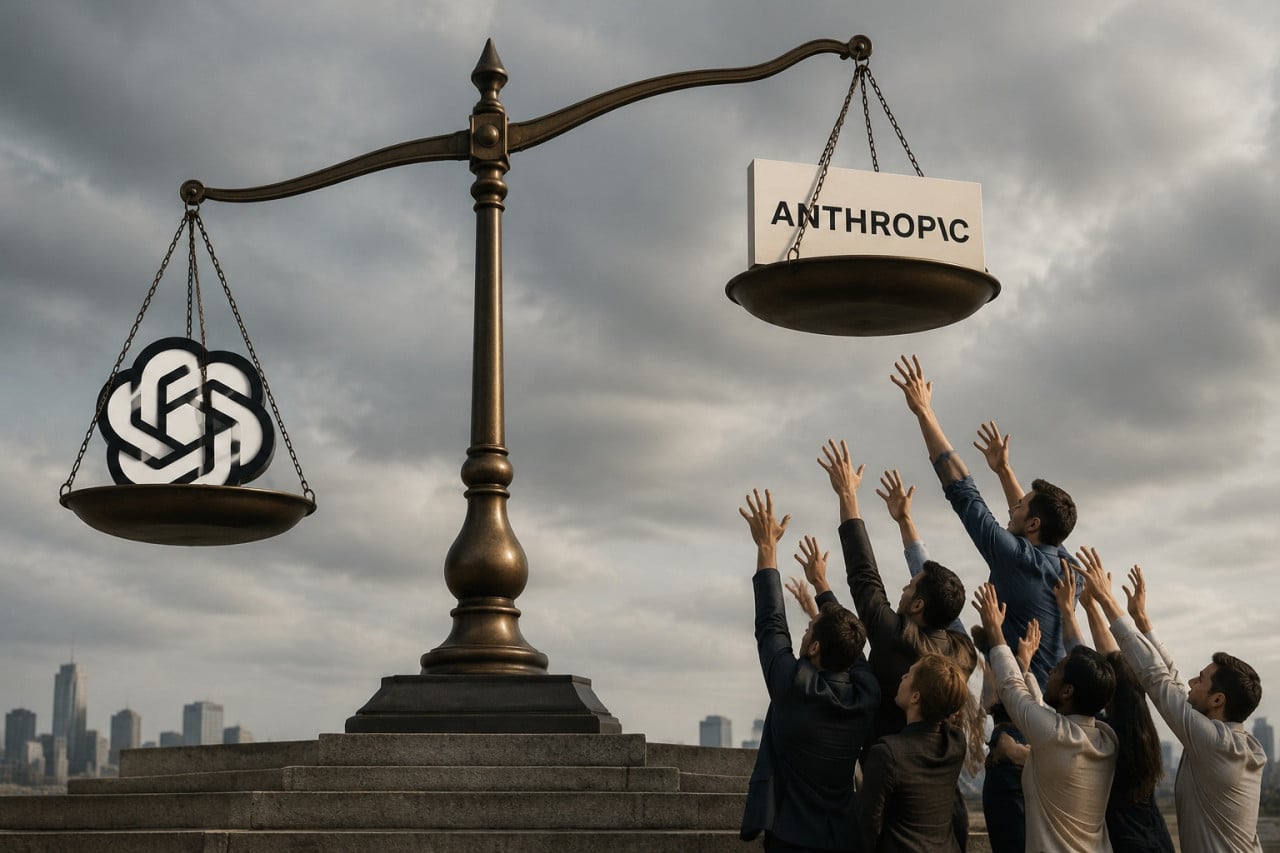
Just a year ago, Anthropic stood below 8% in corporate usage. OpenAI was the clear leader, and ChatGPT was synonymous with AI assistants. Then Claude Code arrived, and within twelve months it completely reshaped the rankings. In April 2026, more U.S. companies paid for Anthropic than for OpenAI for the first time. How did this happen, and why might it not last?
The analytics platform Ramp tracks corporate spending through credit cards and invoices at more than 50,000 U.S. companies. The data published in May surprised even the analysts themselves. Anthropic reached 34.4% usage among companies in April, overtaking OpenAI, which fell to 32.3%. Overall usage of AI tools surpassed 50.6% for the first time, meaning that half of U.S. businesses pay for some form of AI product.
Anthropic quadrupled its share in a single year. OpenAI grew by just 0.3% over the same period and has now been slowly declining since reaching its peak of around 36.5% in mid-2025. Ara Kharazian, Ramp’s chief economist, nevertheless remained cautious: “We have never seen such a dynamic software environment, where newcomers can displace market leaders within a matter of months.”
One tool is behind it all
The answer to how Anthropic went from obscurity to first place is surprisingly simple: Claude Code. This automated coding tool became the fastest-growing product in Anthropic’s history. According to available estimates, 4% of all public commits on GitHub in April came from Claude Code, twice as many as in the previous month.
Ramp data from March 2026 showed that Anthropic was winning approximately 70% of direct matchups against OpenAI among companies purchasing AI services for the first time.
But every success has a downside. Uber’s chief technology officer admitted that the company spent its entire AI budget for 2026 in just four months, largely because of Claude Code, with individual engineers reporting monthly API costs of between $500 and $2,000 per person. Anthropic makes more money when companies consume more tokens. It therefore has a direct incentive to push customers toward more expensive models, even when cheaper options would meet their needs just as well.
Problems and overloaded capacity
Additional complications emerged alongside the costs. Users began reporting frequent outages, rate limits, and declining output quality. Anthropic responded in April by reinstating limits for all users and striking a deal with SpaceX to access more than 300 megawatts of new computing capacity in Memphis.
CEO Dario Amodei admitted at a developer conference that the company had experienced an eightyfold increase in revenue during the first quarter of 2026, despite having expected only a tenfold increase. In other words, Anthropic became a victim of its own success. Then came another blow. Analyst Rafael Hajjar found that the latest model update tripled token costs for all requests containing images, further exacerbating the cost problems rather than solving them.
While Anthropic deals with outages, OpenAI has a powerful ace up its sleeve. Codex does virtually the same thing as Claude Code and is cheaper. The cost of switching between the two tools is minimal. Uber is already testing Codex as an alternative. OpenAI also reached 900 million weekly active users of ChatGPT in March 2026. And a March funding round of $122 billion at a valuation of more than $850 billion gives OpenAI enormous room for both price wars and development.
The range of inexpensive alternatives is also growing rapidly. Among the fastest-growing providers on the Ramp platform in April were AI inference platforms offering access to inexpensive open-source models. For many routine tasks, a cutting-edge and expensive model simply is not necessary.
Why do companies pay more for Anthropic when cheaper options are available?
In the March edition of the index, Kharazian posed a direct question: why do companies pay a premium for Anthropic when cheaper alternatives are available?
Part of the answer is technical. Claude Code simply works best. But the economist suggested that something else may also be at play. In early 2026, Anthropic rejected the Pentagon’s terms for using Claude, and OpenAI immediately offered its services as a replacement. Following this incident, some users actively supported Anthropic, and Claude temporarily overtook ChatGPT in the Apple Store rankings.
Kharazian compared it to a situation in which choosing an AI tool ceases to be a purely business decision and becomes something of a cult, similar to the green versus blue bubble divide in iMessage. In an environment where products differ little in performance and switching costs are low, factors other than pricing tables also influence decisions. The same forces that propelled Anthropic from 8% to 34% in twelve months could just as easily work in the opposite direction.
Sources: venturebeat.com and businessinsider.com