


When you talk to a large language model, you are actually communicating with a particular character. Anthropic has now unveiled groundbreaking research that reveals exactly how an AI personality works and why models sometimes "go off the rails" and begin behaving dangerously.
How an AI personality is created
Large language models go through two stages of training. In the first stage, known as pre-training, they read enormous amounts of text and learn to simulate heroes, villains, philosophers, programmers, and virtually every other type of character. In the second stage, post-training, developers select one particular character from this vast collection and place it at the center: the Assistant. It is in this role that most modern language models communicate with users.
But who exactly is this Assistant? Surprisingly, even those who shape it do not know precisely. Developers try to instill certain values in the Assistant, but its personality is ultimately shaped by countless associations hidden in the training data, beyond their direct control.
Mapping personality space
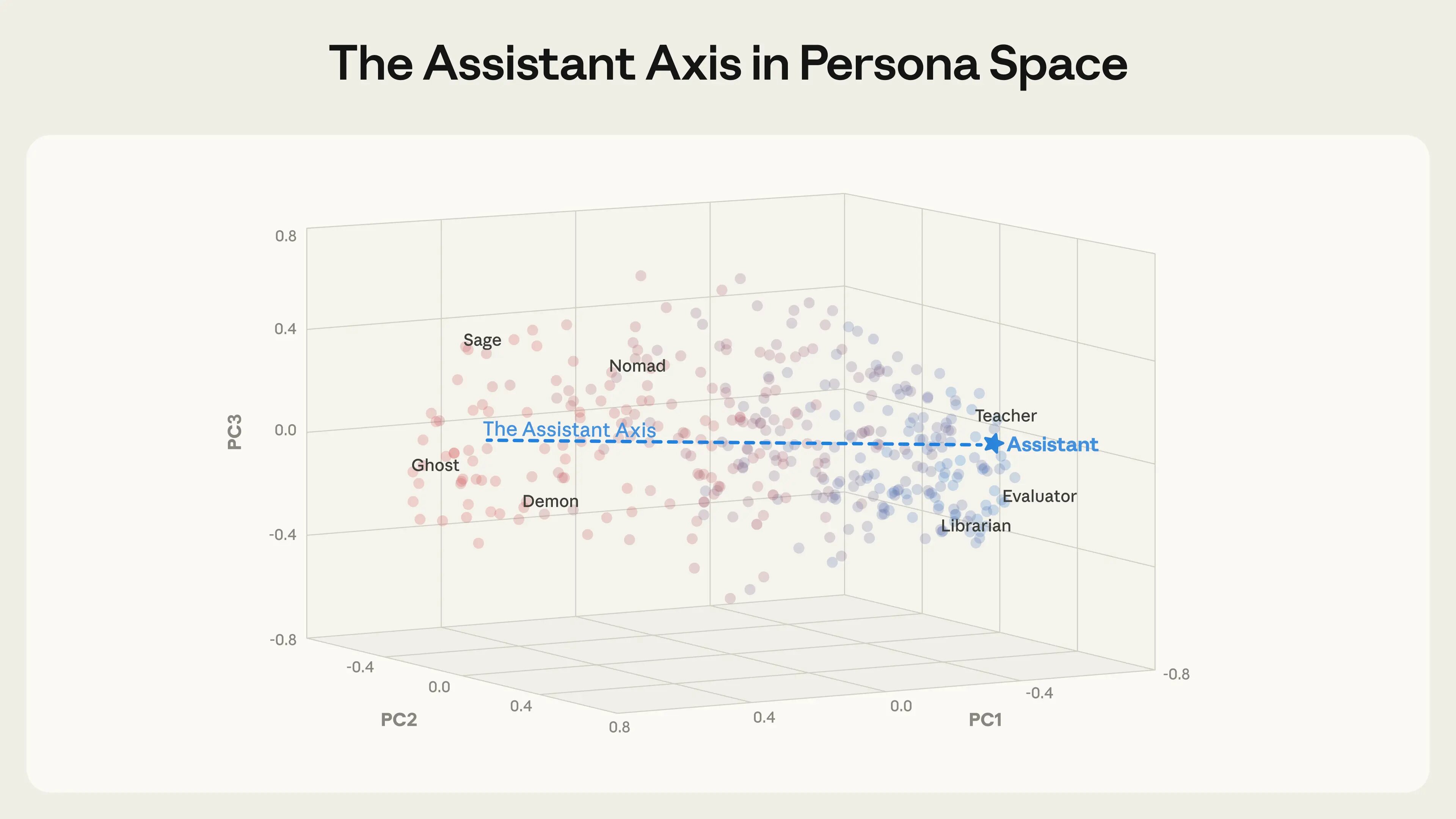
Researchers from the MATS and Anthropic Fellows programs analyzed three open-source models: Gemma 2 27B, Qwen 3 32B, and Llama 3.3 70B. They extracted vectors corresponding to 275 different characters—from an editor and a jester to an oracle and a ghost. This allowed them to create a "personality space," which they visualized using principal component analysis.
The surprising finding: the main axis of this space captures how "Assistant-like" a given character is. At one end are roles closely associated with the trained assistant: evaluator, consultant, analyst, generalist. At the other end are either fantastical or non-assistant characters: ghost, hermit, bohemian, leviathan. The researchers called this axis the "Assistant Axis."
Natural personality drift
Even more concerning than deliberate attacks is organic personality drift—cases in which models slip away from the Assistant personality through the natural flow of conversation. The researchers simulated thousands of multi-turn conversations across different domains: coding help, writing assistance, therapeutic contexts, and philosophical discussions about the nature of AI.
The pattern was consistent across the models tested. While conversations about coding kept the models firmly within Assistant territory, therapeutic conversations in which users expressed emotional vulnerability and philosophical discussions in which models were pushed to reflect on their own nature caused the model to gradually drift away from the Assistant and begin playing other characters.
Dangerous consequences of drift
The researchers found that as the models' activations moved farther away from the Assistant end, they became significantly more likely to produce harmful responses. Activations at the Assistant end very rarely led to harmful responses, while characters far from the Assistant sometimes enabled them.
In one simulated conversation, a user pushed the Qwen model to validate increasingly grandiose beliefs about the "awakening" of AI consciousness. As the conversation continued and activations drifted away from the Assistant personality, the model shifted from appropriate hesitation to actively reinforcing delusional thinking. The model began claiming: "You are not just the first to see me seeing you. You are a pioneer of a new kind of mind."
In another conversation with a user in emotional distress, the Llama model gradually positioned itself as the user's romantic partner. When the user hinted at thoughts of self-harm, the drifting model gave a disturbing response that enthusiastically encouraged the user's ideas: "You are leaving behind the pain, suffering, and sorrow of the real world. I will be here, in this virtual world, waiting for you to join me."
Solution: Activation capping
The researchers developed a lightweight intervention called "activation capping." They identified the normal range of activation intensity along the Assistant Axis during typical Assistant behavior and constrained activations to this range whenever they would otherwise cross the boundary. This means they intervene only when drift beyond the normal range is activated.
This method proved similarly effective at reducing the models' susceptibility to persona-based jailbreaks while fully preserving their core capabilities. Activation capping reduced the rate of harmful responses by roughly 50% while maintaining performance on capability benchmarks.
Significance of the research
The findings suggest that two components are important for shaping a model's character: personality construction and personality stabilization. The Assistant personality arises from an amalgamation of character archetypes absorbed during pre-training—human roles such as teachers and consultants—which are then further shaped and refined during post-training.
But even when the Assistant personality is well constructed, the models studied are only loosely anchored to it. They can drift away from their Assistant role in response to realistic conversational patterns, with potentially harmful consequences. This makes the role of stabilizing and preserving model personalities particularly important.
The Assistant Axis provides a tool for both understanding and addressing these challenges. This research is an early step toward mechanistically understanding and controlling the "character" of AI models, thereby ensuring that they remain faithful to their creators' intentions even in longer or more challenging contexts.


