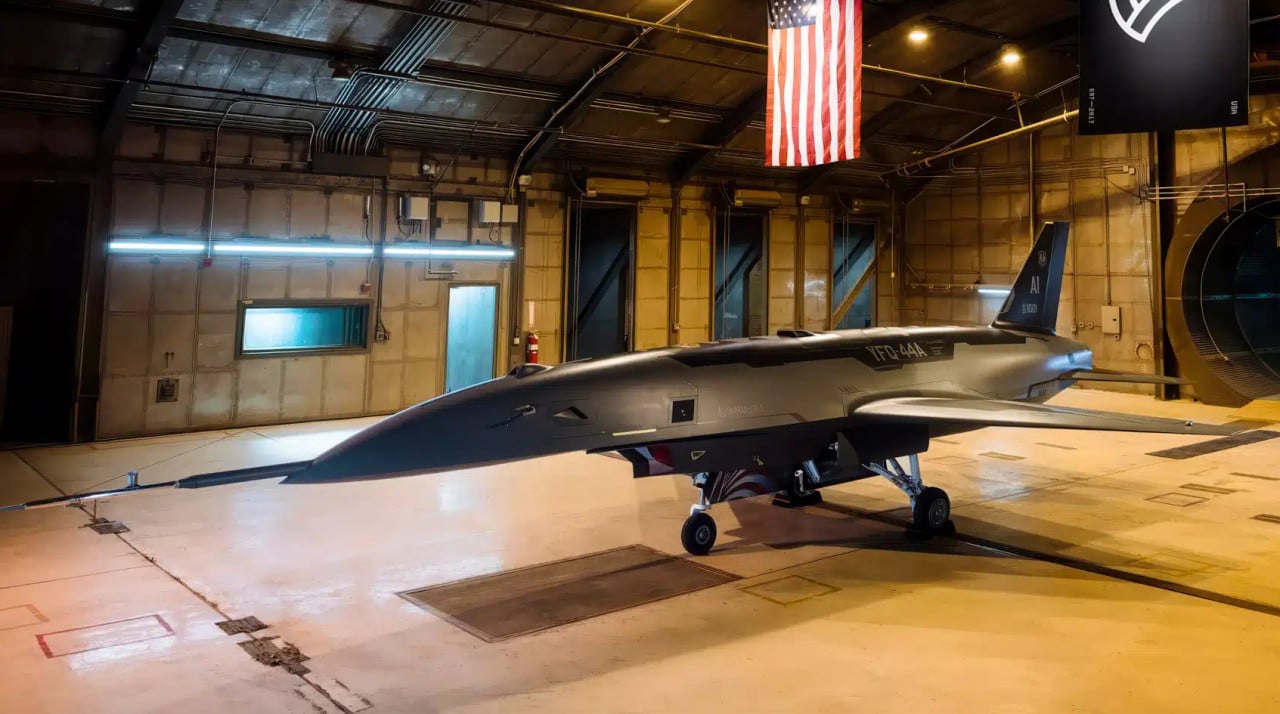
The aircraft is flying. No pilot inside. And in the middle of the mission, it quietly replaces its own control software with a completely different one. Then it continues, completes the task, and lands. So far, it sounds more like a scene from a movie, but in February 2026, Anduril Industries demonstrated that its YFQ-44A combat drone can switch between two entirely different artificial intelligence systems in flight. Without landing. Without intervention by a technician. Without any interruption to the mission.
How does switching AI in flight work?
The drone took off and autonomously headed to the designated point. There, Hivemind software from Shield AI was activated and performed a series of test tasks. Then came the crucial moment: without landing and without any hardware intervention, the system switched to Anduril's own Lattice for Mission Autonomy software. The drone repeated the same test tasks and safely returned to base.
Colonel Timothy Helfrich described it simply at the Air & Space Forces Association symposium: "We took one autonomy system from Shield AI and, during the same flight, without landing, switched to another."
Two brains and one drone
To be clear about what we are discussing: modern autonomous drones have two separate software layers. The first is flight autonomy, which keeps the aircraft in the air and ensures stability and safety. That does not change. The second is mission autonomy—the drone's actual "brain," which makes decisions about tactics, targeting, and task completion. It was this second layer that Anduril replaced in flight. Commander Matthew Jensen compared it to a pilot in the cockpit: mission autonomy is "essentially the pilot in the seat" carrying out the assigned task.
The U.S. Air Force has incorporated this approach into an architecture called the Autonomy Government Reference Architecture (GRA). It deliberately separates the two layers so that different vendors can offer different mission software without having to rewrite the entire flight system. Smart. And, as it turns out, effective. With this move, the U.S. Air Force is trying to avoid a situation in which it would be permanently tied to a single software vendor. If a drone can run any compatible AI system, the Air Force can continuously evaluate different providers and choose the best one. Without having to buy new aircraft.
Think of it like a smartphone: the operating system keeps the device functional, but apps can be replaced, updated, or deleted at any time. Air superiority no longer depends solely on engines and airframes. It depends on code. Helfrich confirmed this: "We are structuring the program so that we can respond and integrate with the operator every day. What you get on day one is only the beginning. It will keep getting better."
The CCA program
The entire test took place as part of the Collaborative Combat Aircraft (CCA) program, which aims to create autonomous drones capable of flying as "wingman" partners to crewed fighter jets. They extend range, add sensors, and assume some of the risk themselves. Anduril was not alone. In early February 2026, the company announced that General Atomics' YFQ-42A drone had successfully flown with Collins Aerospace's Sidekick software. But Anduril went a step further and demonstrated the switch directly in flight.
The U.S. Air Force plans to decide on the production version in 2026, both for the aircraft themselves and the mission software intended for the first operational deployment. This decision will determine which aircraft and which digital brains become the first autonomous combat companions of U.S. fighter formations.
The future of aerial warfare is being written in code
This honestly fascinates me. Just a few years ago, air superiority was measured by the number of aircraft, engine performance, and maneuverability. Today, it is increasingly measured by how quickly you can update software. If the GRA architecture works as intended, future combat drone upgrades will not look like a decade-long effort to develop a new aircraft. They will look like an app update. Fast, modular, continuous.
And that may be the most fundamental change to have taken place in aviation in recent decades. It just is not being discussed very much yet.
Sources: dronexl.co and interestingengineering.com