

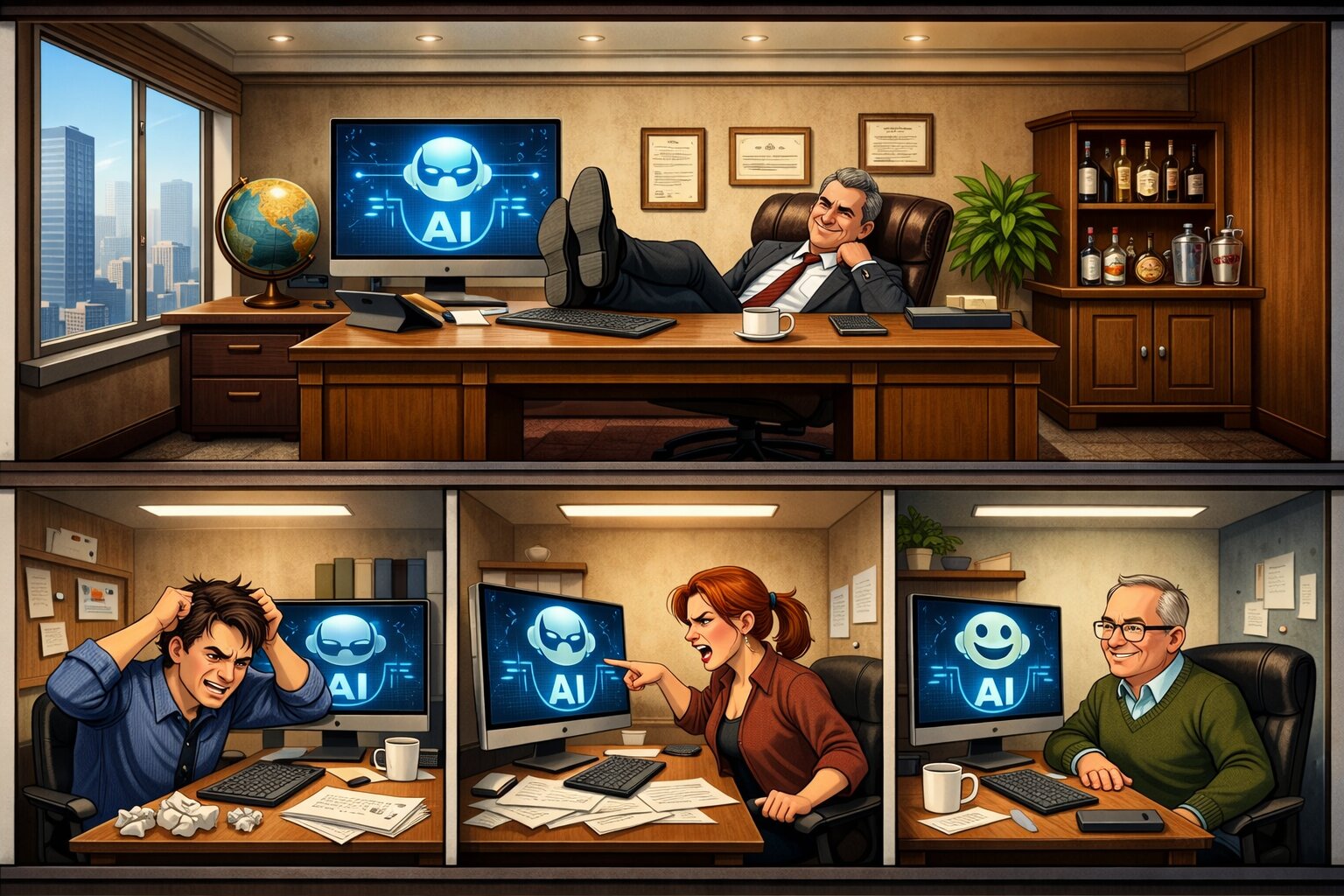
Artificial intelligence was supposed to be a revolution that would transform the way people work and save employees hours of drudgery. Corporate leaders are investing enormous sums in AI in the belief that the technology will usher in a new era of efficiency and profit growth. But the reality for ordinary employees is completely different – and the gap between what bosses claim and what people in offices actually experience is enormous.
A dramatic difference in views
A new survey by consulting firm Section of 5,000 office workers revealed striking differences. Two-thirds of nonmanagement employees said AI saves them less than two hours a week, or no time at all. By contrast, more than 40% of executives say the technology saves them more than eight hours of work a week.
The biggest difference? A full 38 percentage points. While 40% of ordinary employees said AI saves them no time at all, only 2% of executives shared this view. At the opposite end of the spectrum, 19% of managers say AI saves them more than 12 hours a week – compared with just 3% of ordinary employees.
Frustration instead of enthusiasm
Steve McGarvey, a 53-year-old user interface designer from Raleigh, North Carolina, describes the problem clearly: "Executives automatically assume that AI will be the savior. I cannot count how many times I have looked for a solution to a problem, asked a large language model, and received a solution to an accessibility problem that was completely wrong."
McGarvey acknowledges that some specific AI use cases – such as using Perplexity as a research assistant – have saved him considerable time. But part of his job involves ensuring that websites are accessible to visually impaired users. He spent several sessions explaining to an AI bot why its proposed solution would not work.
"If you do not have a certain degree of judgment or discernment in the field you work in, you can genuinely harm the customer base – or cause harm within the team – simply by assuming that anything a large language model says is true," McGarvey warns.
The productivity "AI tax"
Section's survey showed that employees were much more likely to feel concerned or overwhelmed about AI than excited – while the opposite was true for executives. A full 40% of all respondents said they would not mind if they never used AI again. The most common way most people said they used AI tools was for basic purposes, such as replacing Google searches or generating drafts. Far fewer people used it for more complex tasks, such as data analysis or code generation.
A new report from enterprise software company Workday even calls frustration with the technology an "AI tax" on productivity. Although 85% of the approximately 1,600 employees included in the survey said they saved one to seven hours a week by using AI, much of that time was offset by the need to correct errors and rework AI-generated content.
Uncertainty and unpredictability
Dan Hiester, a 44-year-old user interface engineer from Seattle, describes one of the biggest challenges – uncertainty about what AI can and cannot do well. During the summer, Hiester turned to a large language model to fix some code, expecting it to take less than half an hour. In the end, it took the entire afternoon. Meanwhile, another task that would previously have taken Hiester days took him 20 minutes with generative AI. "It completely reset my understanding of how to estimate the time needed to get something done," Hiester says.
Whatever changes AI is bringing to business operations and jobs, CEOs said they have not yet translated into financial results. In a PricewaterhouseCoopers survey of CEOs presented at the World Economic Forum's annual meeting in Davos, Switzerland, this week, 12% said AI had delivered both cost and revenue benefits. More than half of the nearly 4,500 CEOs surveyed worldwide said they had not yet seen any significant financial benefit.
When AI alone is not enough
Some companies have already reported ambitious AI initiatives that later required human assistance. Payment provider Klarna leaned on AI in 2024 to replace the work of hundreds of outsourced customer service agents. The company later reversed course again and hired about a dozen human contract workers to answer more challenging inquiries.
At language-learning app Duolingo, CEO Luis von Ahn told employees in a memo last year that the company would "gradually stop using contractors to do work that AI can handle." He later said he expected the company to continue hiring, but that AI would "accelerate what we do, at the same or a better level of quality." The company ultimately had 14% more employees year over year, von Ahn wrote on LinkedIn.
Sources: wsj.com and wsj.com


