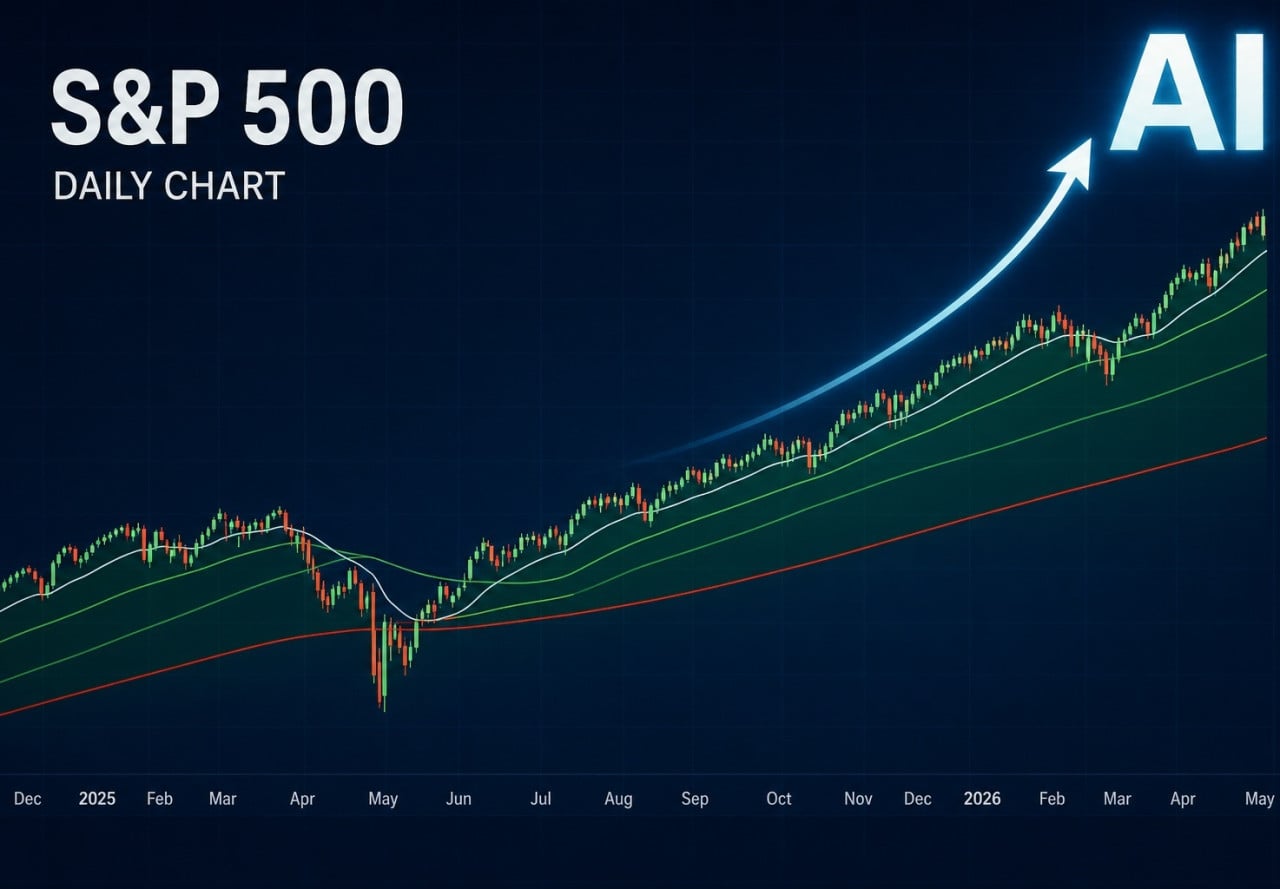
U.S. stocks are making history again this year. The S&P 500 is up 16% from its March lows, the NASDAQ has gained more than 26%, and semiconductor stocks have risen by roughly 70% since then. But these figures conceal one important detail. Virtually all of the growth is being driven by a single theme: artificial intelligence.
Goldman Sachs analysts warned this week that the stock market has effectively turned into one enormous trade. Gains are extremely concentrated in AI stocks, while the rest of the market is lagging behind. On one side are AI stocks: hyperscalers such as AWS, Microsoft, or Cloud, semiconductors, data centers, and equipment. And on the other side is everything else."
At the same time, the corporate earnings figures themselves are not bad. Over the past 12 months, this marks the sixth consecutive quarter of earnings growth, at a rate of more than 17%. Estimates for the next 12 months point to 13%. But precisely because indices such as the S&P 500 are so heavily tilted toward AI names, these results primarily reflect their performance.
Goldman Sachs: This Cannot Last Forever
Chip companies are having their best year yet. They are reporting record revenue and profits. Meanwhile, hyperscalers—large cloud service providers such as Amazon, Microsoft, Google, and Meta—plan to spend a combined $755 billion on investments in AI infrastructure this year. That represents a year-over-year increase of 38%. And this is exactly where Goldman Sachs sees a problem. James Covello, the bank's head of global equity research, described it this way: "Chip companies should prosper when their customers prosper. They should not prosper at their customers' expense."
According to Covello, the current situation, in which semiconductor companies are breaking records while the rest of the AI world continues to invest heavily without clear returns, is "unprecedented and unsustainable." Goldman is therefore shifting its preference away from chips and toward cloud providers and companies that are actually deploying AI for practical use.
Once businesses begin generating real returns from their AI investments, investors will be willing to pay higher multiples for the shares of major cloud providers. Conversely, if companies cut spending on AI infrastructure to improve cash flow, chip companies will lose out, while major cloud providers will benefit.
Bubble or Not?
The question hanging in the air is: Is this the AI bubble? Shawn Tuteja, who heads ETF trading at Goldman Sachs, has a clear answer. No, it is not. At least not in the traditional sense. "A bubble would mean that once it bursts, stocks return to where they were two years ago. That will not happen."
Nevertheless, he warns of something else. Leverage in the system is at a record high. New ETF products continue to emerge, offering double or triple exposure to semiconductor stocks. By their very nature, these products amplify swings in both directions. When the market rises, they have to buy. When it falls, they have to sell. This means that a 3% decline can very quickly turn into a 10% drop.
Ben Snider of Goldman Sachs adds his perspective. He notes that earnings provide a firmer foundation for growth than they did during previous waves. Back then, it was mainly about expanding valuations. This time, corporate earnings estimates are genuinely rising, particularly in AI infrastructure and energy. But other sectors are stagnating. Consumer goods, healthcare, real estate. These stocks are almost immune to AI trades, but they are also almost invisible in the indices' overall returns.
Where Goldman Is Looking for the Next Opportunity
The AI trade has its own progression. Tuteja describes it as a gradual shift in investor interest. First came chips as the underlying infrastructure, then cloud providers as those financing everything, followed by data centers and then memory chips. This year, optical cables used for data transmission within data centers have taken the spotlight, and this segment has risen by more than 100% since the beginning of the year.
Now Goldman Sachs sees an opportunity in liquid cooling. Traditional data centers consume enormous amounts of electricity for air cooling—almost as much as the computing itself. Liquid cooling changes this ratio dramatically, by as much as tenfold. Lower cooling consumption means more energy available for actual computing power. This segment is up approximately 30% so far this year. This segment has risen by approximately 30% this year.
Samsung Surpasses One Trillion and South Korea Dominates Global Markets
While the U.S. market is rising by single-digit percentages, things look completely different on the other side of the world. South Korea's Kospi index is up 75% this year and has become the world's best-performing major stock market. For comparison, the S&P 500 has gained approximately 6%, while the NASDAQ has added about 9%.
The greatest symbol of this boom is Samsung Electronics. The company's shares have more than doubled in value this year, and on May 7 Samsung surpassed one trillion dollars in market capitalization. It thus became only the second Asian company to reach this valuation, after Taiwanese chipmaker TSMC.
This result did not come out of nowhere. Samsung reported a 750% increase in operating profit for the first quarter of this year, reaching record levels. SK Hynix performed similarly, with its shares gaining more than 100% since the beginning of the year. Both are benefiting from a single driver: insatiable demand for AI memory chips.
According to analysts at Swiss private bank Lombard Odier, 80% of all Asian technology growth is concentrated among semiconductor exporters, particularly those from South Korea. Supplies are limited, and prices are holding firm. At least for now.
What to Watch Next
Tuteja identifies three factors that could change the situation. The first is long-term bond yields. On May 13, the yield on the 30-year U.S. Treasury crossed the psychologically important 5% threshold. That is a signal even shareholders of AI companies cannot ignore. Higher yields make financing more expensive and push technology valuations lower. The second factor is the earnings report from Nvidia, the world's largest company, which is due this week. The market will scrutinize every word about how capital expenditures are translating into actual returns.
The third theme is U.S.-China negotiations. Chinese stocks have been notable underperformers this year, and many investors are asking whether Chinese technology companies could become the next major investable opportunity.
Sources: seekingalpha.com, goldmansachs.com and finance.yahoo.com