

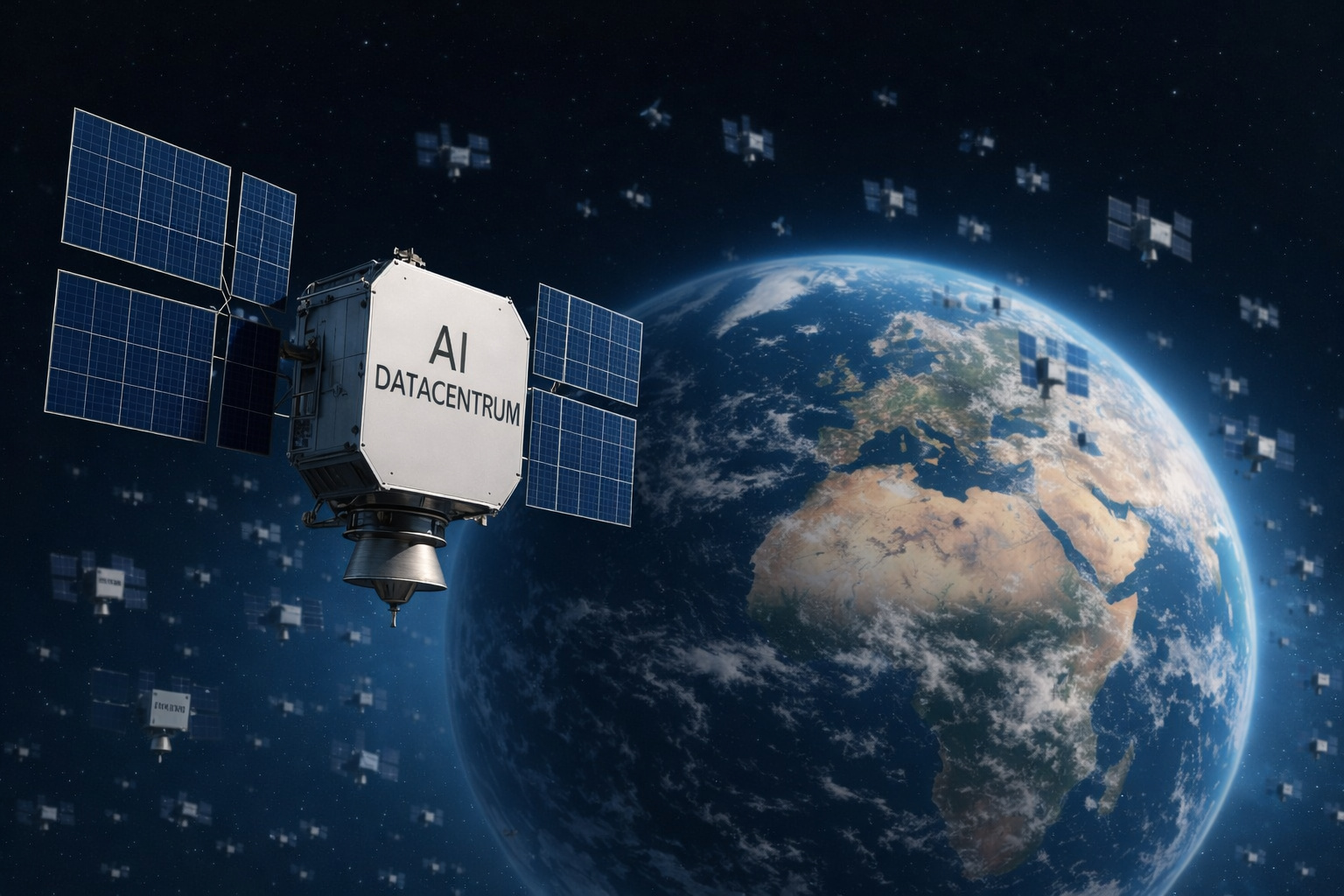
Elon Musk has a vision. A million satellites orbiting Earth, powered by the sun and processing artificial intelligence far from terrestrial constraints. Does it sound like science fiction? Maybe. But Musk is serious. SpaceX has already asked regulators for permission to build solar-powered data centers directly in orbit—with up to 100 gigawatts of capacity.
"The cheapest place for AI will be in space in 36 months or less," Musk declared on a podcast last week. And he is not alone. Google has launched Project Suncatcher, while startup Starcloud has submitted plans for a constellation of 80,000 satellites. Even Jeff Bezos has agreed that this is the future.
But then reality sets in. And it is brutal.
The painful numbers
Andrew McCalip, a space engineer, took the time to calculate how much it would actually cost to build a data center in orbit. The result? A 1-gigawatt orbital data center would cost $42.4 billion. That is almost three times as much as its terrestrial equivalent. Why? Because getting anything into space costs a fortune. And then it has to survive there.
To understand this, let us go back to basics. Every space business stands or falls on one question: how much does it cost to put a kilogram of payload into orbit? SpaceX currently offers the lowest price on the market—about $3,600 per kilogram (roughly CZK 74,000)—thanks to its reusable Falcon 9 rocket. Does that sound good? Not even close. According to Google's Project Suncatcher study, the price would have to fall to $200 (CZK 4,100) per kilogram for space-based data centers to become economically viable at all. That is an eighteenfold improvement. And such prices are not expected to become available until sometime in the 2030s.
Starship: savior or just another promise?
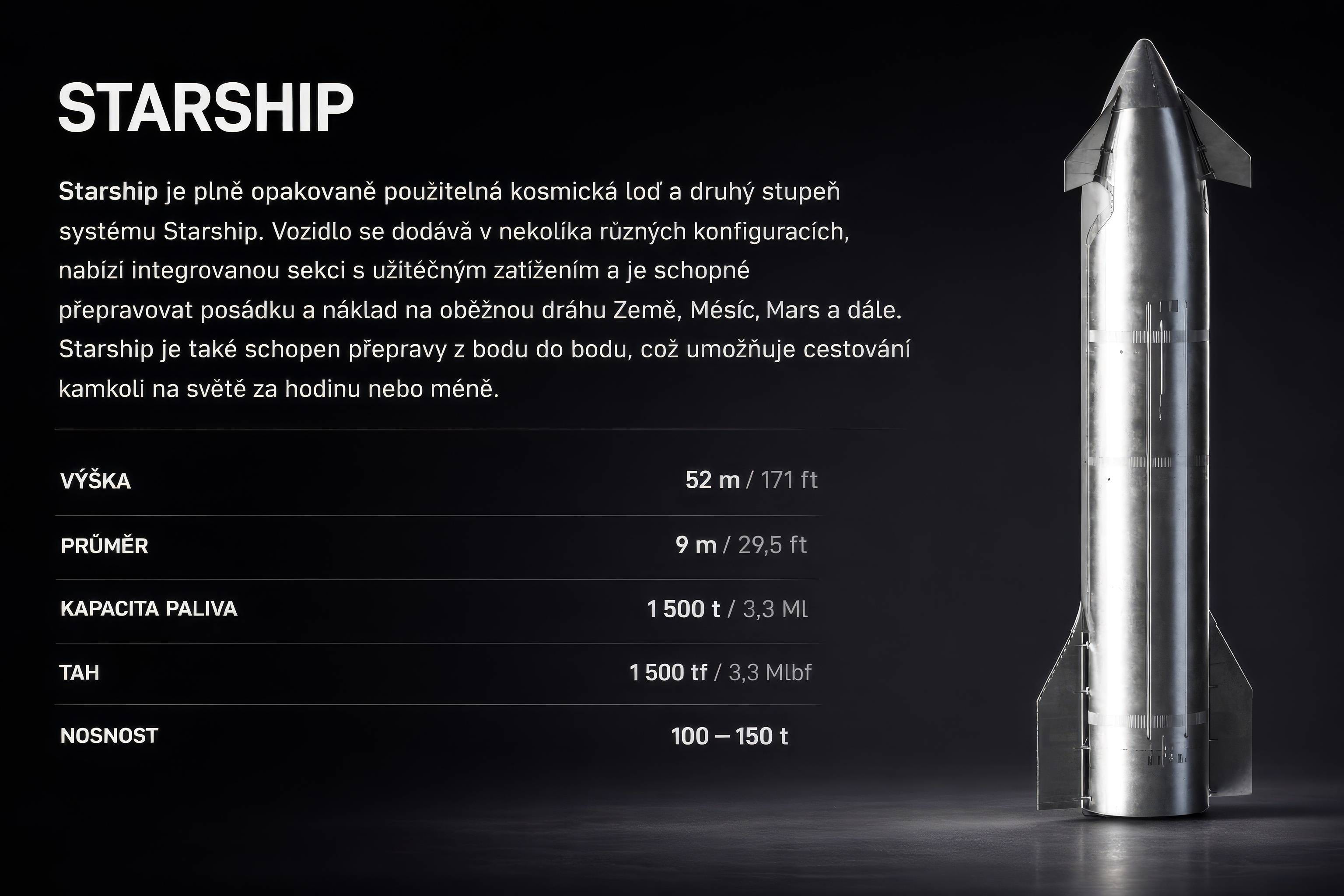
The entire plan rests on one card: Starship. SpaceX's new mega-rocket is supposed to revolutionize the cost of space transportation. The problem? Starship has yet to complete a single successful orbital flight. Its third version is expected to launch in the coming months. And even if Starship worked perfectly, economists at consulting firm Rational Futures warn that SpaceX will not charge much less than its competitors. Why would it? If Jeff Bezos's Blue Origin offers a launch for $70 million, SpaceX will charge a similar amount. Otherwise, it would be leaving money on the table.
"There aren't enough rockets yet to launch a million satellites," said Matt Gorman, head of Amazon Web Services (AWS). "The cost of transportation to space is massive today. It simply isn't economical."
Satellites are not free
But rockets are only half the problem. The other half? The satellites themselves. "Everyone takes it for granted that Starship will cost hundreds of dollars per kilogram," says McCalip. "But no one takes into account that satellites cost nearly a thousand dollars per kilogram right now."
SpaceX has managed to significantly reduce satellite manufacturing costs thanks to Starlink—its record-breaking communications network. The company hopes mass production will deliver further savings. That is why it is talking about a million satellites. But AI satellites will be much more complex than ordinary Starlink satellites. They need enormous solar panels, sophisticated heat dissipation systems, and laser communication links. All of that adds weight. And every additional kilogram means higher costs.
Let us compare it another way: on Earth, a kilowatt of energy for a data center costs between $570 and $3,000 (CZK 11,700–61,800) per year, depending on local electricity prices. Starlink satellites get their energy from solar panels, but when you factor in the cost of manufacturing, launching, and maintaining those satellites, the figure reaches $14,700 (CZK 302,800) per kilowatt per year. That is five times as much. At a minimum.
Space is harsh
Advocates of orbital data centers like to claim that cooling is "free" in space. But that is an oversimplification bordering on a lie. Without an atmosphere, it is actually much harder to get rid of heat. You have to rely on enormous radiators that emit heat into the vacuum of space. And that means a great deal of additional surface area and mass. "It is recognized as one of the main challenges, especially over the long term," says Mike Safyan of Planet Labs, which is building prototype satellites for Google Suncatcher.
And that is not all. Cosmic radiation gradually degrades chips and can cause "bit flip" errors—when the value of a bit in memory changes at random, potentially corrupting data. You can protect chips with shielding, use more resilient components, or operate them in arrays with redundant checks. But all of these options mean greater mass and higher costs.
Google tested its tensor processing units (chips designed specifically for machine learning) using a particle accelerator. SpaceX has reportedly purchased its own accelerator for this very purpose.
Solar panels: both a blessing and a curse
The project's logic sounds simple: solar panels in space are five to eight times more efficient than on Earth. And if they are in the right orbit, they can remain in sunlight for 90% of the day or even longer. Electricity is the primary fuel for chips, so more energy means cheaper data centers. But solar panels are also more complicated in space.
Panels made from rare-earth materials are durable but too expensive. Silicon panels are inexpensive and increasingly common in space—both Starlink and Amazon Kuiper use them. But they degrade much faster because of space radiation. That will limit the lifespan of AI satellites to roughly five years. Some analysts, however, do not think this is such a major problem. "After five or six years, the dollars per kilowatt-hour no longer deliver a return because they are no longer state-of-the-art," says Philip Johnston, head of Starcloud.
Danny Field of startup Solestial, which manufactures silicon solar panels for space, sees orbital data centers as a major growth driver. He is talking with several companies about potential projects. But as a veteran spacecraft designer, he does not downplay the challenges. "You can always extrapolate the physics to a larger scale," says Field. "I'm curious to see how some of these companies get the economics to a point where it makes sense."
What will we actually do with space-based data centers?
The fundamental question is: what will orbital data centers be used for? Will they be general-purpose, used only for inference, or used for training models? Training new AI models requires running thousands of GPUs simultaneously. Most training is not distributed but takes place within individual data centers. Hyperscalers are trying to change that to improve the performance of their models, but so far they have not succeeded. Similarly, training in space will require coherence among GPUs across multiple satellites.
Google's Suncatcher project team notes that the company's terrestrial data centers interconnect their TPU networks with bandwidth measured in hundreds of gigabits per second. Today's fastest commercial inter-satellite communication links, which use lasers, reach only about 100 Gbps. This led to an interesting architecture for Suncatcher: it involves 81 satellites flying in formation close enough together to use the same transmitters as terrestrial data centers. Of course, this creates problems of its own: the autonomy required for each spacecraft to remain in the correct position, even when it has to maneuver to avoid space debris or another satellite.
Inference tasks do not have the same need for thousands of GPUs working in coordination. The work can be handled by dozens of GPUs, perhaps on a single satellite—an architecture that represents a kind of minimum viable product and a likely starting point for the orbital data center business. "Space is not an ideal place for training," says Johnston. "I think almost all inference tasks will be done in space," he says, envisioning everything from customer service voice agents to ChatGPT queries being processed in orbit. He says his company's first AI satellite is already making money by performing inference in orbit.
SpaceX is betting on both options
While details are scarce even in SpaceX's filing with the FCC (Federal Communications Commission), the company's orbital data center constellation is expected to deliver about 100 kilowatts of computing power per metric ton—roughly twice the performance of current Starlink satellites. The satellites will operate in conjunction with one another and use the Starlink network to share information; the filing claims that Starlink's laser links can achieve petabit-level bandwidth.
For SpaceX, the recent acquisition of xAI (which is building its own terrestrial data centers) will allow the company to establish a presence in both terrestrial and orbital data centers and see which supply chain adapts faster. That is the advantage of having fungible floating-point operations per second—if you can get it running. "A FLOP is a FLOP, no matter where it lives," says McCalip. "SpaceX can simply scale until it runs into permitting or capital constraints on the ground, and then return to space-based deployments."
So... does it make sense?
Let us return to the fundamental question. Does it make economic sense to build data centers in space?
Not yet. The costs are too high, the technology is not ready, and the infrastructure does not exist. But Musk and others are betting that this will change. That Starship will reduce transportation costs, that mass production will make satellites cheaper, and that terrestrial data centers will run into limits—whether related to energy, regulation, or space.
Maybe they are right. Perhaps in a few years we will look back and laugh at the fact that we doubted them. Or perhaps we will discover that some things simply belong on Earth. In any case, one thing is certain: when Elon Musk says he is going to do something, it is worth watching. Even if the math is still screaming "no."
Source: techcrunch.com


