

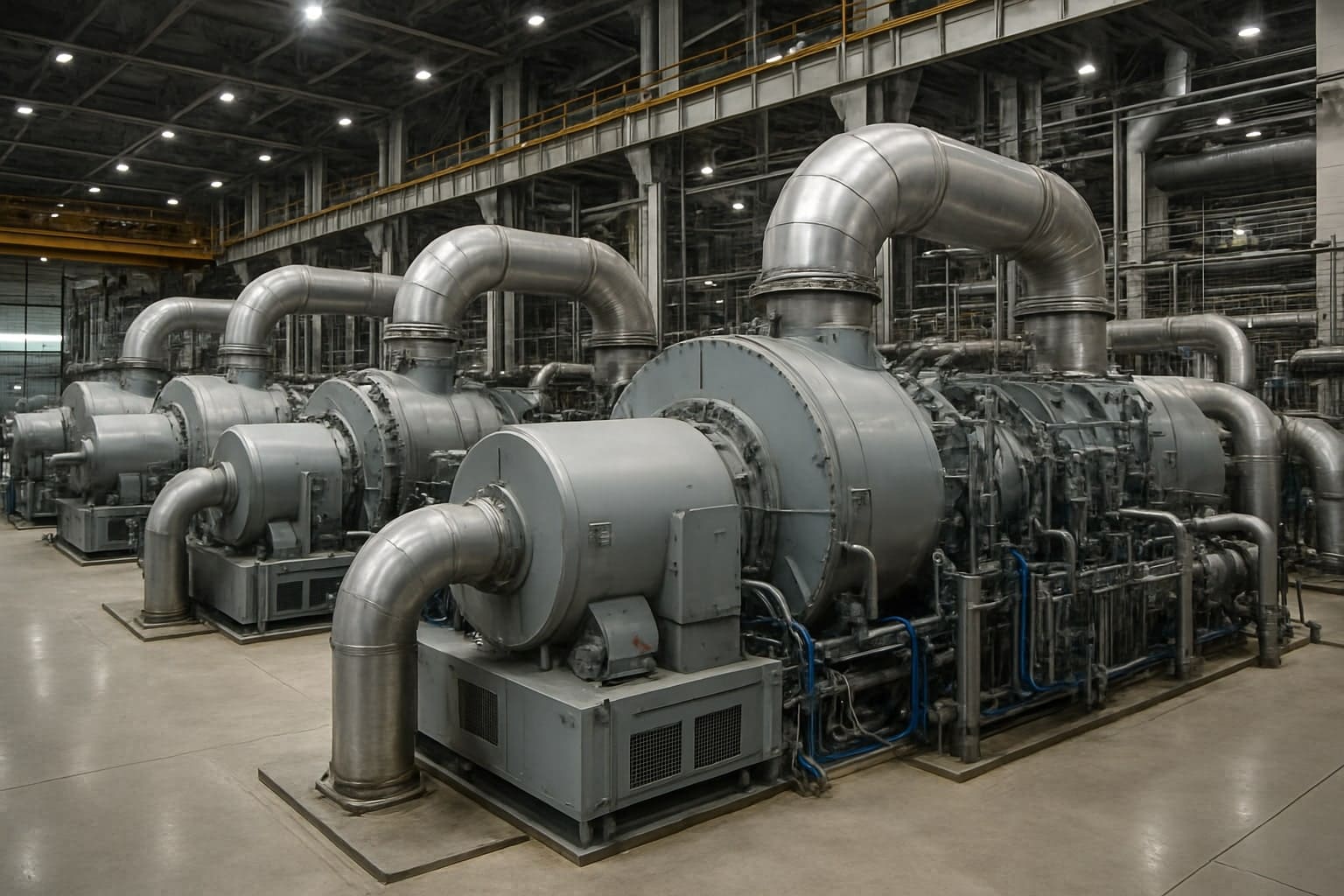
Technology companies racing to develop artificial intelligence need enormous amounts of electricity and cannot wait for the aging U.S. power grid to catch up. Instead, they are building their own power sources, creating a Wild West in the energy sector and transforming the entire U.S. system. Natural gas power plants are under construction in West Texas as part of OpenAI and Oracle's $500 billion Stargate project. Gas turbines are already running at the massive Colossus 1 and 2 data centers being built by Elon Musk's xAI in Memphis, Tennessee. More than a dozen Equinix data centers across the United States use fuel cells to generate electricity. This "bring your own power" trend is a quick solution to grid interconnection bottlenecks. Most technology giants would prefer to connect their facilities directly to the power grid, but supply chains and permitting are complicating everything. The United States is not building enough transmission lines or power plants to handle the sudden surge in electricity demand. According to consulting firm ICF, America should add about 80 gigawatts of new generation capacity annually to keep pace with artificial intelligence, cloud computing, cryptocurrencies, industrial demand, and electrification. It is currently building less than 65 gigawatts, a gap large enough to power two Manhattans on the hottest summer days.
Data centers used to take electricity for granted, says KR Sridhar, founder and CEO of Bloom Energy, which supplies fuel cells to companies that need power quickly. That is no longer possible because training artificial intelligence models requires as much electricity as entire cities. A single data center consumes as much electricity as 1,000 Walmart stores, and an AI search can use ten times more energy than a standard Google search. The growth is enormous: At the end of the second quarter, the United States had around 522 hyperscale data centers, accounting for about 55% of global capacity, according to Synergy Research Group. Roughly another 280 are expected to come online by 2028. Before 2020, data centers consumed less than 2% of U.S. electricity, but that figure could reach as much as 12% by 2028, according to the Department of Energy and Lawrence Berkeley National Lab. Energy company executives compare it to rural electrification or the arrival of air conditioning after World War II, when U.S. industry was booming.
President Trump declared a national energy emergency in January to prevent the U.S. from falling behind China in the artificial intelligence race and issued orders to accelerate the construction of data centers and infrastructure. China is investing twice as much as the U.S. in power plants, storage, and the grid this year; according to the International Energy Agency, it added 429 gigawatts of new capacity last year, compared with just 50 gigawatts in the U.S. Centralized planning allows China to avoid construction obstacles. Most U.S. developers see grid access as the biggest challenge, but according to ICF, the U.S. should begin delivering nearly 80 gigawatts of new generation annually starting in 2027, twice the average of the past five years. Even so, in some locations data centers will not be able to connect to the grid until the 2030s because of a backlog of projects and a shortage of high-voltage infrastructure. Bill Stein of Primary Digital Infrastructure, which finances Stargate, expects the energy shortage to last three to five years.
Waiting for Reinforcements
Many data center developers plan to use on-site power sources for only a few years until grid infrastructure catches up, while some want to bypass the grid permanently or combine both approaches. Ultimately, most will want a grid connection for its reliability and diversification, says Andy Power, CEO of Digital Realty, which has 300 centers globally and views on-site power as a temporary solution. Planning major power plants or infrastructure expansions takes years and is now even more difficult because of permitting, shortages of equipment and labor, and rising costs exacerbated by Trump's tariffs on steel, aluminum, and copper products.
Transformer orders surged during COVID-19, according to Wood Mackenzie, and demand from data centers is ten times higher, with a fivefold increase expected next year. Transmission line construction has declined: 888 miles last year and 450 miles the year before, according to Grid Strategies, compared with an average of more than 900 miles annually between 2015 and 2019. Data centers are tapping whatever resources they can, and natural gas is winning. Large turbines have backlogs stretching years, but smaller turbines, reciprocating engines, and fuel cells are available, and companies are combining them like Lego blocks to achieve the output of large power plants. In Memphis, xAI's Colossus 1 initially used smaller turbines to power hundreds of thousands of Nvidia processors and now uses a mix of on-site and grid power; Colossus 2 will have turbines across the border in Mississippi. Stargate in Texas near the Permian Basin will draw on natural gas for more than a gigawatt of capacity, equivalent to San Francisco's power consumption.
In San Jose, Equinix generates power using natural gas fuel cells and solar panels; it is one of 19 such centers in the U.S., with more to come. A Meta Platforms project in Ohio is abandoning the grid entirely: Williams will spend $1.6 billion (approximately CZK 37.3 billion) on on-site gas-fired generation near Columbus. In Oklahoma, Governor Kevin Stitt is attracting investors with cheap electricity and gas; state law allows companies to build their own power sources, drawing projects such as a $3.5 billion (approximately CZK 81.6 billion) development by Citizen Capital and Lightfield Energy in Chickasha. Billy Sorenson of Lightfield says only natural gas has sufficient energy density for artificial intelligence, with a design that includes turbines, batteries, and diesel generators.
Construction Shortfall
Years of flat demand growth mean few natural gas projects are under construction, while costs have tripled in recent years. Developers plan to add less than 20 gigawatts by 2027, according to a Wall Street Journal analysis. Hugh Wynne of Sector & Sovereign Research predicts that this will constrain data center growth. Texas expects peak demand to rise by 62% by the end of the decade, equivalent to adding California, and is offering loans for gas-fired generation, but some projects have been canceled because of costs. Recent investment has focused on renewable energy: 214 gigawatts of solar, wind, and battery capacity are planned, but that figure is expected to fall because of the loss of tax incentives under Trump, who favors fossil fuels. Projects worth $22 billion (approximately CZK 512.6 billion) have already been canceled or scaled back, and the Department of Energy is cutting another $24 billion (approximately CZK 559.2 billion) from green projects. Instead, land is being opened for extraction, gas export terminals are being approved, and coal-fired power plants are being upgraded at a cost of $625 million (approximately CZK 14.6 billion).
Erik Lensch of Leyline Renewable Capital has paused new projects because of grid interconnection issues, interest rates, and the end of tax credits, and is focusing on the existing 18 gigawatts. Equinix is signing agreements for small modular nuclear reactors to provide flexibility in its multi-gigawatt plans. Caterpillar is seeing growing demand for smaller turbines and engines and is investing $725 million (approximately CZK 16.9 billion) in an Indiana factory. Mark McDougal of Joule Capital Partners plans to use the company's equipment together with batteries for a project in Utah designed for future grid connection but without depending on it.
Source: wsj.com


